
Team misalignment gets blamed on the team almost every time it appears, and almost every time, that is the wrong place to look. A team cannot align around a decision that was never actually made. When three departments are pulling in three directions, the usual read is a communication problem or a culture problem. The more accurate read is that the founder made a call that felt clear in their own head and never actually landed as a decision anyone else could act on. The first correction is not a team offsite. It is checking whether the thing everyone is supposedly misaligned about was ever actually decided.
Key Takeaways
- Team misalignment is frequently the visible symptom of an unclear founder decision, not a team dysfunction
- A decision that exists only in the founder’s head has not actually been made, from the team’s perspective
- Alignment workshops fix the symptom of disagreement without touching the missing decision underneath it
- Each team member filling the gap with their own reasonable interpretation is what produces visible misalignment
- The correction is making the decision explicit, not making the team more aligned
What Does It Mean When Your Team Is Misaligned?
Marketing is pushing a premium positioning. Sales is closing deals with discounts that undercut it. Delivery is building features aimed at a different customer segment than either team is selling to. In a leadership meeting, all three functions sound reasonable, and all three are pulling the company in different directions.
The instinct is to call this a misalignment problem and schedule a session to get everyone on the same page. But ask each team where their direction came from, and the answer is usually some version of “that’s what I understood we were doing.” Nobody is ignoring a decision. Nobody received one clearly enough to align around in the first place.
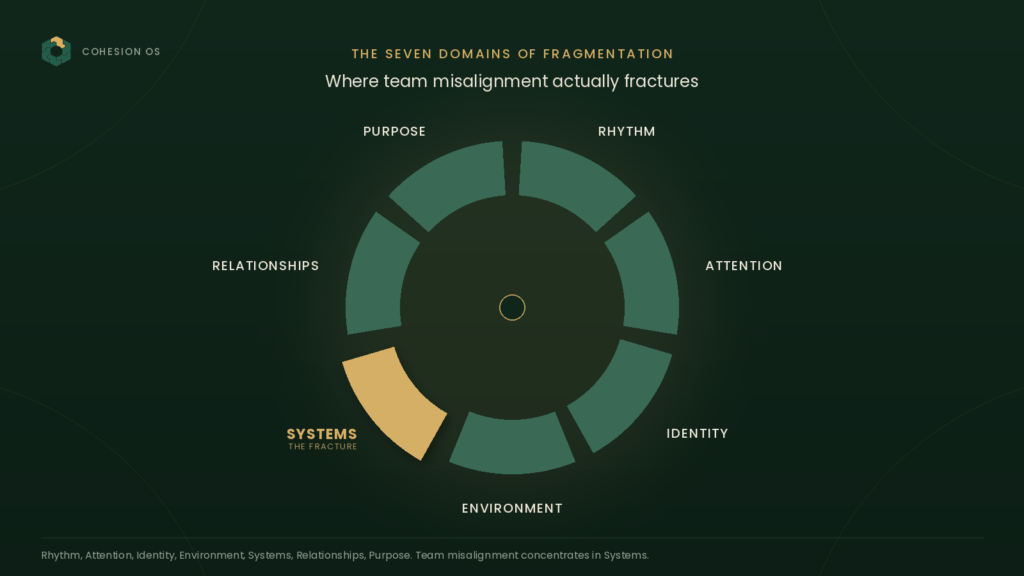
Team misalignment, in cases like this, is not three teams disagreeing. It is three teams independently and reasonably filling a gap the founder left open, each filling it slightly differently. Cohesion OS treats this as a Systems fracture: a decision that was assumed to be made, communicated, or obvious, but was never actually encoded anywhere the team could act on consistently.
Why Doesn’t an Alignment Workshop Fix It?
The standard response to visible misalignment is a session: get the leads in a room, talk it through, agree on a shared direction, write up the takeaways.
This treats the wrong layer, for a specific reason.
A workshop produces temporary agreement, not a decision. Three leads leaving a room having verbally aligned is not the same as a decision that persists past the meeting. Without something written down that outlives the room, each team returns to their own interpretation within a few weeks, because the actual gap, an undefined choice, was never closed. It was only smoothed over conversationally.
It assumes the problem is willingness, not information. A workshop works when people know the right answer and are simply not cooperating. It does nothing when people do not know the right answer because it was never actually decided. You cannot align three teams around a founder decision that does not yet exist in any form they can reference.
It puts the burden on the team to interpret founder intent correctly, repeatedly. Even a successful workshop just produces a slightly better shared guess. The next ambiguous situation, not covered in that meeting, gets filled the same way the original gap did: independently, reasonably, and differently by each team.
A workshop can improve the mood in the room. It cannot manufacture a decision that was never made.
The Hidden Mechanism Behind Team Misalignment
What looks like a team disagreement is usually three separate, reasonable interpretations of the same unresolved gap.
Marketing’s premium positioning, sales’s discounting, and delivery’s feature choices are not contradictory instincts. They are three consistent, logical extensions of the same missing decision: what is this company actually optimising for right now. Each team answered that question for themselves, in the direction their function naturally leans. Marketing leans toward brand. Sales leans toward closing. Delivery leans toward what is technically interesting or already scoped. None of them are wrong on their own terms. They are simply answering a question the founder never actually settled.
This is why the fracture sits in Systems rather than in the team: the missing asset is a decided, documented answer to a question that affects every function, not a communication failure between people who already agree. Fixing communication between three functions that are each correctly executing a different founder priority does not resolve anything. It just makes the disagreement louder and better-informed.
3-Minute Diagnostic
Which of the seven domains is actually costing you the most?
Why Founders Keep Blaming the Team Instead of the Decision
The pattern holds because it feels, from the founder’s chair, like the decision was already made. It was discussed in a strategy session six months ago. It felt settled at the time. The founder moved on, confident the direction was clear.
What rarely happens is a check on whether that decision was ever translated into something durable enough for three separate departments to reference the same way, months later, without you in the room. A decision that exists as a memory of a conversation degrades fast. Each team’s recollection of that meeting, filtered through their own priorities, produces a slightly different version of what was agreed.
So the founder sees three teams acting inconsistently and reasonably concludes the team is misaligned. The team, each acting on their best understanding of a decision that was never actually written down anywhere they could check it, is doing exactly what you would expect people to do with an ambiguous mandate.
What Changes When You Fix the Decision Instead of the Team?
- Cross-functional conflicts drop, because the underlying question has an actual, checkable answer instead of three competing guesses
- New hires align faster, because they inherit a documented decision instead of an oral history that degrades with each retelling
- Founders stop scheduling alignment sessions for problems that were never about alignment
- Teams stop each independently guessing at founder intent and start executing against something explicit
- The next ambiguous situation gets resolved by checking the document, not by another meeting
This does not mean writing a rule for every possible business question. It means recognising that the specific, recurring misalignments in your company usually trace back to one or two decisions that were never actually closed.
This pattern is not unique to founder-led companies. A recent workplace survey found that a majority of both leaders and individual contributors named unclear decision-making authority as a driver of organisational misalignment, ranking it above most other causes measured, including workload and team structure (Mural, 2025). The pattern holds at every size of company. It is simply harder to see in a founder-led business, because the founder is usually the one person in the room who feels the decision was already made.
Founder Field Note
One founder was convinced his leadership team had a trust problem. Meetings were tense, decisions from one function kept undercutting another, and he had started interviewing culture consultants to help repair what he read as a breakdown in collaboration.
The actual gap surfaced during a single direct question: what does this company say no to right now. Three leaders in the room gave three different answers, each stated with total confidence, none of them contradicting the others out of spite. Each had simply been working from their own honest read of priorities the founder had discussed in pieces, across different conversations, over several months, none of it ever consolidated into one place.
The correction was not a trust-building offsite. It was a single page, written by the founder, stating plainly what the company would and would not pursue for the next two quarters, circulated to all three leaders the same day. The tension in meetings dropped within weeks, not because anyone had learned to collaborate better, but because the thing they had been silently negotiating around finally existed as an actual answer.
Common Mistakes When Your Team Seems Misaligned
- Scheduling a workshop before checking whether a decision actually exists. A session cannot fix a gap it does not diagnose.
- Assuming misalignment means a communication failure. Often each side is communicating clearly. The thing behind it was never decided.
- Treating a discussed decision as a documented one. A conversation that felt clear at the time is not the same as something a team can reference later.
- Blaming personality or culture for what is a structural gap. Reasonable people fill an undefined space reasonably, and differently.
- Re-explaining the decision verbally instead of writing it down. Verbal re-explanation degrades the same way the original did.
- Fixing the visible disagreement without fixing the source question. The specific conflict quiets down; the next one, from the same undecided root, follows shortly after.
How to Start Fixing the Real Fracture Behind Misalignment
- Pick the current disagreement and ask what question is actually underneath it. Not who is right, but what unresolved decision would settle it.
- Ask each side, separately, what they believe the answer already is. The gap between their answers shows you exactly how undefined the decision has been.
- Make the actual decision, once, in writing. Not a preference. A clear, specific answer to the underlying question.
- Circulate it the same way to every team it affects. Not filtered through one department first.
- Reference the document the next time a related disagreement surfaces. This is what turns a one-time fix into a durable one.
Do not try to resolve every open question in the company at once. Start with the specific disagreement currently costing you the most.
FAQ
How do I know if my team’s misalignment is a decision problem versus an actual culture issue?
Ask each side what question they believe is settled and what their answer to it is. If they give different, individually reasonable answers to the same underlying question, that is a decision gap. If they agree on the question and the answer but still will not cooperate, that points toward a genuine relational or accountability issue instead.
Isn’t it the founder’s job to resolve disagreements between teams as they come up?
Resolving the disagreement in the moment treats the symptom. The more durable move is resolving the underlying decision once, in a form the teams can reference independently, so the same disagreement does not need founder mediation the next three times it recurs in a slightly different shape.
Why does the same kind of misalignment keep happening even after I have addressed it directly?
Because addressing it directly in a conversation or a meeting produces temporary clarity that decays. If the decision was never written down somewhere durable, it reverts to ambiguity as soon as memories of the conversation start to differ, which happens faster than most founders expect.
Can the Founder Cohesion Assessment identify whether team misalignment traces back to a Systems gap?
Yes. The Assessment is built to identify which of the seven domains is generating the most fragmentation in your company right now, including whether recurring team misalignment traces back to an undocumented Systems decision rather than an actual team or culture problem.
Next Step
If this sounds familiar, do not add another system yet. First, identify where the fracture is actually happening. Take the Founder Cohesion Assessment to see which of the seven domains is creating the most fragmentation in your company and what to correct first.
Your team was never out of step with each other. They were each in step with a different guess about what you actually wanted.
3-Minute Diagnostic
Which of the seven domains is actually costing you the most?
Dominik Boecker is the creator of Cohesion OS. He helps founder-led companies identify the fracture lines that create overload, dependency, and operational fragmentation, then install the systems that restore cohesion across rhythm, attention, identity, environment, systems, relationships, and purpose.
The Cohesion Letter
GET THE FREE 4-WEEK COHESION RESET
Plus weekly signal for founders rebuilding capacity, not chasing more hustle.