
Fast Answer
To measure founder progress, most founders rely on one instrument: whether they feel better. The opposite is closer to true. Feeling tracks the last 48 hours, not the structure underneath. The difference matters because a good week and a fixed domain look identical from the inside. The first shift is to score the same domain on Day 0 and Day 30, using the same questions, and let the comparison do the judging.
Key Takeaways
- To measure founder progress, compare scores, not moods. Feelings drift with the week.
- Recency bias makes a good Thursday feel like a fixed fracture, and a bad Monday feel like nothing changed.
- Use the same questions, the same domain and fixed dates so the comparison is fair.
- Aim for a clear, sustained lift, not a perfect score.
- When a secondary domain moves too, that is evidence the primary correction is holding.
The Belief Every Founder Repeats
It is Friday, 17:30. The week went well. The 9 to 11 block held three days out of five, Slack is quiet, the ClickUp board is mostly green and nobody sent a “can you just approve this” after lunch. You tell your partner you finally feel on top of things. You decide the problem is solved.
The following Wednesday an investor update slips, a hire falls through and two clients escalate on WhatsApp before 8am. By Friday you are back in the old pattern, answering voice notes between calls and wondering what changed. Nothing changed. The structure was the same both weeks. Only the load was different.
The belief underneath is simple: I will know it is working because I will feel better.
Why It Feels True
Feeling is the only instrument most founders have. It is fast, it is free, and on average it points in the right direction. When something has improved, you usually do feel better.
The trouble is resolution. Feeling responds to the last few days, to sleep, to whether the last call went well, to whether the Stripe dashboard was up or down this morning. A single good week can feel like the whole business has changed, and a bad one can erase real gains.
Research on how people remember experiences backs this up. In a well-known study by Kahneman and colleagues, people judged an experience mainly by its most intense moment and how it ended, largely ignoring how long it lasted. A founder judging a month by how Friday felt is doing the same thing.
What Is Actually Happening
Structural change is slow and mostly invisible in the moment. A fixed point in the calendar, a written decision rule or a clean handover each lower the load a little. None of them feel dramatic. Meanwhile, mood swings at a much larger scale and drowns the signal.
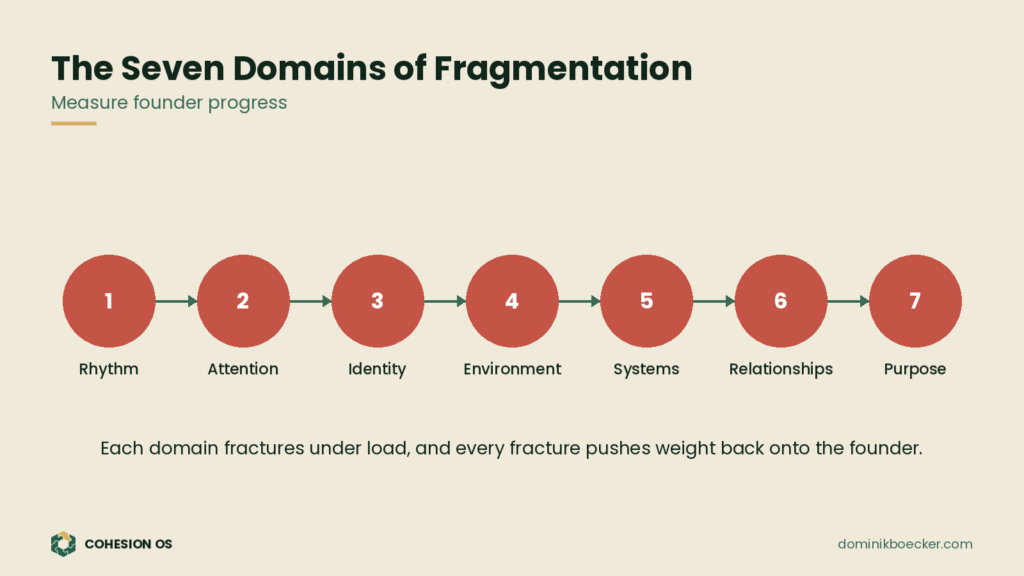
This is why Cohesion OS scores each of the seven domains rather than asking how you feel. Fragmentation is structural, so a structural improvement should show up as a higher score on the same questions, asked the same way, a few weeks apart. The number is blunt, but it is not moved by Thursday.
Each domain has something you can score that mood will never report accurately:
- Rhythm: did the fixed points in the week survive a heavy week, or only a light one?
- Attention: how many of your best hours reached decisions only you can make?
- Identity: are you still doing the job the company needed from you two stages ago?
- Environment: is there one source of truth, or are decisions still scattered across Notion, Google Drive and unread threads?
- Systems: did a recurring problem get solved once, or solved by you again?
- Relationships: are expectations with your leaders explicit, or still carried silently?
- Purpose: could the team make last week’s calls without you?
Two scores also reveal something feeling cannot: whether a secondary domain moved too. If Attention rises after you corrected Rhythm, that is evidence of a real change spreading through the operating layer, not a quiet week.
Founder Cohesion Assessment
Get your Day 0 score.
A 4-minute assessment that scores all seven domains and shows where your company is fracturing first. It is the baseline every later score is measured against.
Take the AssessmentFree. Takes about 4 minutes.
The Better Question to Ask
Replace “do I feel better?” with a question you can use every Friday:
What would my score say, not my mood?
If you cannot answer it, take the same questions again and look at the number. Then ask what in the structure is different: which fixed point held, which decision rule got used without you, which handover stuck. If you cannot name a structural difference, the good week was probably a light week.
The question also protects you in the other direction. After a brutal week it stops you abandoning a correction that is working, because a hard week on top of better structure still scores higher than a hard week on top of the old one.
Founder Field Note
One founder came in believing the fix had worked because the last two weeks had felt calm. The real issue was that those weeks had no deadlines, no board prep and nobody off sick. His retake of the same questions showed a smaller lift than he expected, which pointed to one correction that had never really been installed. The first adjustment was not a new plan. It was re-running that third correction with a fixed time and a definition of done. A month later the score confirmed what he had hoped to feel. This pattern repeats because mood is a poor instrument for slow structural change.
Common Mistakes When Trying to Measure Founder Progress
- Judging by how the week felt. A calm week is not proof. It may simply have been light.
- Changing the questions between measurements. A new question set gives you a new baseline, not a comparison.
- Measuring too often. Weekly scoring turns noise into anxiety and pulls you back into reactive mode.
- Chasing a perfect score. The aim is a clear lift in the domain you corrected, not a flawless profile.
- Ignoring the secondary domains. They tell you whether the correction is spreading or staying contained.
- Skipping the baseline. Without a Day 0 number there is nothing to compare, and you are back to judging by mood.
How to Apply the Reframe This Week
- Take a baseline. Score your lowest domain today and write the number down somewhere you will find it in a month.
- Set the retake date. Thirty days out, in the calendar, with the same questions.
- Define a meaningful lift. Decide in advance what number you would be glad of, such as ten to fifteen points, so the result cannot be reinterpreted later.
- Keep a weekly note. Two lines every Friday: what held, what broke. It gives the score context without replacing it.
- Compare on the day. Look at the primary domain and the secondary ones, then decide which correction comes next.
Do not try to fix the entire business at once. Start where the fracture is loudest, and let the score tell you when it has moved.
FAQ
How do I measure founder progress without vanity metrics?
Use a repeatable diagnostic and score the same domain on a fixed schedule. Revenue and headcount tell you the company grew, not whether it depends on you less. Add a small number of structural signs alongside the score, such as whether your protected block survived a heavy week or whether a recurring decision got made without you.
How often should I re-score?
Every 30 days is enough for most founders. More often and the result starts tracking mood again, because a few days is not long enough for structure to change. Less often and drift can set in unnoticed. Put the retake in the calendar on the day you take the baseline so it cannot slide.
What counts as a meaningful lift?
A clear, sustained rise on the same questions. Ten to fifteen points on a domain is a useful target, but direction and consistency matter more than the exact figure. A smaller lift that holds through a heavy month is worth more than a big jump measured after a quiet one.
What if my score does not rise?
That is data, not failure. Check which correction did not hold, then adjust its timing, its size or who owns it, and run the month again. A flat score points at the structure, not at you. It is far more useful than a good feeling that hides an unfinished correction.
Next Step
If this changed how you see the problem, find out where it applies most. Take the Founder Cohesion Assessment to see which of the seven domains is shaping your company right now and what to correct first.
Your Assessment result becomes your Day 0 score. Every correction you make after that is judged the same way: the same questions, thirty days later, and a number that either moved or did not.
If it only shows up in how you feel, it has not been installed yet.
Free Cohesion OS Program
Get the free 9-module founder program.
Step 1 is a 4-minute assessment. It scores all seven domains, shows where your company is fracturing first, and starts the program there.
Start with the AssessmentFree. One stabilising move a week for 8 weeks.
About the Author
Dominik Boecker is the creator of Cohesion OS. He helps founder-led companies identify the fracture lines that create overload, dependency, and operational fragmentation, then install the systems that restore cohesion across rhythm, attention, identity, environment, systems, relationships, and purpose.