
Fast Answer
Founder focus is the ability to give your best hours to the decisions only you can make. It solves the problem of a day lost to leaks, from open loops and always-on messaging to constant task switching, by closing one leak a week instead of relying on discipline. Most founders can run the first audit in three days. Here is how to build founder focus over thirty days, and what to expect in the first month.
Key Takeaways
- Founder focus is a structure problem, not a discipline problem. The leaks are built into the week.
- Close one leak per week: single-task blocks first, then message windows, then one open-loop list.
- A three-day leak audit shows where attention actually goes, which is rarely where you think.
- Batching messages into fixed windows trains the team as well as you.
- At two weeks you should finish one meaningful piece of work per day. At six, the team has adapted.
Why Founder Focus Fails When Discipline Is the Fix
You blocked 9 to 11 for strategy. By 9:17 you had answered a WhatsApp, checked Stripe, opened ChatGPT, replied to a “quick one” in Slack and made a decision your ops manager should not have needed you for. At 11 you are tired, three tabs are still open, and nothing is finished.
You call this a focus problem. Closer to the truth is that you have an attention system with no walls. Every channel can reach you, every open loop sits in your head, and every small request carries the same weight as the work that matters.
Telling yourself to concentrate harder spends effort on the symptom. You can win that fight on a quiet Tuesday and lose it every day a launch, a hire or a client escalation lands. Founder focus needs the leaks closed first, so the good hours are protected by structure rather than by resolve.
The Mechanism It Corrects
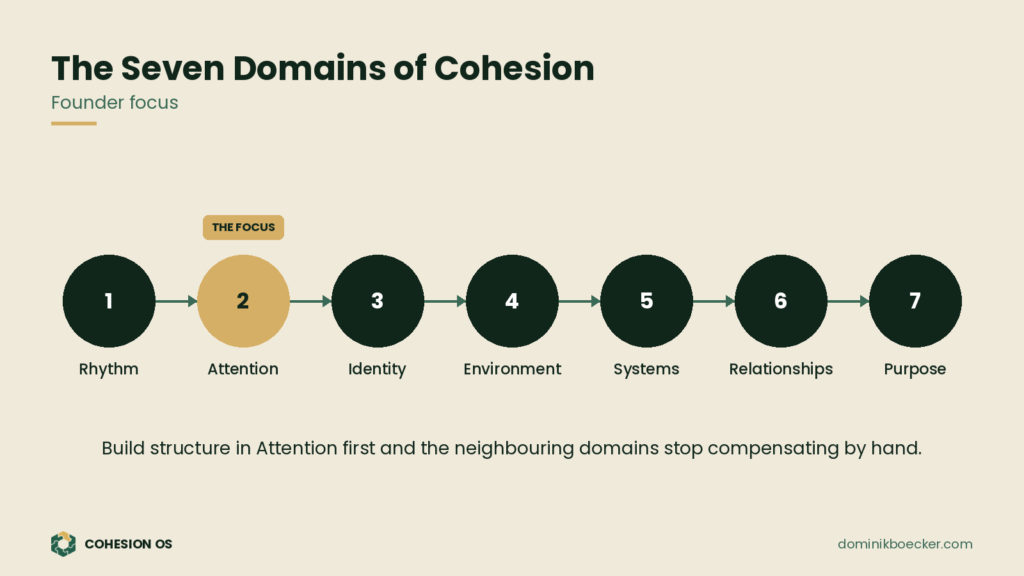
This sits in the Attention domain, the second of the seven domains: Rhythm, Attention, Identity, Environment, Systems, Relationships and Purpose. Attention covers where founder focus goes and what interrupts it. When it holds, the best hours reach the decisions only the founder can make.
The fracture is three leaks working together. Switching between tasks drains the first twenty minutes of each new one, so a morning of short bursts produces almost nothing finished. Always-on messages train everyone to expect instant replies, which turns the founder into the default answer for every question. Open loops running in the background take attention before you open a single app: the unsigned contract, the hire you have not decided on, the voice note you meant to reply to.
Closing the leaks in order, one per week, gives each fix time to settle before the next. It also lets the team adjust gradually, which is what makes the change hold. When Attention holds, the neighbouring domains stop compensating by hand: Rhythm gets blocks that actually produce work, and Systems get the questions that should have had a written rule all along.
Founder Cohesion Assessment
Find out where your company is fracturing first.
See which of the seven domains needs structure first, so the leaks you close are the ones costing you most.
How to Build Founder Focus: Step by Step
- Week 1, days 1 to 3: run the leak audit. Each time something pulls you off a task, write down the time, what it was, who it came from and whether it could have waited. Keep it in one note on your phone or a sheet on your desk. Two minutes at the end of each day to review.
- Week 1, day 4 onwards: add one single-task block. 60 to 90 minutes, daily, on one piece of work, worked to completion, with your phone out of reach and every other tab closed. Use the audit to choose the time: the slot with the fewest interruptions and the most energy.
- Week 2: set message windows. Two or three fixed times a day for Slack, email and WhatsApp. Everything else is closed between them. Tell the team the windows in two lines, and tell them exactly what to do for a real emergency.
- Week 3: build the open-loop list. One place, a single Notion page or a paper notebook, where every unfinished thing goes the moment you notice it. Clear it on Friday: do, delegate, schedule or delete.
- Name one person with the authority to decide for you. Someone who can answer the question that would otherwise arrive in your window, with a simple rule for what they can decide alone.
- Write the fallback. On a heavy day, protect 30 minutes, not zero. A short block that happens keeps the structure alive.
- Week 4 and every Friday: a two-line report. What held, what broke. When something breaks, adjust the structure (the time, the window, the rule), not your resolve.
Copy-Paste Template
FOUNDER FOCUS: 30-DAY ATTENTION INSTALL

THREE-DAY LEAK AUDIT (week 1, days 1 to 3)
Time | What pulled me off | Who/where from | Could it have waited? (Y/N) | Time lost

SINGLE-TASK BLOCK (week 1, day 4 onwards)
Time and days:
The one piece of work:
Phone / tabs: closed
Fallback on a heavy day (30 minutes):

MESSAGE WINDOWS (week 2)
Window 1:
Window 2:
Window 3 (optional):
A real emergency means:
Who can decide for me, and on what:

OPEN-LOOP LIST (week 3)
Where it lives:
Friday clear: do / delegate / schedule / delete

FRIDAY REPORT (week 4 onwards)
What held:
What broke, and what I will change in the structure:
Worked Example
One founder of a 30-person services firm came in believing she needed more discipline. She ran the three-day audit and found 41 interruptions, 29 of which could have waited. Most came through WhatsApp, and most were “can you just approve this” questions her ops lead could have answered with a rule.
Her first block, 9 to 10:30 on Tuesday and Thursday, was moved once in week one. The fallback (30 minutes at 14:00) saved the habit. In week two she set windows at 11:00 and 16:00, told the team, and named her ops lead as the decision-maker for anything under a set value. In week three the open-loop list took the background noise out of her head.
By week four her ops lead had stopped sending quick questions and started batching them, and she finished two pieces of strategy work that had been stuck for a month. What made it hold was not her willpower. It was that the team learned the windows.
Common Mistakes When Setting Up Founder Focus
- Skipping the audit and guessing where the leaks are.
- Blocking time without closing the channels that interrupt it.
- Announcing message windows without giving the team an emergency route.
- Trying all three fixes in the first week, so none of them settles.
- Keeping open loops in your head “because it is quicker”.
- Counting the hours at your desk instead of the work finished.
How to Know It Is Working
At 2 weeks: one meaningful piece of work finished each day, even if only in its fallback form, and a clear picture of your single biggest leak.
At 6 weeks: the team respects the windows, urgent items genuinely are urgent, questions arrive in batches, and your open-loop list is clear on Fridays. The day feels less scattered because fewer things can reach you between windows.
Attention Fragmentation Domain
Attention Fragmentation Scorecard + Playbook Bundle
Score where your attention is leaking, then follow the playbook to close the leaks so your best hours reach the decisions only you can make.
FAQ
Why can I not focus even with a quiet calendar?
Often because attention is spent before work begins. Open loops, unread threads and pending decisions take capacity in the background, so a clear calendar still meets a crowded head. Writing every loop into one list and clearing it weekly gives the quiet calendar something to work with. Without that, the empty slot fills with checking rather than finishing.
Is it unprofessional to batch my messages?
Not if you tell the team the windows and give them a clear route for real emergencies. Most requests that feel urgent are not, and the team usually adapts within two weeks. What looks unprofessional is a founder who replies instantly but finishes nothing, because the important work keeps slipping to evenings and weekends.
How long should a single-task block be?
60 to 90 minutes is enough for most founders. It is long enough to get into hard work and short enough to defend on a busy week. Start with one block a day rather than several. On a heavy day, run a 30-minute fallback instead of skipping it, so the team keeps treating the block as real.
What if I run a client-facing business?
Set your message windows around client hours and give clients a clear emergency route, such as a phone call rather than a message. Staff can handle a surprising share of client requests once a written rule exists for them. The aim is not to be unreachable. It is to stop being the default answer for every question.
Next Step
Before you install another tool, check it is the right one. Take the Founder Cohesion Assessment to see which of the seven domains needs structure first, so this system goes where it will hold.
Focus is not something you find. It is what is left when the leaks are closed.
Free Cohesion OS Program
Get the free 9-module founder program.
Step 1 is a 4-minute assessment. It scores all seven domains, shows where your company is fracturing first, and starts the program there.
Start with the AssessmentFree. One stabilising move a week for 8 weeks.
About the Author
Dominik Boecker is the creator of Cohesion OS. He helps founder-led companies identify the fracture lines that create overload, dependency, and operational fragmentation, then install the systems that restore cohesion across rhythm, attention, identity, environment, systems, relationships, and purpose.