
Fast Answer
Most founders believe real founder accountability needs a weekly call with a coach, a mentor or a peer group. The opposite is closer to true: calls create the feeling of progress, while a short written report on what held and what broke creates the change. The difference matters because the work has to happen inside your week, not inside a meeting about your week. The first shift is to replace one check-in call with a two-line Friday report.
Key Takeaways
- Founder accountability does not come from a call. It comes from observing what you actually changed.
- Calls reward talking about the work. Written reports force you to look at it.
- A voice note can be replayed on the Tuesday when things wobble. A call cannot.
- Asynchronous feedback fits a founder calendar instead of adding another meeting to it.
- Every one of the seven domains is corrected by a change to structure, and a written report is what makes that change visible.
- The weekly question is: what did I change this week, and can I show it?
The Belief Every Founder Repeats
It is Monday, 14:00. You finish an hour-long call with your coach. You are energised, clear on priorities and certain this week will be different. You took notes, though they are in a notebook, and the Notion page you meant to update is still open in a tab next to Stripe and an unread Slack thread.
By Wednesday, the week has eaten it. A supplier problem, a hiring decision, three “quick questions” on WhatsApp and a voice note from your ops lead have taken over. By Friday you cannot quite say what changed since Monday. You can say what you talked about. You cannot point to what is different.
The belief is simple: accountability means someone expecting you on a call. If you had a regular meeting, you would follow through. So when things slip, the instinct is to add a call, move to weekly, join a mastermind, or book a peer group that meets every other Thursday.
Why It Feels True
Calls do work for some things. A good conversation can clarify thinking, challenge a belief you have been too close to, and give you a lift on a heavy week. Being expected somewhere is a real motivator, and many founders do deliver more in the two days before a call.
That is exactly the problem. The lift comes from the expectation, not from the change. The call becomes a deadline for looking busy about the work. The 48 hours before it get sharper, the days after it get softer, and the underlying structure of the week stays exactly where it was.
There is also a quieter cost. Every call is another fixed slot in a calendar that is already contradicting the strategy. For a founder whose biggest problem is too many conversations, the fix for follow-through cannot be one more conversation.
What Is Actually Happening
In a call, the founder reports what they intended and what they plan. The other person hears a story. Nothing is checked against the week itself, and the energy of the conversation stands in for a change to the calendar, the inbox or the process.
Founder accountability that works is a loop: a specific correction, a fixed time to attempt it, and a record of what held and what broke. Research supports the record part. A Harvard Business School working paper on learning by thinking found that people who spent a few minutes at the end of the day writing about what they had learned performed measurably better than those who simply kept practising. Reflection in writing compounds. Conversation about intentions does not.
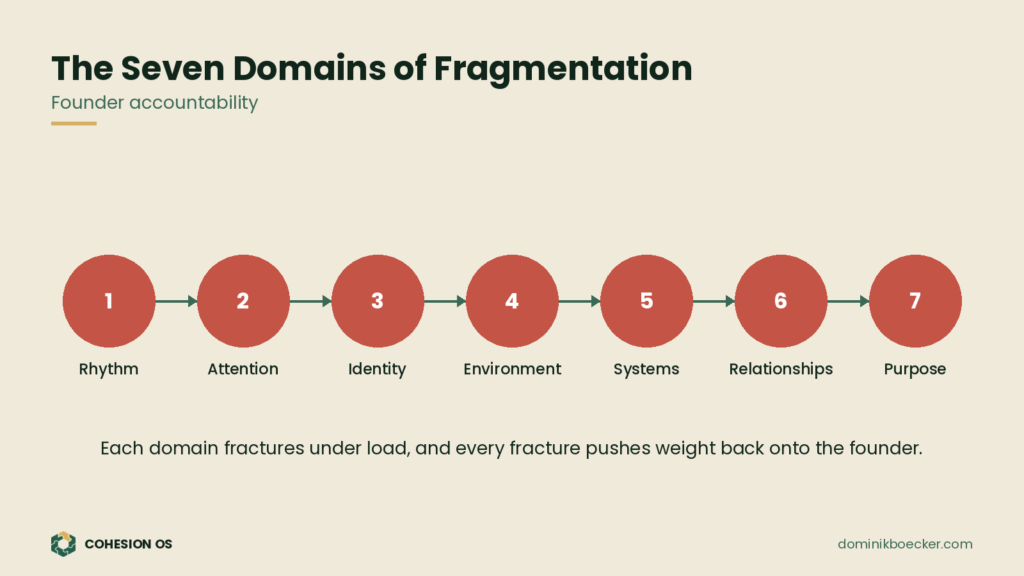
In Cohesion OS terms, the seven domains are corrected by changes to structure, not by changes in mood. A written report makes that structure visible. Here is how it shows up in each one.
Rhythm
The report shows whether your fixed points survived the week. “The Tuesday block held, the Thursday one got eaten by the pipeline call” is information a call rarely surfaces, because by Monday you have forgotten Thursday.
Attention
Writing down where your best hours went exposes the interruptions you no longer notice. Two weeks of reports usually show the same three sources breaking your focus.
Identity
The report reveals which decisions you still take that the company needs someone else to own. If your name appears on every “what broke” line, the role has not moved with the stage.
Environment
A report kept in one place, the same doc every week, is itself a small environment correction: one source of truth instead of notes scattered across a notebook, Notion and your phone.
Systems
“What broke” lines that repeat are recurring problems waiting for a decision rule. The report turns them from irritations into a list of things to solve once.
Relationships
Sending the report to a co-founder, adviser or peer makes expectations explicit. They respond to what happened, not to how you described it on a Monday afternoon.
Purpose
Four weeks of reports show whether the changes you make actually serve the direction you set. If none of them connect, the direction is not filtering decisions yet.
A voice note in reply can name the structural reason something broke in two or three minutes, and you can replay it on the Wednesday it matters. The week is where change happens. A call sits outside it.
Founder Cohesion Assessment
Find out where your company is fracturing first.
See which of the seven domains is shaping your week right now, so the first correction you report on is the one that matters.
The Better Question to Ask
Replace “who is holding me accountable?” with: what did I change this week, and can I show it?
That question works alone, with a peer or with an adviser. It points at evidence: a calendar entry that moved, a decision rule written down, a handover that held, a block that survived a bad day. If you cannot show it, it did not change yet, however good the conversation felt.
It also shifts who does the enforcing. With a call, the other person enforces. With the question, the structure enforces, and the other person only reads what the structure produced.
Founder Field Note
One founder came in believing she needed more frequent calls with her mentor to stay on track. She had moved from monthly to fortnightly, and was considering weekly. The real issue was that she left every call with a list of intentions and no record of what happened afterwards.
The first correction was not more calls. It was a two-line Friday note: what held, what broke. Within three weeks she could see that interruptions broke the same block every Thursday, because the Thursday supplier call always overran and people queued their questions behind it. She moved the block, wrote a rule for the queue, and stopped promising to try harder. This pattern repeats because talking about the work feels like doing the work.
Common Mistakes with Founder Accountability
- Treating the call as the work instead of a prompt for it.
- Setting goals as intentions rather than as specific corrections with a day and time.
- Reporting how the week felt instead of what changed.
- Skipping the report because “nothing happened”, which is exactly the data you need.
- Expecting another person to enforce what the structure of your week should enforce.
- Replacing the call with nothing, so no loop exists at all.
How to Apply the Founder Accountability Reframe This Week
- Pick this week’s correction. One change, with a day and a time. Not “protect my mornings”, but “Tuesday 9:00 to 10:30, strategy, Slack closed”.
- Write what done looks like. One sentence you could check on Friday without interpretation.
- Set a Friday reminder. A recurring slot, ten minutes at most, in the same place every week.
- Write two lines. What held, what broke. Add the structural reason, not an excuse.
- Send it to someone, or keep a log. A peer, an adviser, or a single doc you read back after four weeks. If you send it, ask for a short written or voice reply, not a call.
Do not try to fix the entire business at once. Start where the fracture is loudest.
FAQ
Do I need a coach for founder accountability?
Not necessarily. You need a loop: a specific correction, a time to attempt it and a record of what happened. A coach, a peer, a co-founder or a note to yourself can hold that loop. What matters is that it produces evidence you can read back. A coach who only hears your account on a call is working with a story, not a record.
Are calls ever useful?
Yes. Calls are good for thinking out loud, being challenged and making a hard decision with someone who knows the context. They are weak at keeping a change alive across a heavy week, because nothing in them touches the week itself. Use calls for what they do well, and let a written loop carry the follow-through between them.
Why a written report rather than a quick update?
Because writing forces observation. A sentence about what broke is harder to fudge than a spoken update, and it can be compared against last week and last month. Spoken updates drift towards how the week felt. Written ones show patterns: the same block breaking on the same day for the same reason, which is the thing you actually need to fix.
What if I have nothing to report?
Write that. “Nothing held” is useful, because it tells you the correction was too big, badly timed or undefended. It is also the point at which most founders stop, so it is worth keeping the report going. Shrink the correction, keep the Friday slot, and see what holds next week. One correction a month that sticks beats four that do not.
Next Step
If this changed how you see the problem, find out where it applies most. Take the Founder Cohesion Assessment to see which of the seven domains is shaping your company right now and what to correct first.
The work happens inside your week, not inside a meeting about your week.
Free Cohesion OS Program
Get the free 9-module founder program.
Step 1 is a 4-minute assessment. It scores all seven domains, shows where your company is fracturing first, and starts the program there.
Start with the AssessmentFree. One stabilising move a week for 8 weeks.
About the Author
Dominik Boecker is the creator of Cohesion OS. He helps founder-led companies identify the fracture lines that create overload, dependency, and operational fragmentation, then install the systems that restore cohesion across rhythm, attention, identity, environment, systems, relationships, and purpose.