
Fast Answer
In willpower vs systems, most founders back willpower: they believe the people who win simply have more of it. The opposite is closer to true. Every decision that depends on willpower is a fracture waiting for a heavy week. The difference matters because fragmentation is structural, so only structural corrections hold, and only structural corrections show up when you measure them. The first shift is to count the decisions you make by force each week and replace one with a rule.
Key Takeaways
- In willpower vs systems, willpower loses on any week that is harder than the one you planned for.
- Willpower works like a daily budget, and fragmentation spends most of it before 10am.
- A system removes a decision. Willpower only wins it, and has to win it again tomorrow.
- Because fragmentation is structural, structural corrections can be measured, which is what makes real change trackable.
- The weekly question is not “how do I try harder” but “which decision did I make by force that a rule could make for me”.
The Belief Every Founder Repeats
It is 21:40. You are still answering a Slack thread that began with “can you just approve this”. Two WhatsApp voice notes are waiting. There is a Stripe dispute you meant to look at this morning, and a ChatGPT tab still open from a proposal you started at 14:00 and never finished.
You tell yourself you will be stricter tomorrow. You say it most nights. Tomorrow you will be sharp at the start and worn down by lunch, because the same pile of small calls is waiting for you, and none of them has moved.
The belief underneath is simple: high performers are made of more discipline. If you could just hold the line on your calendar, close the tabs and stop saying yes, the week would behave.
Why It Feels True
It feels true because on a good week it is. When nothing is on fire, a founder with strong habits does produce more. Many successful founders also describe their wins in terms of grit, early mornings and refusing to quit, which reinforces the story every time you read it.
The mistake is in what it explains. Discipline shows up most clearly where the structure was already supportive. The founder who looks disciplined often has a quiet calendar, a capable leadership team, clear decision rights, or a partner absorbing load at home. Take those away and the same person looks scattered.
So the belief is not wrong about effort. It is wrong about where the result comes from.
What Is Actually Happening in Willpower vs Systems
In a founder-led company, every missing structure becomes a decision the founder makes personally. No written rule for refunds, so the founder decides. No fixed point for planning, so the founder decides every morning what matters. No default for notifications, so the founder resists each one by hand.
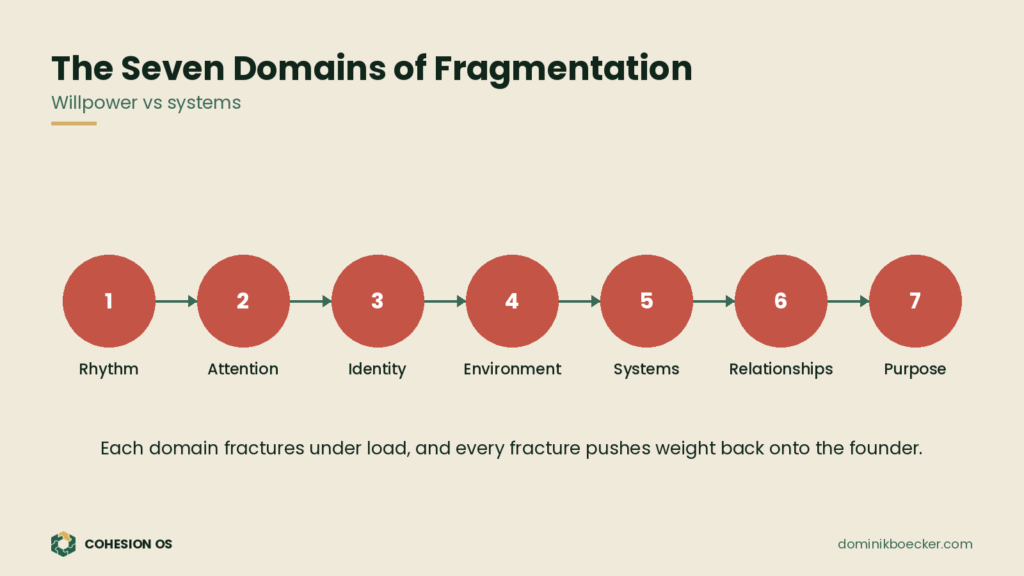
Each of these costs willpower. By mid-morning the budget is spent, and the founder reaches 15:00 making worse calls and concluding that the problem is character. The Cohesion OS view is that the problem is missing structure across the seven domains. Here is how it shows up in each one.
Rhythm
With no fixed points for decisions, reviews and planning, urgency sets the week. Every morning you have to decide again what today is for, and you defend that decision against every message that arrives.
Attention
Your best hours are open to anyone with Slack access. Each interruption is a small decision: answer now or later. Thirty of those before lunch is a full budget of self-control spent on triage.
Identity
If you still see yourself as the person who knows best on every topic, every question that reaches you feels like yours to answer. Saying “that is not mine any more” takes effort each time, because the role was never redefined.
Environment
Phone on the desk, twelve tabs open, three tools that all claim to hold the plan. When the wrong action is the easy one, you have to choose the right one by force, again and again.
Systems
No documented decision rules, no named owner for the recurring process. The same pricing question, the same supplier issue and the same approval reach you every week, and you solve each one fresh.
Relationships
Expectations with your co-founder, leaders and team are implicit, so you hold back from asking, or you carry load nobody agreed you would carry. At home the same pattern runs on whatever is left at 21:40.
Purpose
If direction is not written down in a form the team can use, every trade-off comes back to you. Purpose that only lives in your head cannot filter anyone else’s decisions.
A Rhythm fixed point, an Environment default and a Systems rule each take a decision off the founder for good. That is the real contest in willpower vs systems: willpower wins a decision for one day, structure removes it.
And because the cause is structural, the correction is structural, and structure can be re-scored. Score a domain, install one change, score it again a few weeks later with the same questions. That is the only reason a measured change is possible at all. You cannot measure resolve. You can measure whether a decision still reaches you.
Founder Cohesion Assessment
Which decisions in your company still run on willpower?
The 4-minute assessment scores all seven domains and shows where missing structure is costing you most, so you know what to correct first.
Take the AssessmentFree. Takes about 4 minutes.
The Better Question to Ask
Once a week, ask: which decision did I make by force this week that a rule could have made for me?
It is a better question than “how do I try harder” because it has an answer you can act on. Approving small spends. Replying to a client within the hour. Defending a deep work block. Deciding who joins the Monday call. Each one can move out of your head with one written rule and one named owner.
The old question makes you the solution. The new one makes the structure the solution, which is the only version that survives a heavy week.
Founder Field Note
One founder came in believing he needed to be firmer about not taking calls during his deep work hours. The real issue was that he had no stated rule for which calls justified an exception, so each one became a negotiation, usually opened with “sorry, just a quick one”. The first correction was not a firmer stance. It was a one-line rule naming three situations that could interrupt his block, which his team then followed without asking. His own refusals dropped from daily to almost none. This pattern repeats because founders try to win the same decision every day instead of deciding it once.
Common Mistakes in the Willpower vs Systems Trap
- Treating every slip as a character issue. A slip is usually a signal that a structure is missing, not that you are weak.
- Writing a rule that still needs the founder to enforce it. If you have to police it, it is still your decision.
- Building ten systems in a month. They get abandoned together. One correction that holds beats ten that do not.
- Expecting an app to supply discipline. A new tool adds one more place for fragmentation to hide.
- Counting hours worked as proof the structure holds. Long hours usually mean the opposite.
- Waiting until you are exhausted to change anything. By then every change feels like another demand on willpower.
How to Apply the Reframe This Week
- Log forced decisions. For three days, note each decision you made by effort that you have made before. A note in your phone is enough.
- Pick the most repeated one. The decision that costs you most often, not the most dramatic one.
- Write a rule in one sentence. Who decides, using what condition, up to what limit.
- Tell the person who will use it. A rule nobody else knows is still your decision.
- Review on Friday. Did the rule hold? If not, change the rule, not your resolve.
Do not try to fix the entire business at once. Start where the fracture is loudest.
FAQ
Is willpower useless for founders?
No. It is useful for the occasional hard thing: a difficult conversation, a decision nobody else can make, a week that needs a push. It is a poor foundation for running a company, because it runs out and gets spent on avoidable decisions. Systems protect willpower for the choices that actually need it.
What counts as a system in willpower vs systems?
Any written rule, fixed point or default that removes a decision from you. A calendar block the team respects, a refund limit your ops lead can apply, a notification setting, a named owner for a recurring process. If it still needs you to decide each time, it is not a system yet.
Why do systems feel like more work at first?
Because writing the rule takes effort once, and handing it over feels slower than doing it yourself. The payoff is that the decision stops costing you every day. Start with the decision you make most often, so the return shows up within a week or two.
How do I know a system is working?
Measure it. Score the relevant domain before and after, with the same questions, a few weeks apart. A real structural change shows in the number and in a simple test: does the decision still reach you? If it does, adjust the rule rather than trying harder.
Next Step
If this changed how you see the problem, find out where it applies most. Take the Founder Cohesion Assessment to see which of the seven domains is shaping your company right now and what to correct first.
Discipline is what you use when the structure is missing.
Free Cohesion OS Program
Get the free 9-module founder program.
Step 1 is a 4-minute assessment. It scores all seven domains, shows where your company is fracturing first, and starts the program there.
Start with the AssessmentFree. One stabilising move a week for 8 weeks.
About the Author
Dominik Boecker is the creator of Cohesion OS. He helps founder-led companies identify the fracture lines that create overload, dependency, and operational fragmentation, then install the systems that restore cohesion across rhythm, attention, identity, environment, systems, relationships, and purpose.