
Fast Answer
Founder decision making is the pattern by which you decide what to do, under pressure, with partial information. It becomes expensive when there is no stable reference point, so each decision is made fresh from pressure, approval or comparison. A set of three written decision principles fixes that by giving every call the same filter. Most founders can write the first draft in under an hour. Here is how to build it over thirty days and what to expect in the first month.
Key Takeaways
- Founder decision making gets expensive when decisions are made from pressure, approval or comparison.
- Three written principles give you a reference to decide from, which reduces re-opened decisions.
- Install in order: write the principles, test them on a real decision, then review against principles weekly.
- Principles must be specific enough to rule something out, or they are just values.
- Shared principles let the team make the call without waiting for you.
- At two weeks you should re-open fewer decisions. At six, the team can predict your call.
Why Founder Decision Making Drains You When Instinct Is the Guide
You decided to hire a head of sales on Monday. On Wednesday you saw a competitor post on LinkedIn about their new team, and by Thursday you were reopening the decision. By Friday you had sent two voice notes, asked three people what they thought and felt less sure than before. The offer letter is still sitting in Google Drive, unsigned.
The decision was not the problem. The reference point was. With nothing stable to decide from, each call is made from whatever is loudest that day. That might be pressure from a client, approval from a peer or comparison with someone else’s LinkedIn feed.
Instinct is not the enemy here. Instinct with no fixed point is. It swings with the mood of the week and the last person you spoke to, so the same question gets a different answer on Tuesday than it did on Friday. Your team notices, which is why “can you just approve this” keeps arriving in your WhatsApp.
Principles replace that with something fixed. A decision that fits them is made. One that does not is declined.
The Mechanism It Corrects
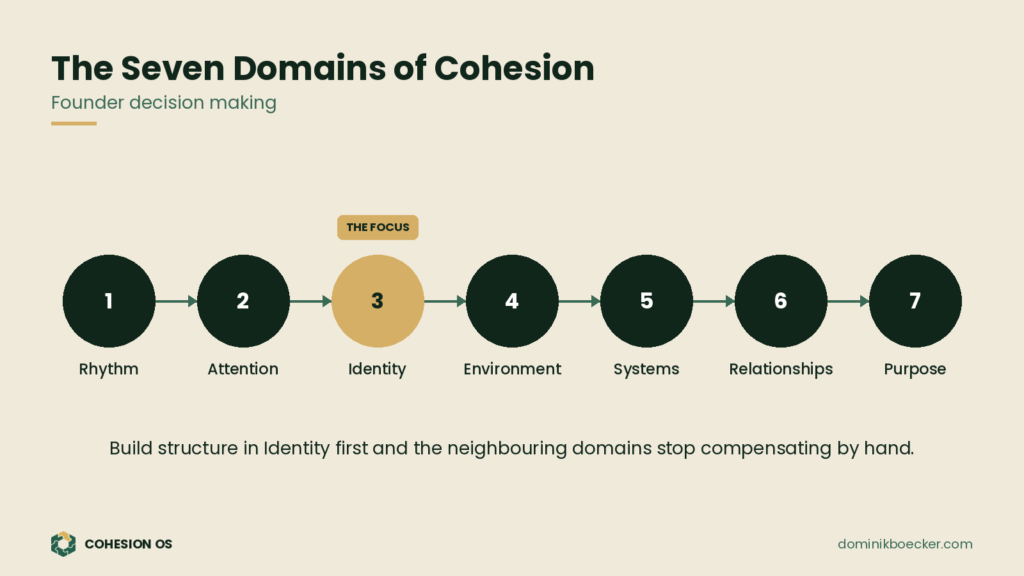
This sits in the Identity domain, the third of the seven domains: Rhythm, Attention, Identity, Environment, Systems, Relationships and Purpose. Identity covers the founder’s role and self-image at the current stage. When it holds, decisions come from who the company needs the founder to be now. When that is unclear, decisions swing with mood and audience.
Principles act as a decision filter. They are not slogans. Each one rules something out, which is how you know it works. It also means decisions can be made by others, because your team can apply them without waiting for you.
That is why a fracture in Identity rarely stays in Identity. Unclear decisions leak into Systems, because nothing gets written down as a rule. They leak into Relationships, because the team learns to wait for your mood rather than trust their judgment. Fix the reference point and the neighbouring domains stop compensating by hand.
Founder Cohesion Assessment
Find out where your company is fracturing first.
See which of the seven domains needs structure first, so the principles you write go where they will hold.
How to Build Founder Decision Making Principles: Step by Step
- Week 1: list your last five hard decisions. Hiring, pricing, a client, a deal, a spend. Note which ones you reopened and what made you reopen them. About 20 minutes, in one Notion page or on paper.
- Week 1: look for what you were protecting. For each decision, write what you were protecting in plain words: speed, relationships, margin, reputation. The same word will usually appear more than once.
- Week 1: draft three principles. Each one a sentence, each one capable of ruling something out. For example: “We do not take clients we would not refer to a friend.”
- Week 2: test them on one real decision. Run it through all three. If a principle does not help you decide, rewrite it until it does.
- Week 2: close one private versus public gap. Pick one place where what you say and what you do differ, and fix it this week. A principle you visibly break is worse than none.
- Week 3: review against principles, not results. On Friday, ask which decisions fitted them. A good decision can have a bad result and still be right.
- Week 4: share them with one person. Someone who can use them without asking you, such as your ops lead or head of sales. Ask them to make one call this week using the principles alone.
Copy-Paste Template
MY DECISION PRINCIPLES

PRINCIPLE 1:
What it rules out:
Last decision it would have changed:

PRINCIPLE 2:
What it rules out:
Last decision it would have changed:

PRINCIPLE 3:
What it rules out:
Last decision it would have changed:

WEEKLY REVIEW (Friday)
Decisions made this week:
Fitted a principle? (Y/N)
Reopened? (Y/N) Why?
Decision someone else made using the principles:
Worked Example
One founder had reopened a pricing decision four times in two months. Each time a prospect pushed back, she asked her sales lead to “hold off for a day” while she thought about it, and each time the answer depended on how the quarter was going.
Her three principles included “we price on value delivered, not on what competitors charge”. She ran the next pricing question through them and the decision took ten minutes. Her sales lead then used the same principle to hold a price in a negotiation without escalating.
What made it hold was that the principle was written, specific and shared. The decision stopped living in her head and started living in the company.
Common Mistakes When Setting Up Decision Principles
- Writing values that sound good but rule nothing out.
- Having more than three, so none gets used.
- Keeping the principles private.
- Judging decisions by outcome rather than by fit.
- Writing them once and never testing them.
- Letting a good-looking exception override them.
How to Know It Is Working
At 2 weeks: you are reopening fewer decisions and can name the principle you used. The hire, the price or the client call that used to drag for days gets settled in one sitting.
At 6 weeks: your team uses the principles without asking, and decisions that used to wait for you get made. Fewer “quick questions” land in Slack, because the answer is already written down.
Identity Fragmentation Domain
Identity Fragmentation Scorecard + Playbook Bundle
Score where your founder role is fracturing, then follow the playbook to make decisions from who the company needs you to be now.
FAQ
What is founder decision making?
It is how a founder chooses under pressure, with partial information. Good founder decision making is repeatable: the same situation gets the same call, regardless of the day or the audience. When it depends on mood, the team cannot predict it, so every decision waits for the founder and the company slows to the founder’s pace.
Are principles the same as company values?
No. Values describe what you care about. Principles say what to do when two good things conflict, and what you will not do. A value such as “customer first” rarely settles a hard call. A principle such as “we do not discount to win a deal we would not renew” does.
How many principles should I have?
Three is enough to start. More than that and the principles stop being used, because nobody can hold them in their head during a real decision. Once the first three hold for a couple of months, you can add one, but only if a recurring decision keeps falling outside them.
What if a principle turns out to be wrong?
Change it deliberately, in writing, not in the moment of a decision. That keeps the filter useful. Note what decision exposed the problem, rewrite the principle on Friday, and tell the people who use it. A principle that quietly bends under pressure teaches the team to wait for you again.
Next Step
Before you install another tool, check it is the right one. Take the Founder Cohesion Assessment to see which of the seven domains needs structure first, so this system goes where it will hold.
A decision made from a principle can be delegated. A decision made from mood cannot.
Free Cohesion OS Program
Get the free 9-module founder program.
Step 1 is a 4-minute assessment. It scores all seven domains, shows where your company is fracturing first, and starts the program there.
Start with the AssessmentFree. One stabilising move a week for 8 weeks.
About the Author
Dominik Boecker is the creator of Cohesion OS. He helps founder-led companies identify the fracture lines that create overload, dependency, and operational fragmentation, then install the systems that restore cohesion across rhythm, attention, identity, environment, systems, relationships, and purpose.