Team uses AI better than the founder in most founder-led companies right now, and it usually gets read as a skills gap the founder should close with a course or a weekend of tinkering. It is not a skills gap. Your team adopts a new tool fastest in whichever part of the business already has clear boundaries and low-stakes decisions. If AI has taken hold everywhere except where you personally operate, that gap is not telling you about your AI literacy. It is telling you where the operational fragmentation already lives.
Key Takeaways
- A team outpacing the founder on AI adoption is a diagnostic signal, not a personal skills gap
- AI adopts fastest where decisions are bounded and clearly owned, and stalls where authority is unclear
- The founder’s own work is usually the least defined in the company, which is exactly where AI struggles to help
- Closing the gap with more AI training misses the actual constraint entirely
- The correction is defining the founder’s own decisions clearly enough that a tool, or a person, could act inside them
What Does It Mean When Your Team Uses AI Better Than You?
Your ops coordinator built a Notion automation that cut a weekly reporting task from two hours to fifteen minutes. Your junior marketer is running AI-assisted content drafts that would have taken a contractor a week. Your customer success lead has an AI-assisted triage system sorting tickets before anyone touches them.
You have tried the same tools. You asked an AI assistant to help you plan next quarter’s priorities and got back generic advice that needed as much editing as writing it yourself would have. You tried automating your inbox triage and it made three wrong calls in the first week, so you turned it off.
The instinct is to read this as your team having caught up on a skill you have not prioritised learning. That is not what is happening. Team uses AI better than founder is not describing an AI literacy gap. It is describing where the domain of Systems, clear decisions, documented boundaries, defined ownership, already exists in your company and where it does not.
Why Doesn’t More AI Training Close the Gap?
The instinct is to treat this like any other capability gap: take a course, read the guides, spend a weekend experimenting until it clicks the way it clicked for the team.
This does not work, for a structural reason that has nothing to do with effort.
AI performs well on bounded, well-defined tasks and poorly on ambiguous ones. Your ops coordinator’s reporting task has a fixed structure: same data sources, same format, same recipient, every week. An AI tool can be handed that boundary and execute inside it reliably. Your quarterly strategic priorities have no equivalent boundary. They depend on judgement calls, competing tradeoffs, and context that has never been written down anywhere a tool, or another person, could read it.
The founder’s own role is usually the least documented job in the company. Every other role has a job description, a set of responsibilities, some version of “here is what you own.” The founder’s actual day-to-day, what gets escalated, what gets decided instantly, what gets deferred, exists almost entirely as instinct. You cannot hand a tool a boundary that has never been drawn.
More training teaches tool usage, not decision clarity. A course improves how you prompt. It does not create the missing definition of what your job actually consists of, which is the real blocker. You would get marginally better outputs from a marginally clearer prompt against a task that was never well-defined to begin with.
Training makes you a better operator of an ambiguous role. It does not make the role less ambiguous.
The Hidden Mechanism Behind the AI Adoption Gap
AI adoption is not evenly distributed across a company. It concentrates exactly where the Systems domain is already healthy, and stalls exactly where it is not.
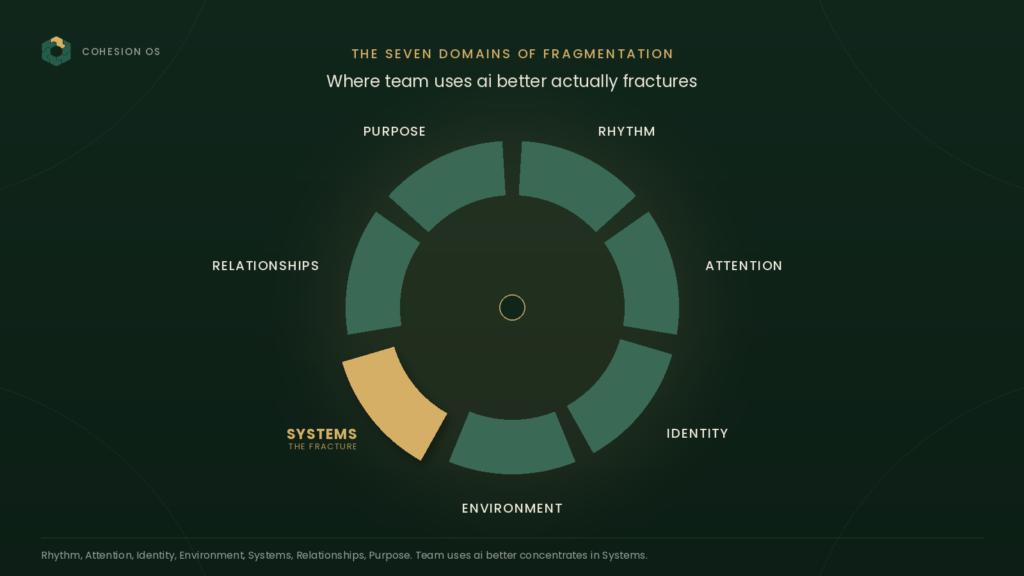
Your ops coordinator’s task worked because the decision boundary already existed: what counts as a complete report, who receives it, what format it takes. AI could be handed that boundary and act inside it. Your own strategic work fails the same test not because the tool is worse at strategy, but because the boundary was never drawn: what actually needs your judgement versus what has simply always landed on you by default, undocumented, unexamined. This is exactly the Systems fracture the rest of the company has already been forced to solve for its own bounded tasks. Your role is the one place nobody, including you, has done that work yet.
This reframes the entire observation. Your team is not more capable with AI. Your team’s work has more of the Systems clarity that makes any tool, human or artificial, actually useful. Where that clarity is missing, in your own role above all, no tool closes the gap, because the gap was never about the tool.
3-Minute Diagnostic
Which of the seven domains is actually costing you the most?
Why Founders Stay Behind on Tools That Work Everywhere Else
The pattern holds because the founder’s role resists the very definition that would make it legible to a tool. Every day looks different. The judgement calls feel too contextual, too instinct-driven, too “you had to be there” to write down as a rule. This feels like a genuine description of senior leadership, and much of the time it is.
But some meaningful share of what feels like irreducible judgement is actually just undocumented pattern. The founder who “just knows” which client escalations need a personal call is applying a rule. It has simply never been extracted from instinct into something written, which is the exact same problem blocking a junior hire from making that call independently, and the exact same problem blocking an AI tool from assisting with it.
The founder attributes the gap to the complexity of the role. The team, without meaning to, has already proven that the actual blocker is definition, not complexity, every time they successfully hand a bounded task to a tool that the founder could not.
What Changes When You Close the Definition Gap, Not the Skills Gap?
- AI tools become genuinely useful for founder-level work once the underlying decisions are defined, not before
- Delegation improves alongside AI adoption, because the same definition work that helps a tool also helps a person
- The founder stops mistaking “this role feels too complex to document” for an accurate description of the actual work
- Training investment shifts from tool literacy, which the founder likely already has enough of, to decision clarity, which is the actual gap
- The company’s AI adoption becomes a diagnostic tool going forward: wherever it stalls next, that is where to look for the next undefined boundary
This does not mean turning every founder judgement call into a rigid rule. It means separating the genuinely irreducible calls from the ones that only felt that way because nobody had tried to define them yet.
Founder Field Note
One founder was frustrated that his ops team had automated half their workflow with AI while his own use of it produced nothing usable. He had assumed the fix was carving out time to properly learn the tools, and had booked two separate weekends to do it.
Looking at what the ops team had actually automated, every instance was a task with a fixed input, a fixed output, and a rule that had already been written down somewhere, even informally, before the automation existed. His own attempts, drafting board updates, triaging which client issues needed him personally, had no equivalent rule anywhere. He was asking a tool to replicate judgement that had never been extracted from his head in the first place.
The correction was not the two weekends of tool training, which he cancelled. It was writing down, in plain language, the actual criteria he used to decide which client issues needed him versus which did not. Once that criterion existed as a document rather than an instinct, both a team member and an AI-assisted triage step could use it. The tool had been capable the entire time. The decision had not been available to hand to it.
Common Mistakes When Your Team Outpaces You on AI
- Treating it as a personal skills deficit. Booking a course addresses the wrong layer of the problem entirely.
- Comparing your use case to your team’s without checking the boundary. Their tasks were bounded before the tool arrived. Yours may not be.
- Assuming your judgement is too complex to ever be defined. Some of it is. Most of it has simply never been tested.
- Trying to automate a decision before writing down its actual criteria. The tool cannot infer a rule that exists only as instinct.
- Reading team AI fluency as a threat to founder relevance. It is closer to a diagnostic report on where clarity already exists in the company.
- Waiting for a better tool instead of writing down a clearer decision. The next tool will hit the same undefined boundary the current one does.
How to Start Closing the Real Gap
- Pick one recurring decision that currently exists only in your head. Something you decide the same way most times it comes up.
- Write down the actual criteria, not the outcome. Not “I decide case by case,” but the two or three factors that genuinely drive the call.
- Test the written rule against the last five instances. Would it have produced the same decision you actually made? Refine until it holds.
- Hand the rule to a person or a tool, not both at once. See whether the definition actually transfers, which tells you if it was real or still too vague.
- Repeat with the next recurring decision. This is a domain-level correction, not a one-time exercise.
Do not try to define your entire role at once. Start with the single most frequent judgement call you make.
FAQ
Does my team using AI better than me mean I am falling behind as a leader?
No. It means the parts of the company with clear boundaries have already made themselves legible to a new tool, and your own role has not yet been through that process. This is a definition gap, not a leadership or competence gap, and it is common at exactly the growth stage where founder judgement has never needed to be written down before.
Should I still invest time in learning AI tools directly?
Some baseline familiarity helps, but it is not the priority fix. The higher-leverage move is defining the decisions in your own role clearly enough that any tool, current or future, has something concrete to work with. Tool skill without decision clarity produces mediocre output regardless of how good the tool is.
Why does this pattern always seem to start with the founder specifically?
Because the founder’s role is typically the least externally defined job in the company by design. Every other role gets a job description, onboarding, and increasing clarity over time. The founder’s own responsibilities accumulate by default and rarely get the same treatment, which makes it the natural place for an undefined-boundary problem to concentrate.
Can the Founder Cohesion Assessment tell me if this is a Systems issue specifically?
Yes. The Assessment identifies which of the seven domains is generating the most fragmentation in your company right now, including whether an AI adoption gap in your own role traces back to Systems specifically, so you correct the actual definition gap rather than booking another tool-training session.
Next Step
If this sounds familiar, do not add another system yet. First, identify where the fracture is actually happening. Take the Founder Cohesion Assessment to see which of the seven domains is creating the most fragmentation in your company and what to correct first.
Your team did not get better at using tools than you. They got clearer, first.
3-Minute Diagnostic
Which of the seven domains is actually costing you the most?
Dominik Boecker is the creator of Cohesion OS. He helps founder-led companies identify the fracture lines that create overload, dependency, and operational fragmentation, then install the systems that restore cohesion across rhythm, attention, identity, environment, systems, relationships, and purpose.
The Cohesion Letter
Plus weekly signal for founders rebuilding capacity, not chasing more hustle.
Weekly. Unsubscribe any time.