
Founders can’t trust their own judgment anymore, and the usual explanation is burnout, imposter syndrome, or a simple loss of confidence with growth. That explanation rarely holds up under examination. The judgement has not degraded. What has degraded is the internal consistency the founder used to bring to each decision, because the founder is now making forty context switches a day across roles that each demand a different version of them. The second-guessing is not a confidence problem. It is what internal fragmentation feels like from the inside.
Key Takeaways
- Second-guessing every call is rarely a sign of declining judgement, it is a sign of internal misalignment
- Constant context-switching between roles erodes the consistency a founder needs to trust their own calls
- The founder has not gotten worse at deciding. The founder is deciding from a different internal position each time
- More confidence-building or reflection time treats the symptom, not the actual fracture
- Rebuilding internal alignment restores decision trust faster than any amount of reassurance
What Does It Mean When a Founder Can’t Trust Their Own Judgment?
You made the same type of pricing call eighteen months ago without a second thought. Today, the same decision takes three re-reads of the same numbers, a message to a colleague for a sanity check, and a night of turning it over before you commit. Nothing about the decision itself is harder. You are objectively more experienced than you were eighteen months ago.
The instinct is to read this as judgement decline. You search for what has gone wrong with your decision-making itself. That search rarely turns anything up. The decision-making machinery has not degraded. What changed is what you were doing in the twenty minutes before the decision. Eighteen months ago, that pricing call might have been the third similar decision of the day, made from a consistent operating position. Today it lands sandwiched between a client crisis, a hiring conversation, and a personal matter. Each one asked you to show up as a genuinely different version of yourself.
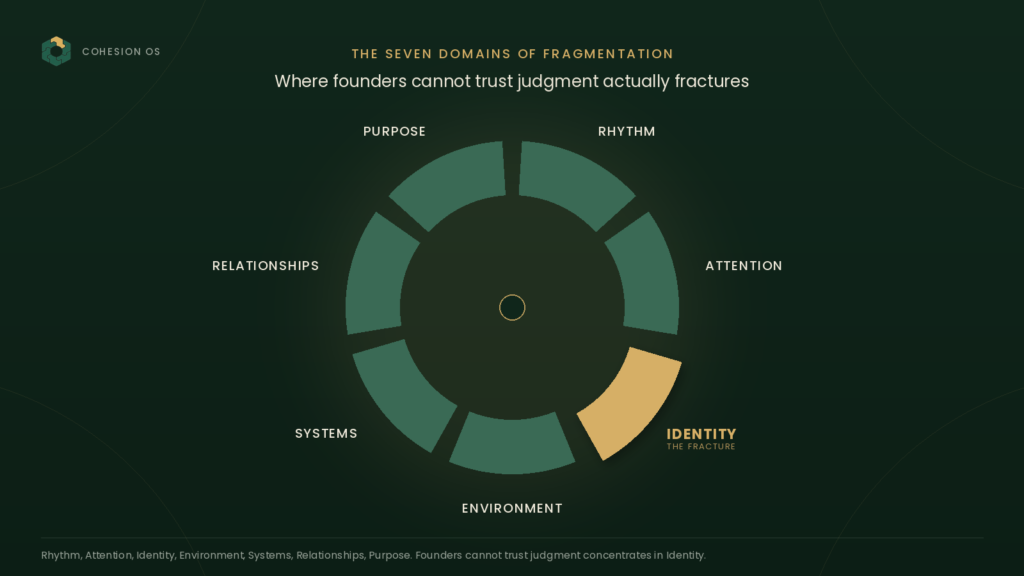
Founders can’t trust their own judgment when the judgement itself is not the problem, the internal consistency behind it is. Cohesion OS calls this an Identity fracture, compounded by Attention fragmentation: the founder has not lost the ability to decide well. The founder has lost the stable internal position from which decisions used to get made.
Why Doesn’t More Confidence or Reflection Fix It?
The standard advice is to build confidence back: journal on past wins, get external validation, take more time before deciding, work with a coach on decisiveness.
This misses the actual mechanism.
Confidence-building assumes the belief in your judgement is broken, not the conditions producing the judgement. You can reassure yourself with a list of past good calls. The hesitation returns on the next one anyway. The list does not address what changed: the fragmented internal state you now decide from, moment to moment.
More reflection time does not restore consistency. It just adds delay to an already inconsistent process. Taking longer to decide feels responsible. But the underlying issue is that you approach the decision from a different, context-switched version of yourself each time. Extra time mostly gives that inconsistency more room to show up as competing internal voices. That often makes the hesitation worse, not better.
A coach on decisiveness treats the output, not the input. Decisiveness training improves how quickly and firmly you commit to a call. It does nothing about the actual variable that changed, which is the fragmented state you are deciding from, not your willingness to commit once you decide.
None of these interventions are wrong in general. They are aimed at a decision-making skill that was never actually the thing that broke.
The Hidden Mechanism Behind Judgement You No Longer Trust
Every decision a founder makes is made from some internal operating position: a working sense of priorities, values, and what matters right now. That position needs to be reasonably stable for the resulting decisions to feel trustworthy, to yourself, in the moment and in hindsight.
Constant context-switching, client call to hiring decision to personal matter to strategic planning, forces the founder to reconstruct that internal position dozens of times a day. Often there is no transition time between switches. Each reconstruction is slightly different, shaped by whatever emotional residue the last context left behind. The pricing call made forty minutes after a tense client escalation is not made from the same internal position as the same call made after a calm morning. The judgement quality has not changed. The stability of the position it is issued from has.
This is why the fracture sits primarily in Identity, with Attention fragmentation as the mechanism forcing the switches. The founder has not lost their values or their standards. The founder is no longer operating from a consistent enough internal position, moment to moment, for decisions to carry the felt trustworthiness they used to. Once you notice this, the second-guessing stops looking like a personal failing. It starts looking like exactly what you would expect from anyone deciding forty times a day from forty slightly different internal states.
Why Founders Keep Attributing This to Personal Decline
The pattern holds because self-doubt is the most available explanation, and the hardest one to argue with from the inside. When a decision that used to feel automatic now feels effortful, the natural conclusion is that something in you has gotten worse. Growth, stress, and age all offer plausible-sounding stories for that decline. Founders reach for them readily. The alternative, that the company has quietly demanded more internal fragmentation of you than it used to, feels less personal and less immediately actionable.
There is also a real absence of contrast. Nobody else sees the internal state you are deciding from moment to moment. Your team sees a founder who makes calls; they do not see the six unrelated contexts you moved through in the hour before making one. Without that visibility, the pattern is invisible even to you, until you specifically look for it.
What Changes When You Rebuild Internal Alignment Instead of Confidence?
- Decisions start feeling trustworthy again because they are being made from a more consistent internal position, not because your underlying judgement changed
- The need for external validation before committing to a call drops, since the hesitation it was compensating for has an actual cause being addressed
- Context-switches still happen, but with enough transition space to avoid carrying residue from one into the next
- Founders stop treating ordinary decision fatigue as evidence of personal decline
- The same decisions that took hours of second-guessing get made in minutes, at the same quality, because the internal noise generating the hesitation has been reduced
This does not mean eliminating context-switching entirely, which is unrealistic for most founder roles. It means building enough transition space between switches that each decision is made from something closer to a stable position.
This is not a founder-specific phenomenon. A 2024 study published in Scientific Reports found that switching between different cognitive strategies produces measurable performance costs even when the underlying task itself stays identical, and that these costs are larger when the switch is self-directed rather than externally cued (Nature Scientific Reports, 2024). A founder moving from a client crisis into a pricing decision is making exactly that kind of self-directed switch, without the external cue that would normally signal a clean transition.
3-Minute Diagnostic
Which of the seven domains is actually costing you the most?
Founder Field Note
One founder described losing trust in her own judgement over about four months, despite nothing in the business objectively worsening. She had started running every meaningful decision past her co-founder before committing, not because she disagreed with her own instinct, but because she no longer trusted that the instinct was reliable.
Tracking a single day made the mechanism visible. Between 9am and 1pm she moved through a product decision, a difficult client call, a disciplinary conversation with a team member, and a personal call about a family matter, back to back, with no space between any of them. The pricing decision she second-guessed that afternoon was not poorly reasoned. It was made forty seconds after closing the disciplinary conversation, from an internal position still carrying that conversation’s weight.
The correction was not confidence coaching. It was inserting five minutes of genuine transition, not admin, not email, between context switches of that kind, specifically before any decision she considered consequential. Within three weeks, she reported making the same category of decisions without needing the co-founder check, not because her judgement had improved, but because it was finally being issued from a position that had settled before being asked to decide.
Common Mistakes When You Stop Trusting Your Own Calls
- Assuming the judgement itself has declined. The mechanism is almost always internal consistency, not decision-making capability.
- Seeking external validation as a permanent fix. It relieves the immediate hesitation without addressing what is producing it.
- Adding more reflection time without addressing the context-switching underneath it. More time inside a fragmented state does not stabilise it.
- Treating it as a confidence or mindset issue. Mindset work targets belief, not the actual mechanical cause.
- Not noticing the pattern because nobody else can see your internal state. The fragmentation is invisible from the outside, including often to yourself, until specifically tracked.
- Trying to eliminate context-switching entirely. Unrealistic for most founder roles; the fix is transition space, not fewer contexts.
How to Start Rebuilding Trust in Your Own Judgment
- Track one full day of your actual context switches. Not your calendar’s intended structure. What you actually moved through, back to back.
- Mark which decisions followed a switch with no transition space. This is usually where the second-guessing concentrates.
- Insert a short, genuine transition before consequential decisions. Not admin or email. A few minutes of actual disengagement from the prior context.
- Test a decision made with transition space against one made without. Notice whether the hesitation differs, not just the outcome.
- Build the transition into your actual schedule, not your intentions. An unprotected gap gets consumed by the next context the same way an unprotected calendar block does.
Do not try to fix your entire schedule at once. Start with the single decision type you second-guess most often.
FAQ
How do I know if this is an internal alignment issue versus an actual decline in my judgement?
Check whether the hesitation is specific to certain conditions, right after a difficult context switch, late in a demanding day, rather than constant and even. A genuine skill decline tends to show up consistently across contexts. Hesitation that concentrates around context-switching and eases with transition space points toward internal fragmentation, not declining ability.
Is this the same thing as decision fatigue?
It is related but not identical. Decision fatigue is about the total volume of decisions wearing down decision quality over a day. This mechanism is specifically about the internal consistency you bring to each decision being disrupted by unmanaged context-switching, which can happen even on a day with a manageable total number of decisions.
Can I fix this without changing my actual schedule?
Not fully. Reflection and mindset work can soften the felt experience temporarily, but the underlying mechanism is structural: context switches with no transition space. Some schedule-level change, even small, is usually necessary to address the actual cause rather than its symptoms.
Can the Founder Cohesion Assessment identify whether this traces back to Identity specifically?
Yes. The Assessment is built to identify which of the seven domains is generating the most fragmentation in your company and your own operating pattern right now, including whether difficulty trusting your own judgement traces back to Identity and Attention fragmentation rather than an actual decline in decision-making ability.
Next Step
If this sounds familiar, do not add another system yet. First, identify where the fracture is actually happening. Take the Founder Cohesion Assessment to see which of the seven domains is creating the most fragmentation in your company and what to correct first.
Your judgement was never the problem. The ground you were making it from kept moving.
3-Minute Diagnostic
Which of the seven domains is actually costing you the most?
Dominik Boecker is the creator of Cohesion OS. He helps founder-led companies identify the fracture lines that create overload, dependency, and operational fragmentation, then install the systems that restore cohesion across rhythm, attention, identity, environment, systems, relationships, and purpose.
The Cohesion Letter
GET THE FREE 4-WEEK COHESION RESET
Plus weekly signal for founders rebuilding capacity, not chasing more hustle.