
Fixing one department never fixes the company because fragmentation is not a departmental condition. It is a company-wide one that happens to be visible in whichever department is under the most strain this quarter. Reorganise that department and the strain does not disappear. It relocates to whichever part of the company has the next-weakest structure. The first correction is not another reorg. It is recognising that the fracture producing the symptom sits above the org chart, not inside one box on it.
Key Takeaways
- A department that improves after a reorg and then produces a new problem elsewhere was never actually the source
- Fragmentation operates at the company level; departments are just where it becomes visible first
- Reorganising the visibly struggling team treats the symptom’s location, not its cause
- The same structural gap will surface in a new department within two or three quarters if left uncorrected
- Correcting the actual domain, not the department, is the only fix that does not relocate the problem
Why Doesn’t Fixing One Department Fix the Company?
Sales has been underperforming for two quarters. You restructure the team, bring in a new sales manager, rewrite the comp plan. Performance improves for a stretch. Six months later, delivery is missing deadlines it never used to miss, and nobody on the delivery team has changed.
This looks like two unrelated problems solved and then created. It is usually one fracture that moved. The sales restructure did not fix a sales problem. It changed who was absorbing a company-wide strain that had been concentrating in sales, and the strain simply found the next department with the least structural resistance.
Fixing one department never fixes the company for this reason: a department is where fragmentation shows up, not where it originates. Cohesion OS treats the visible department as a symptom location and asks which of the seven domains, Rhythm, Attention, Identity, Environment, Systems, Relationships, or Purpose, is actually generating the strain that department has been absorbing.
Why Doesn’t a Reorg Solve the Underlying Problem?
The instinct is entirely rational. A department is visibly failing, so you fix the department. New leadership, new structure, new process, new incentives. All reasonable moves. All aimed at the wrong altitude.
A reorg treats geography, not mechanism. Restructuring sales changes who is in the room and how they report. It does not change whatever company-wide condition, unclear decision authority, an undefined identity at the point of objection, a founder who is the only approval path, was landing disproportionately on sales in the first place. The mechanism survives the reorg intact.
Improvement in the reorganised department looks like proof it worked. For a while it does work, because a fresh structure absorbs strain differently for a period. This is not evidence the fracture was addressed. It is evidence the strain has not yet found its next path.
The next department to show strain looks unconnected. Delivery missing deadlines six months after a sales reorg reads as a delivery problem, run by different people, using different tools, with its own explanation. Nobody traces it back to the same company-wide fracture, because departments are organised to look independent even when the thing straining them is not.
Reorganising a department without diagnosing the domain does not remove the fracture. It moves the address.
The Hidden Mechanism Behind Fragmentation That Moves
Fragmentation behaves like water finding the lowest point, not like a fault contained to one location.
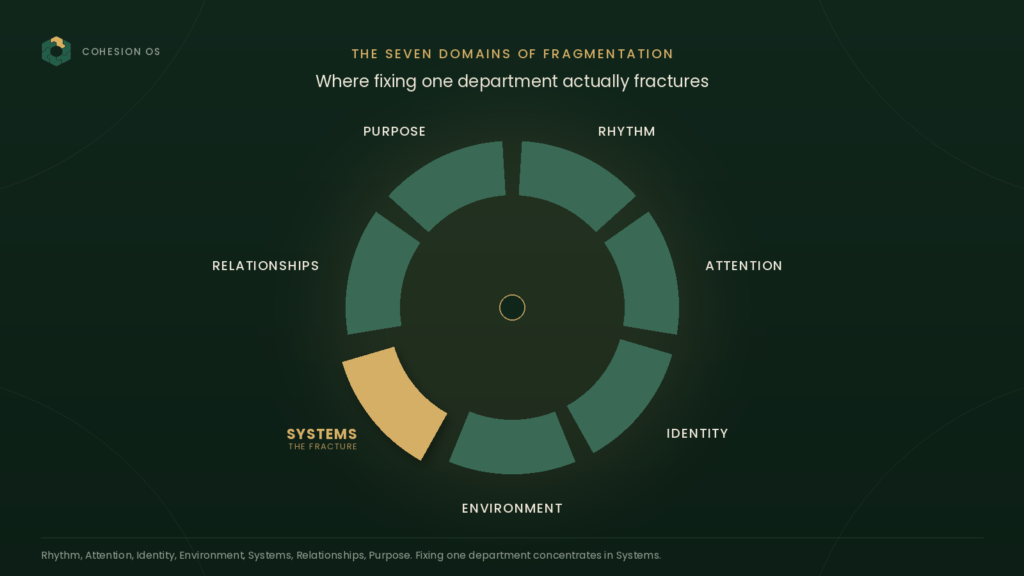
A Systems gap, undocumented decision authority, does not confine itself to one team. It shows up as approval bottlenecks in sales this quarter, missed handoffs in delivery next quarter, and unclear ownership in finance the quarter after. Each looks like a local failure with a local fix. All three are the same domain fracture, wearing three different department names. The department under strain is simply whichever team currently has the least structural buffer to absorb an unresolved company-wide gap.
This is why department-level fixes plateau. You can improve the local buffer, a stronger manager, a clearer process, a better hire, and the department will hold for a while. But the underlying domain gap has not moved, so the strain it generates has to land somewhere. It lands wherever the buffer is thinnest next.
3-Minute Diagnostic
Which of the seven domains is actually costing you the most?
Why Founders Keep Reorganising the Same Fracture Into New Departments
The pattern persists because a department-level fix is fast, visible, and satisfying. You can point to the new sales structure and the improved numbers within a quarter. Pointing to a company-wide domain fracture and a page of decision rules is a much less dramatic story, even though it is the one that actually holds.
There is also a genuine diagnostic difficulty. When strain resurfaces in a new department, it rarely announces itself as a repeat. Different symptoms, different language, different people involved. It takes a deliberate step back, looking at the pattern across departments rather than the problem inside one, to notice that three “unrelated” issues over eighteen months share a single structural cause.
Without that step back, founders keep correctly diagnosing the department and incorrectly diagnosing the company.
What Changes When You Fix the Domain Instead of the Department?
- The fracture stops resurfacing in a new department every few quarters, because the actual cause has been addressed once
- Department-level fixes become genuinely durable, because they are no longer fighting a company-wide gap underneath them
- Founders spend correction effort at the source instead of paying for a new reorg every time the symptom relocates
- Cross-department pattern recognition improves, so the next strain gets caught before it becomes a full department crisis
- The org chart stops being treated as the diagnostic tool it was never designed to be
Nothing here means departments stop needing normal management. It means the recurring, structural problems stop being treated as if a new manager will out-organise a company-wide gap.
Founder Field Note
One founder had reorganised the same function twice in eighteen months. First it was called a sales problem and fixed with a new sales director. Then it resurfaced as a customer success problem and got fixed with a new CS lead. Both hires were good. Both restructures were reasonable. The underlying number, client churn at the ninety-day mark, barely moved.
The actual fracture was in Identity. The company had never resolved what it stood for when a client pushed back hard on price or scope, so every team facing that moment, sales at the close, CS at renewal, improvised a different answer under pressure. Each department’s version of the fracture looked like a department problem because that is where the client interaction happened. The cause was upstream of both departments.
The correction was not a third reorg. It was a single written position on what the company would and would not flex on, agreed once at the top, and handed to both teams the same week. Churn at the ninety-day mark moved within the following quarter, without a third hire.
Common Mistakes When a Department Keeps Underperforming
- Treating a resurfacing problem as a new problem. Different department, same fracture, gets diagnosed as unrelated each time.
- Measuring success by the reorganised department alone. Improvement there says nothing about whether the underlying gap was closed.
- Hiring a stronger leader as the default fix. A strong leader can absorb strain for a while. They cannot out-manage a company-wide domain gap.
- Not tracking where strain has appeared across the last eighteen months. Without that record, the pattern across departments is invisible.
- Assuming the org chart shows where the fracture lives. It shows where the fracture is currently landing, which is a different thing.
- Reorganising again before diagnosing the domain. A fourth restructure without a domain diagnosis just adds another department to the list.
How to Start Fixing the Domain, Not the Department
- List every department-level “fix” from the last eighteen months. Reorgs, new hires into existing roles, process rewrites.
- Look for a shared shape across them. Not the same words, the same mechanism: unclear authority, undefined standards, a founder bottleneck, a boundary nobody enforces.
- Name the domain the shared shape points to. Rhythm, Attention, Identity, Environment, Systems, Relationships, or Purpose.
- Correct at the domain level with one written rule or boundary. Not a new structure. A defined answer to the actual gap.
- Watch the next department under strain before declaring it solved. If the pattern moves to a new team within a couple of quarters, the domain diagnosis needs another look.
Do not try to fix every department at once. Trace the pattern first, then correct the one domain generating it.
FAQ
How do I know if my department problem is actually a company-wide fracture?
Look at your last eighteen months. If a “solved” problem in one department has resurfaced under a different name in a different department, that is the signature. A genuine department-specific issue does not typically relocate; a company-wide fracture does.
Isn’t it possible that a department really is just underperforming, with no wider cause?
Yes, and most departments have ordinary performance variation that has nothing to do with a systemic fracture. The distinguishing test is recurrence across departments, not a single team having a rough quarter. One instance is a department issue. A repeating pattern across different teams is a domain issue.
Why does the fracture always seem to move to a different department instead of getting worse in the same one?
Because the department you already restructured usually has, for a while, the strongest local defences against the fracture: fresh leadership, tighter process, closer attention. The path of least resistance moves to whichever department has not just been reinforced, which is rarely the one you already fixed.
Can the Founder Cohesion Assessment identify which domain is actually behind a recurring departmental problem?
Yes. The Assessment is built to find which of the seven domains is generating the most fragmentation across the company right now, rather than assessing one department in isolation, which is exactly the blind spot that lets a fracture relocate undetected.
Next Step
If this sounds familiar, do not add another system yet. First, identify where the fracture is actually happening. Take the Founder Cohesion Assessment to see which of the seven domains is creating the most fragmentation in your company and what to correct first.
The department was never the problem. It was just where the problem was standing when you looked.
3-Minute Diagnostic
Which of the seven domains is actually costing you the most?
Dominik Boecker is the creator of Cohesion OS. He helps founder-led companies identify the fracture lines that create overload, dependency, and operational fragmentation, then install the systems that restore cohesion across rhythm, attention, identity, environment, systems, relationships, and purpose.