Fast Answer
AI stack outpaces your decisions when execution speed grows faster than your judgment can keep up with. Founders spend months building an AI-powered operation, faster reporting, faster drafts, faster workflows, and then discover the actual constraint has not moved. It has just relocated. The tools are not the bottleneck anymore. The founder deciding what the tools should do next is.
Key Takeaways
- Speed gained from AI does not disappear, it accumulates at whatever point still requires human judgment
- A founder can have an AI stack that executes in seconds and still be the reason nothing actually ships faster
- The bottleneck used to be execution capacity. For AI-heavy operations, it is now decision capacity
- Adding more AI tools compounds this gap rather than closing it, since more tools means more decisions waiting on the same founder
- The fix is deliberately increasing decision throughput, not adding more automation on top of an unchanged decision process
- Founders who correct this treat their own decision-making as the thing to redesign, not the AI stack
3-Minute Diagnostic
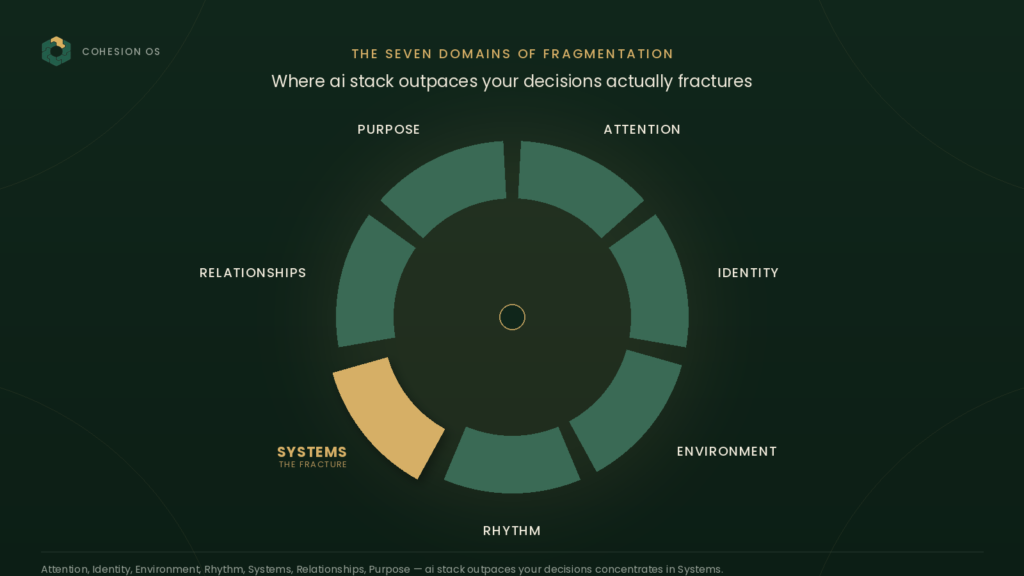
Which of the seven domains is actually costing you the most?
What Does “AI Stack Outpaces Your Decisions” Actually Mean?
It is the specific, disorienting experience of building genuinely fast AI infrastructure and discovering the business still does not move any faster. Reports that used to take a day now take minutes. Drafts that used to take hours now take seconds. And the business still ships at roughly the same pace it always did.
The reason is straightforward once named. Speed does not disappear when a workflow runs faster, it just accumulates wherever the process still needs a human to decide something. If the founder is that human, and the founder is still deciding at the same pace they always did, then the AI stack has not actually increased throughput. It has increased the size of the queue waiting on the founder’s judgment.
This shows up as an operation that looks remarkably fast on paper, dashboards updating instantly, drafts appearing in seconds, and still feels exactly as slow as before from the inside, because the actual constraint was never execution speed. It has quietly become decision speed instead.
Cohesion OS treats this as an operational fragmentation pattern, the domain that routes into Founder AI OS. AI does not remove the bottleneck. It relocates it to whatever is left that AI cannot do, which is usually the founder’s judgment.
Why Does Adding More AI Tools Not Fix This?
The instinct once a founder notices the business still feels slow is to add more automation, another integration, another AI layer to speed things up further. Founders try this and the underlying pace does not improve, sometimes it gets worse.
Here is why. More AI tools increase execution speed, which was never the actual constraint once the first wave of automation already closed that gap. Adding a second or third layer of speed on top of a bottleneck that lives in human judgment just produces more finished work waiting on the same founder to decide what happens with it. The queue gets longer, not shorter, because the input rate increased while the decision rate stayed exactly the same.
This is the same trap as delegating tasks without delegating decisions, the mechanism is identical, just running at AI speed instead of human speed. A faster stack does not solve a decision bottleneck. It exposes it more sharply, because the gap between how fast the tools work and how fast the founder decides becomes impossible to ignore.
The Real Mechanism Behind This Bottleneck Shift
There is a specific, predictable mechanism behind why AI speed exposes decision capacity as the real constraint.
Execution speed and decision speed are two separate variables. AI dramatically increases the first without touching the second. A business only moves as fast as its slowest constraint, and once execution stops being that constraint, decision-making inherits the role by default.
Faster tools generate faster demand for decisions. A workflow that used to produce one draft a day now produces ten. Each one still needs a founder’s judgment on whether it is right, whether to ship it, whether to adjust it. Speed multiplies the input into the decision queue, not the queue’s throughput.
Founders rarely redesign their own decision process alongside the tooling. Enormous effort goes into building and refining AI workflows. Almost none goes into deliberately increasing how many decisions the founder can process, or how many of those decisions could be handled by someone else entirely.
The bottleneck becomes harder to see because everything around it looks efficient. Dashboards, execution times, and output volume all look impressive. The actual constraint, a founder who still processes decisions one at a time, hides behind metrics that measure the wrong thing.
Why Founders Stay Stuck in This Pattern
The loop looks like this: the founder builds AI infrastructure to speed things up, execution genuinely gets faster, the business still feels slow because decisions are the real constraint, the founder assumes the tools need improving further, they add more automation, which increases the queue of finished work waiting on their judgment even more. Nobody stops to ask whether the founder’s own decision throughput was ever addressed, because every visible metric suggests the tools are working exactly as intended.
This is why buying a more sophisticated AI platform rarely solves the felt slowness. The platform was never the constraint. The founder’s capacity to decide, at the speed the new tools now demand, was.
What Changes When This Is Corrected?
When this fracture is corrected, AI speed actually translates into business speed, because the founder has deliberately redesigned how decisions get made alongside the tooling. Some decisions get delegated outright. Some get turned into default rules the AI can apply without a human in the loop. What remains for the founder to personally decide shrinks to genuinely warrant their judgment, and moves at a pace that matches the rest of the stack.
This is not about slowing down AI adoption. It is about making sure decision capacity keeps pace with execution capacity, instead of quietly becoming the new ceiling on how fast the business can actually move.
Founder Field Note
One founder had built an impressively fast AI-powered content operation, drafts generated in minutes, research compiled automatically, formatting handled without a person touching it. He expected output to multiply and was confused when the actual publishing pace barely moved.
The real issue surfaced once he tracked where finished drafts sat before publishing. Every single one waited for his personal review and approval, regardless of how routine or low-risk the content was. The AI stack was producing ten times the volume it used to. His approval rate had not changed at all.
The first correction was not another tool. It was defining a clear standard for what “good enough to publish without review” looked like, and explicitly authorising a team member to apply that standard directly, reserving his personal review for the handful of pieces that genuinely warranted it.
Within weeks, actual publishing volume finally caught up to what the AI stack had been capable of producing all along.
This pattern repeats because faster execution feels like progress on its own. It is only visible as incomplete once you track where finished work is actually waiting, and how fast that waiting queue is moving compared to how fast it is filling up.
Common Mistakes with AI Speed and Decision Bottlenecks
- Assuming faster tools automatically mean a faster business. Speed only compounds if the decision layer keeps pace with the execution layer.
- Adding more automation to fix a felt slowness that is actually a decision bottleneck. This increases the queue rather than clearing it.
- Measuring success by execution metrics instead of end-to-end throughput. Fast drafts sitting in a review queue are not the same as work that actually ships.
- Reviewing every AI output personally regardless of risk or routineness. This keeps the founder as a mandatory checkpoint for volume the AI stack was specifically built to increase.
- Treating this as a tooling problem rather than a decision-design problem. The correction is redesigning how decisions get made, not upgrading the stack further.
- Waiting for the felt slowness to resolve itself as the tools mature. It will not, the gap between execution speed and decision speed only widens as more automation gets added.
How to Start Correcting This
- Track where AI-generated work currently sits before it ships. Identify the actual queue, not the execution time, that is where the real bottleneck usually lives.
- Sort what is waiting into genuinely needs your judgment and does not. Be honest, most AI-generated output waiting in a queue does not require the founder specifically.
- Define a clear standard for what can ship without your review. Specific enough that someone else can apply it consistently.
- Authorise a named person to apply that standard directly. Not vague permission, explicit authority to ship without checking with you first.
- Track your actual publishing or shipping pace for two weeks after the change. Confirm it has caught up to what the AI stack is capable of producing.
Do not try to fix the entire business at once. Start where the fracture is loudest.
FAQ
Does this mean my AI tools are not actually helping?
No, the tools are working, execution genuinely sped up. The gap is that decision-making was never redesigned to keep pace with the new execution speed, which is a separate, fixable problem.
How do I know if my bottleneck is execution or decisions?
Track how long finished AI output sits before it ships. If it sits waiting for approval far longer than it took to produce, the bottleneck has moved to decisions, not execution.
Should I slow down AI adoption until my decision process catches up?
Not necessarily, but adding more automation on top of an unaddressed decision bottleneck will make the gap more visible, not less. Fixing decision throughput alongside the tooling produces better results than pausing.
Is this the same as the general founder approval bottleneck?
Closely related, this is the AI-accelerated version. The same mechanism, decisions defaulting to the founder, becomes far more visible once execution speed increases enough to expose exactly how much is waiting on judgment.
3-Minute Diagnostic
Which of the seven domains is actually costing you the most?
Next Step
If this sounds familiar, do not add another system yet. First, identify where the fracture is actually happening. Take the Founder Cohesion Assessment to see which domain is creating the most fragmentation and what to correct first.
Dominik Boecker is the creator of Cohesion OS. He helps founder-led companies identify the fracture lines that create overload, dependency, and operational fragmentation, then install the systems that restore cohesion across attention, identity, environment, rhythm, systems, relationships, and purpose.