
The real fracture behind a recurring business problem is not the thing that is visibly failing. It is usually a structural gap upstream that keeps producing new visible failures. When founders fix the symptom instead of the fracture, the problem returns wearing a different name within a few months. The first correction is not another fix. It is a short diagnostic pass to find which of seven domains is actually generating the pattern.
Key Takeaways
- A recurring problem that changes shape each time is a sign you are fixing a symptom, not the real fracture
- Hiring, new tools, and new process are the three most common symptom-fixes founders reach for first
- The real fracture usually sits in one of seven domains: Rhythm, Attention, Identity, Environment, Systems, Relationships, Purpose
- Fixing the visible problem without diagnosing the domain guarantees a recurrence in a new form
- A five-minute diagnostic pass before any fix saves months of repeated firefighting
What Is the Real Fracture Behind a Recurring Problem?
Your ops lead has quit for the second time this year, different person, same exit interview. “I never knew what I was actually allowed to decide.” You have hired two people since January specifically to fix this, and the org chart looks better. The exits keep happening.
Or: your close rate has slipped for the third quarter running. You have added a new CRM stage, run a sales training day, and rewritten the pitch deck twice. Deals still stall in the same place, at the same point in the conversation, for reasons nobody can quite name in the post-mortem.
These are not two problems. They are one pattern showing up in two departments. The visible failure changes shape (an exit, a stalled deal, a missed handoff) while the thing actually producing it stays constant. That constant thing is the real fracture. Cohesion OS treats the visible symptom as data pointing somewhere, never as the problem itself.
Why Doesn’t Fixing the Visible Problem Work?
The instinct is reasonable: something is broken, so fix the broken thing. A departing ops lead gets replaced. A stalled sales process gets a new stage in the CRM. A missed client deadline gets a new checklist.
Here is why this fails structurally, not occasionally.
The fix targets the output, not the mechanism. A new hire is a new person operating inside the same unclear authority structure that pushed the last one out. A new CRM stage is a new field for the same unresolved decision that was already stalling deals. You have added surface area to the system without changing what the system actually does.
The fix consumes the evidence. Each new hire, new tool, or new process resets the clock. The pattern that would have told you where the fracture lives gets scattered across a new context, a new name, a new set of excuses. Three related incidents that would have been obviously connected now look like three unrelated ones.
The fix is faster than the diagnosis, which is exactly the trap. Hiring someone takes two weeks of admin. Diagnosing why the role keeps breaking takes one honest conversation and thirty minutes. Founders reliably choose the thing that feels like action over the thing that actually is action, because the fast option produces visible motion and the slow option produces an uncomfortable answer.
More tools do not create organisation. They create more places for the fracture to hide.
The Hidden Mechanism Behind Misdiagnosed Problems
Every recurring business problem traces back to one of seven domains, and the domain is rarely the one the symptom appears in.
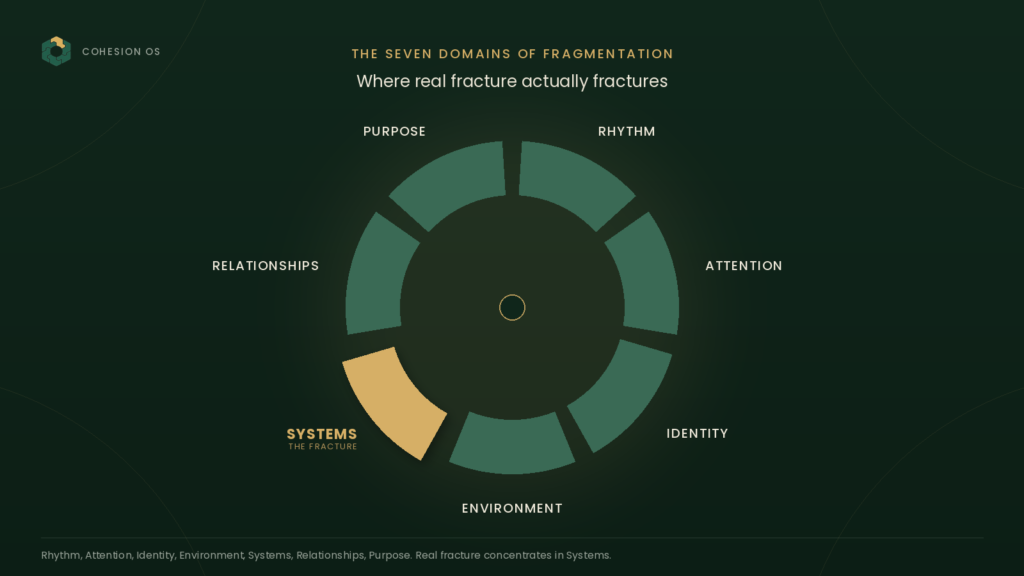
The ops-lead exits above look like a hiring problem or a management problem. They are a Systems fracture: decision authority was never documented, so every hire inherits the same unanswerable question of what they are actually allowed to decide, and eventually leaves rather than keep guessing. The stalled sales deals look like a training problem. They are frequently an Identity fracture upstream, where the founder has never resolved what the company actually stands for at the point of objection, so the sales team has nothing firm to hold when a prospect pushes back.
This is the diagnostic discipline: treat the visible symptom as a pointer, not a destination. Ask where the pattern actually originates before you spend a single pound correcting where it shows up. A protected block is not protected if the team still treats it as available time, and a hiring plan is not a fix if the role keeps breaking for the same reason regardless of who fills it.
3-Minute Diagnostic
Which of the seven domains is actually costing you the most?
Why Founders Stay Stuck Fixing the Wrong Thing
The loop is self-reinforcing. A visible problem appears. Pressure to act rises immediately, because a founder doing nothing while something breaks feels like negligence. The fastest available action gets taken: hire, tool, process, meeting. The visible problem quiets down for a few weeks, which reads as evidence the fix worked. The underlying fracture, untouched, produces a new visible problem in a different shape a quarter later. Nobody connects incident three to incident one, because they look nothing alike on the surface.
This repeats because speed is mistaken for correctness. A fast response feels responsible. It is not the same thing as an accurate one, and founders rarely have the fifteen minutes of stillness required to tell the difference before they act.
What Changes When You Diagnose the Real Fracture First?
- Recurring problems stop recurring in new disguises, because the actual source gets addressed once
- Fixes get cheaper, because you stop paying for hires, tools, and process that treat symptoms
- Pattern recognition improves across the team, because incidents get labelled by domain instead of by department
- Founders spend correction effort once per fracture instead of once per incident
- The gap between “we fixed it” and “it happened again” widens from months to something closer to never
Nothing here promises a company that never has problems. It promises that the same problem stops costing you twice.
Founder Field Note
One founder came in believing he had a retention problem. Three operations hires in fourteen months, each leaving within the first two quarters, each citing some version of “unclear expectations” on the way out.
The real issue was not the hires. It was that no one, including the founder, could say in one sentence what an operations lead in this company was actually authorised to decide without checking. Each new hire spent their first ninety days discovering the boundary by hitting it, then spent the following months either overstepping and getting corrected in front of the team, or under-stepping and getting quietly resented for being too cautious. Either path ended the same way.
The first correction was not a better hiring process or a more thorough onboarding deck. It was a single written page defining the decision authority of the role, reviewed with the founder before the next candidate ever started. This pattern repeats because founders diagnose people problems where the actual gap is structural, and no amount of better people fixes a role that was never actually defined.
Common Mistakes When Diagnosing a Recurring Problem
- Treating each incident as isolated. Three related failures get filed as three unrelated ones because they look different on the surface.
- Hiring your way out of a structural gap. A new person inherits the same undefined system the last person left.
- Adding process before asking why the process was missing. A new checklist without a diagnosis just adds a step the fracture will eventually route around.
- Confusing quiet with solved. A visible problem going quiet for a few weeks is not evidence the fracture closed.
- Skipping the domain question entirely. Jumping straight to a fix without first asking which of the seven domains is actually generating the pattern.
- Assuming the fracture sits where the symptom appears. The department that feels the pain is rarely the department where the fracture originates.
How to Start Diagnosing the Real Fracture
- Write down the last three occurrences of this problem, however different they looked. Same client type, same role, same stage of a process. Look for the constant, not the surface details.
- Ask what stayed the same across all three. Not the people, not the department. The actual mechanism that failed each time.
- Map that mechanism to a domain. Rhythm, Attention, Identity, Environment, Systems, Relationships, or Purpose. Most recurring problems sit clearly in one once you look for the constant.
- Correct at the domain level, not the incident level. One written rule, one clarified decision, one defined boundary, not a new hire or a new tool.
- Watch the next occurrence before declaring it fixed. If the same shape returns, the diagnosis was wrong, not the correction.
Do not try to fix the entire business at once. Start where the fracture is loudest.
FAQ
How do I know if I am fixing a symptom instead of the real fracture?
Check whether the same problem has returned in a different form within the last six to twelve months. A genuine fix removes the mechanism producing the problem. A symptom fix removes the current instance and leaves the mechanism intact, which means it produces another instance eventually, usually somewhere that looks unrelated at first glance.
Why does the real fracture rarely sit where the symptom shows up?
Because the domain that fails first is not always the domain under strain. A Systems gap in decision authority routinely shows up as a Relationships problem, staff who seem disengaged or who leave. An Identity gap in what the company stands for routinely shows up as a sales or marketing problem. The symptom travels; the fracture stays put.
Do I need the Founder Cohesion Assessment even if I already think I know the problem?
Especially then. The instinct to name the problem quickly is exactly the instinct that produces symptom-fixes. A short diagnostic pass costs less time than one more hire or tool aimed at the wrong layer, and it tells you whether your instinct was right before you spend against it.
Can more than one domain be involved in the same recurring problem?
Yes, though there is usually one primary fracture generating the pattern and one or two domains absorbing the strain downstream. Correct the primary fracture first. The downstream strain tends to ease once the source is addressed, rather than needing a separate fix of its own.
Next Step
If this sounds familiar, do not add another system yet. First, identify where the fracture is actually happening. Take the Founder Cohesion Assessment to see which of the seven domains is creating the most fragmentation in your company and what to correct first.
The problem is not that you keep failing to fix things. It is that you keep fixing the wrong thing correctly.
Dominik Boecker is the creator of Cohesion OS. He helps founder-led companies identify the fracture lines that create overload, dependency, and operational fragmentation, then install the systems that restore cohesion across rhythm, attention, identity, environment, systems, relationships, and purpose.