
Founder dependency is easiest to see by asking one honest question: if you disappeared for two weeks, no laptop, no phone, what would actually break. Most founders answer this quickly with a general sense of unease, then move on without writing down the specific list. The specific list is the diagnostic. It names, item by item, exactly where the business currently cannot run without you, and every item on it points to a domain that has never been handed off in a form anyone else could operate.
Key Takeaways
- The two-week test surfaces founder dependency more precisely than any general sense of being “too involved”
- What breaks is rarely random. It clusters around a small number of undocumented decisions or relationships
- A vague answer to the question is itself informative: it means the dependency has never been mapped
- Fixing founder dependency starts with the specific list, not a general delegation push
- Each item on the list belongs to one of the seven domains, which tells you what kind of fix it actually needs
What Does Founder Dependency Actually Look Like?
Try answering the question properly, not the reassuring version. Not “the team would manage,” but the specific, concrete list: which client would have no one to call, which decision would sit unmade, which relationship would go quiet, which number nobody else knows how to check.
For most founders, the honest list is longer and more specific than the comfortable answer they gave first. A handful of clients who only ever speak to you. A pricing exception process that lives entirely in your judgement. A supplier relationship where you are the only contact. A go/no-go call on new work that nobody else has ever been asked to make.
This is founder dependency made concrete. Not a personality trait or a control issue, but a specific, nameable list of places where the business currently has no path forward without you personally. The list is almost always shorter and more specific than “everything,” which is why the exercise is worth doing properly rather than answering it in your head.
Why Doesn’t “Just Delegate More” Fix This?
The standard advice, once a founder identifies this dependency, is to delegate the items on the list. Hand the client relationships to account managers. Give the pricing exceptions to sales leadership. Let ops own the supplier contact.
This partially works and partially fails, for a specific reason.
Delegating the task without delegating the decision recreates the dependency one level down. An account manager taking over a client relationship inherits the relationship. They do not automatically inherit the judgement behind decisions you made in that relationship, because that judgement was never written down anywhere they can reference it. The dependency does not disappear. It moves to whoever now has to keep checking with you.
Some items on the list are not delegation problems at all. A supplier relationship that only exists because of years of personal trust is not fixed by introducing a new contact and hoping the relationship transfers. Some dependency is genuinely relational, not procedural, and needs a different kind of fix than a handoff document.
The list mixes several different domains, and one fix does not suit all of them. A pricing exception process is a Systems gap. A client who only trusts you is a Relationships gap. A go/no-go call nobody else has been trained to make might be an Identity gap, an unclear sense of what the company actually says yes and no to. Treating the whole list with the same generic “delegate it” instruction ignores that each item needs a different correction.
Delegation is part of the fix for some of the list. It is the wrong fix for the rest of it.
The Hidden Mechanism Behind What Breaks When You Are Gone
The two-week test works because absence removes the thing that has been quietly compensating for every undocumented gap in the business: you, personally, filling in wherever something was never actually built to run independently.
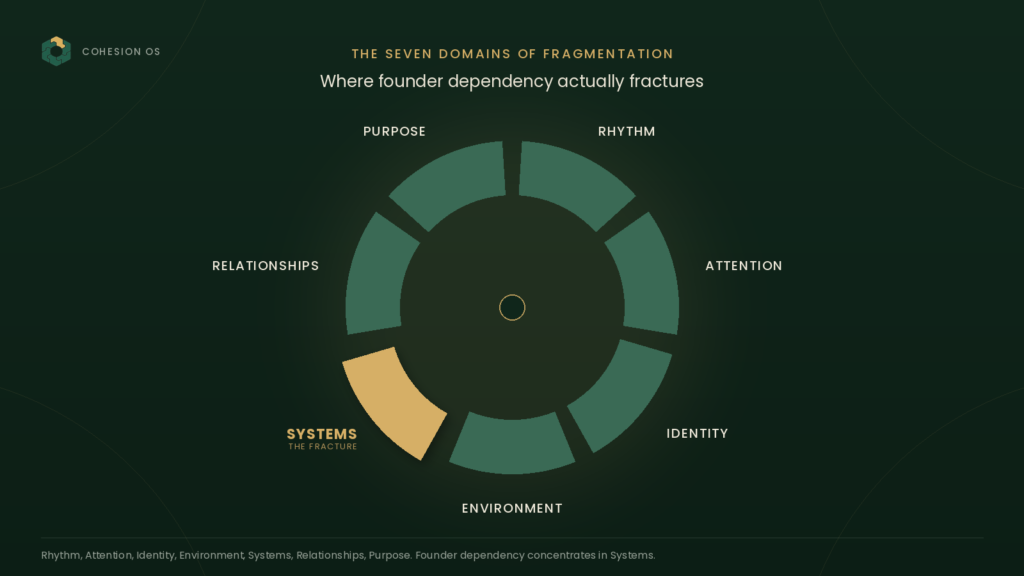
Each item on your honest list maps to one of the seven domains. A decision nobody else can make is Systems. A relationship that only holds through you is Relationships. A standard that only you seem to hold the line on is Identity. A rhythm that collapses without your presence, meetings that only happen because you chase them, is Rhythm. The two-week test is not really asking what would break. It is asking which domains have been running on your personal presence instead of on something structural, and the answer, item by item, tells you exactly where to start.
This is why a generic delegation initiative underperforms a properly diagnosed list. Delegation initiatives tend to target visible workload. The two-week test targets structural absence, the places where nothing exists yet for someone else to pick up, which is a more precise and more useful map of where founder dependency actually lives.
3-Minute Diagnostic
Which of the seven domains is actually costing you the most?
Why Founders Avoid Running This Test Honestly
The pattern holds because a vague answer feels safer than a specific one. “The team would manage” requires no further action. A specific list of five things that would genuinely break requires acknowledging, in writing, exactly how much currently depends on you, which can feel uncomfortable even when nobody else ever sees the list.
There is also a genuine blind spot. Some of what would break is invisible to the founder precisely because it has never failed. The client who has never once needed anyone but you has never demonstrated the dependency, so it does not register as a risk the way an obvious bottleneck does. The test only works if it is answered with real specificity, including the items that feel too routine or too minor to count.
What Changes When You Fix the Actual List, Not a Vague Sense of Overinvolvement?
- Each dependency gets the correction it actually needs, not a generic delegation instruction applied to everything equally
- The business becomes genuinely less fragile to founder absence, not just less busy for the founder day to day
- Founders stop conflating “I am very involved” with “the business depends on me specifically,” which are different problems
- The next honest answer to the two-week test gets visibly shorter over time, which is a real, trackable measure of progress
- Correction effort goes toward the domains actually generating dependency, not toward whichever task feels most urgent this week
None of this eliminates the founder’s role or makes the business founder-independent overnight. It means the dependency that remains is a deliberate choice, not an unexamined default.
This tension is well documented outside the founder-fragmentation lens too. A Forbes Business Council contributor has observed that as businesses grow, many founders become trapped by the very companies they built, indispensable to the point that the business cannot outgrow their personal capacity, which caps both earnings potential and the eventual sale value of the company (Forbes Business Council, 2024). The two-week test is simply a way of finding that ceiling before it finds you.
Founder Field Note
One founder ran this exercise expecting a short list, mostly around a couple of key client relationships he already knew about. The honest version, written out properly rather than answered from memory, ran to nine items. Three were client relationships. Two were pricing and scoping decisions that had never been written down as a rule. One was a supplier relationship built entirely on a personal friendship. Three were internal: decisions his own leadership team still routed to him out of habit rather than necessity.
The client relationships and the supplier friendship were genuinely relational and needed a different kind of correction, structured introductions over several months, not a handoff memo. Pricing and scoping were Systems gaps, fixed within two weeks once written down as explicit rules. The three internal habits were the easiest and fastest: a short message to his leadership team stating plainly that three named decisions no longer needed his sign-off closed that part of the list almost immediately.
Nine items sorted into three different kinds of fixes, each moving at its own pace. Treating all nine as the same delegation problem would have meant applying the wrong solution to at least six of them.
Common Mistakes When Assessing Founder Dependency
- Answering the question in your head instead of writing the list out properly. A mental answer is almost always vaguer and shorter than the real one.
- Treating every item on the list as a delegation problem. Some items are relational or structural gaps that a handoff memo will not fix.
- Only counting the obvious bottlenecks. The items that have never failed yet are often invisible precisely because they have never been tested.
- Fixing the list without sorting items by domain first. A Systems fix and a Relationships fix look nothing alike, and using one for the other wastes effort.
- Doing the exercise once and considering it finished. The list changes as the business grows; it is worth rerunning periodically, not treating as a one-time audit.
- Feeling discouraged by a long list instead of treating it as useful data. A longer list is more informative, not more damning.
How to Start Running the Two-Week Test Properly
- Write the answer down, in full, as if you were actually about to disappear. Not a summary. The specific list, however long it turns out to be.
- Sort each item by what kind of gap it actually is. A missing decision, a personal relationship, an unclear standard, a rhythm that depends on your presence.
- Group items by domain. Systems, Relationships, Identity, Rhythm, and so on, using the sort from the previous step.
- Correct each domain with the fix that actually suits it. A written rule for Systems gaps, a structured introduction for Relationships gaps, a stated standard for Identity gaps.
- Rerun the test in three to six months. A genuinely shorter, more specific list is the clearest evidence the corrections held.
Do not try to fix all nine, or however many, items in the same week. Sort first, then work through them in the order that reduces the most risk fastest.
FAQ
Isn’t some founder dependency inevitable, especially at an early stage?
Yes. The goal of this exercise is not zero dependency, which is unrealistic and often undesirable at smaller scale. It is making the dependency deliberate rather than accidental, so you know exactly what remains and why, instead of discovering it under pressure during an actual absence.
What if my honest answer to the two-week test is genuinely almost everything?
That is common and is itself useful information rather than a reason to abandon the exercise. Start with the three or four items causing the most immediate risk or stress, sort them by domain, and correct those first. The list does not need to be addressed all at once to be worth having.
How is this different from a general succession or business continuity plan?
A continuity plan usually answers “who takes over if something happens to the founder long-term.” The two-week test is narrower and more diagnostic: it surfaces the specific, current gaps in the business that founder presence is quietly covering for, right now, which is useful even for founders with no succession plans at all.
Can the Founder Cohesion Assessment help me sort my two-week test list by domain?
Yes. The Assessment is built to identify which of the seven domains is generating the most fragmentation in your company right now, which is the same sorting exercise the two-week test requires, applied systematically rather than item by item on your own.
Next Step
If this sounds familiar, do not add another system yet. First, identify where the fracture is actually happening. Take the Founder Cohesion Assessment to see which of the seven domains is creating the most fragmentation in your company and what to correct first.
The list of what would break is not a verdict on you. It is the most honest map of where to correct next.
3-Minute Diagnostic
Which of the seven domains is actually costing you the most?
Dominik Boecker is the creator of Cohesion OS. He helps founder-led companies identify the fracture lines that create overload, dependency, and operational fragmentation, then install the systems that restore cohesion across rhythm, attention, identity, environment, systems, relationships, and purpose.