
Fast Answer
AI didn’t cause the fracture in your business, it just made it impossible to keep ignoring. When a founder rolls out AI tools and the result is chaos, half-finished workflows, and confused teams, the instinct is to blame the tool. The real cause is almost always an operating condition that already existed: unclear ownership, undocumented process, inconsistent judgment. AI doesn’t create dysfunction. It runs faster than dysfunction can hide.
Key Takeaways
- AI adoption failures are usually operational fragmentation that finally has a fast enough process to become visible
- A tool that multiplies your current operating condition will multiply chaos just as efficiently as it multiplies output
- “The AI isn’t working” is frequently a mistranslation of “the process the AI was given was never actually defined”
- Slowing down AI rollout doesn’t fix this. Neither does buying a better tool
- The correction is diagnosing and fixing the underlying process before automating it, not after
- Founders who get this right don’t automate less. They automate on top of a foundation solid enough to hold the speed
3-Minute Diagnostic
Which of the six domains is actually costing you the most?
What Does “AI Didn’t Cause the Fracture” Actually Mean?
Almost every founder who rolls out AI tools hits the same wall. The chatbot gives inconsistent answers. The automation breaks on edge cases nobody accounted for. The team starts using it in three different, conflicting ways. The founder’s conclusion is usually “AI isn’t ready for us” or “we picked the wrong tool.”
Neither is usually true. What actually happened is that AI was handed a process that only ever worked because a person was quietly filling in the gaps, making judgment calls, and correcting mistakes nobody documented. AI doesn’t fill gaps. It executes exactly what it’s given, at speed, without the judgment a human was silently supplying. The fracture, unclear ownership, undocumented decisions, inconsistent standards, was already there. AI just removed the person who was compensating for it.
This is why the same rollout can look completely different in two businesses. In one, AI accelerates a process that was already clean, and the results are genuinely impressive. In another, AI accelerates a mess, and the mess just moves faster.
Cohesion OS treats this as operational fragmentation, the domain that routes into Founder AI OS. It’s rarely a technology problem being disguised as one.
Why Doesn’t a Better AI Tool Fix This?
The standard response to a failed AI rollout is to try a different tool, a better prompt, a more expensive platform, or a consultant who promises the “right” implementation. Founders cycle through two or three of these before the pattern repeats.
Here’s why it keeps repeating. A better tool is still just faster execution. If the underlying process is undocumented or inconsistent, a better tool executes that inconsistency more efficiently, it doesn’t resolve it. Swapping ChatGPT for a custom-built agent doesn’t define who owns a decision if nobody had defined that before. A sharper prompt doesn’t create a consistent judgment standard if three team members were applying three different standards to begin with.
This is the same trap as hiring to fix a capacity problem, or adding more meetings to fix a communication problem. It adds capability on top of a structure that was never actually built to hold it. The tool gets blamed because it’s the newest, most visible variable. The actual variable, the operating condition underneath, was there long before the AI arrived and stays exactly the same after you swap tools.
The Hidden Mechanism Behind “AI Exposes the Fracture”
There’s a specific mechanism at work, and it’s consistent across almost every founder-led business that hits this wall.
Humans quietly patch gaps that AI can’t see. In a manual process, a person notices when something looks off and adjusts. They fill in missing context from memory. AI doesn’t do this by default. It follows the process exactly as given, gaps included.
Speed removes the buffer that hid the fracture. A slow, manual process gives founders time to catch and correct inconsistencies before they compound. AI removes that buffer. Errors and unclear decisions that used to surface once a week now surface constantly, because the process runs constantly.
Scale multiplies whatever the process actually is. A good process multiplied by AI produces excellent results faster. A fragmented process multiplied by AI produces fragmented results faster. AI is not a corrective force, it’s an amplifier, and it amplifies whatever is actually there, not what founders assume is there.
The blame lands on the newest variable. When something breaks after an AI rollout, AI is the most recent change, so it gets the blame. The underlying process, which was fragile long before AI touched it, goes unexamined because it was “working fine” before, even though “working fine” often meant a person was manually absorbing the cost of its gaps.
Why Founders Stay Stuck in This Pattern
The loop looks like this: a founder adopts AI to move faster, the rollout exposes a process gap that was previously invisible, the founder blames the tool rather than the process, they swap tools or slow the rollout, and the same gap resurfaces the next time they try to scale anything, AI or otherwise. Nobody addresses the actual process, so the fracture just waits for the next accelerant to expose it again.
This is why “let’s pause AI until we’re ready” rarely solves anything either. Pausing doesn’t fix the process, it just removes the thing that was making the gap visible. The fracture is still there, quietly costing time and consistency, it’s just no longer showing up as an obvious, attributable failure.
What Changes When This Is Corrected?
When this fracture is corrected, AI adoption stops being a gamble. Founders diagnose the actual process first, who owns which decision, what the consistent standard is, where judgment is currently undocumented, and only then hand that process to AI. The results compound instead of compounding chaos. Teams trust the tools because the tools are finally executing something coherent.
This isn’t about becoming an AI-first company for its own sake. It’s about AI finally amplifying something worth amplifying.
Founder Field Note
One founder rolled out an AI-powered customer support tool expecting it to cut response times. Within two weeks, customers were getting contradictory answers to the same question, and the founder assumed the tool was fundamentally unreliable.
The real issue surfaced once the underlying support process was mapped: three team members had three different unwritten standards for handling the same type of request, and each had been quietly using their own judgment to smooth over the inconsistency for months. Nobody had noticed because the inconsistency moved slowly enough for humans to individually compensate for it.
The first correction wasn’t switching AI providers. It was writing down one consistent standard for that request type, agreed across the team, before touching the tool again. Once the AI was given a single coherent standard instead of three conflicting ones, the “reliability problem” disappeared.
This pattern repeats because AI failures look like technology failures from the outside. They’re almost always a process that was fragmented long before AI arrived to make that fragmentation visible.
Common Mistakes with AI Adoption and Fragmentation
- Blaming the tool before mapping the underlying process. The tool is usually innocent of the thing it’s being blamed for.
- Buying a “better” AI platform to fix inconsistent results. A better tool multiplies the same process faster, it doesn’t clean it up.
- Slowing down or pausing AI rollout instead of fixing the process. This hides the fracture again rather than correcting it.
- Assuming a good prompt can substitute for a defined process. A prompt can’t invent ownership or consistency that was never established.
- Rolling AI out to the whole team at once, on an undocumented process. This scales the inconsistency to everyone simultaneously instead of catching it early with one user.
- Treating this as a one-time fix. As the business changes, processes drift again. AI will keep exposing whatever drifts, that’s a feature of the diagnostic, not a flaw to eliminate.
How to Start Correcting This
- Pick the process where AI adoption felt the most chaotic. That’s your clearest signal of an existing fracture, not a random starting point.
- Map how that process actually runs today, not how it’s supposed to run. Include every quiet judgment call a person currently makes without anyone noticing.
- Find where the standard is inconsistent across people. This is almost always where “AI unreliability” is actually coming from.
- Write down one single standard, agreed by whoever owns the process. Not a long document, a clear, specific rule for the most common decision points.
- Re-run AI against the corrected process before touching anything else. Compare the result to before. The difference is usually immediate.
Do not try to fix the entire business at once. Start where the fracture is loudest.
FAQ
Does this mean AI tools are never actually the problem?
Not always, some tools genuinely are unreliable or poorly suited to a task. But before blaming the tool, rule out the far more common cause: a process that was already inconsistent before AI touched it. Most “bad tool” complaints resolve once the underlying process is fixed.
How do I know if my AI rollout problem is a tool issue or a process issue?
Test the same request with two different team members using the current process, manually, no AI involved. If you get two different answers, that’s a process fracture. AI didn’t create the inconsistency, it just stopped hiding it.
Should I pause AI adoption until my processes are perfect?
No. Perfect isn’t the bar, and waiting for it delays the diagnostic value AI is actually giving you for free. Fix the specific process that’s causing the most visible chaos first, then continue rolling out.
Isn’t this just an argument for hiring an AI consultant?
Not necessarily. Most AI consultants focus on tool selection and prompt engineering, not on diagnosing the operational fracture underneath. The correction here is structural, not technical, and it’s usually something the founder or ops lead can map directly.
3-Minute Diagnostic
Which of the six domains is actually costing you the most?
Next Step
If this sounds familiar, do not add another system yet. First, identify where the fracture is actually happening. Take the Founder Cohesion Assessment to see which domain is creating the most fragmentation and what to correct first.
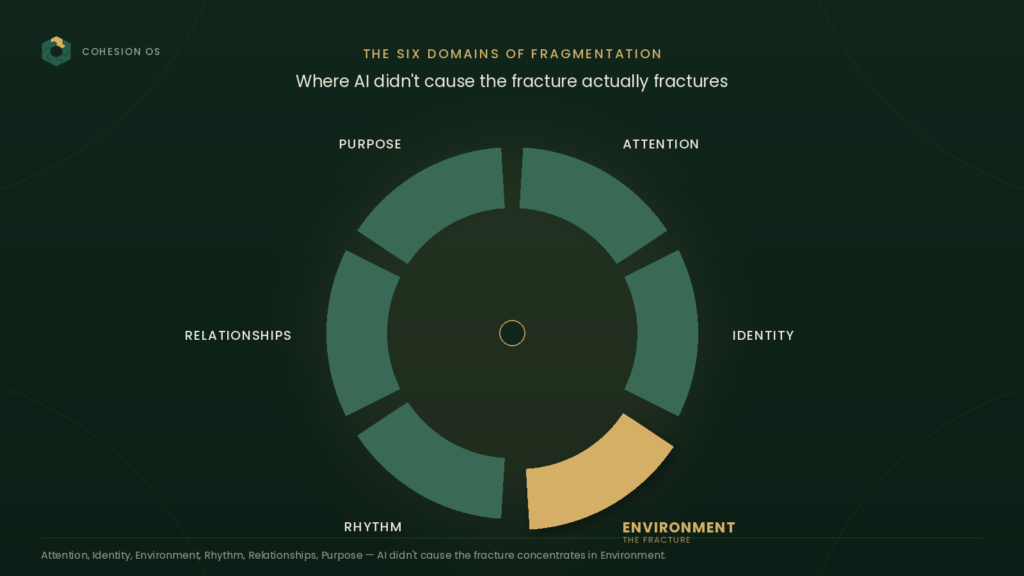
Dominik Boecker is the creator of Cohesion OS. He helps founder-led companies identify the fracture lines that create overload, dependency, and operational fragmentation, then install the systems that restore cohesion across attention, identity, environment, rhythm, relationships, and purpose.