
Fast Answer
Nothing ships without you because approval, not capability, is the real bottleneck. Your team can usually design, build, and execute the work fine on their own. What they can’t do is release it, because release has been quietly wired to require your sign-off, regardless of whether the decision actually needs your judgment. The fix isn’t a more capable team. It’s removing yourself as the mandatory final step.
Key Takeaways
- If nothing ships without you, the constraint is almost never team competence, it’s an approval structure built around your presence
- Approval bottlenecks form invisibly, one “just run it by me first” at a time, until every release routes through you by default
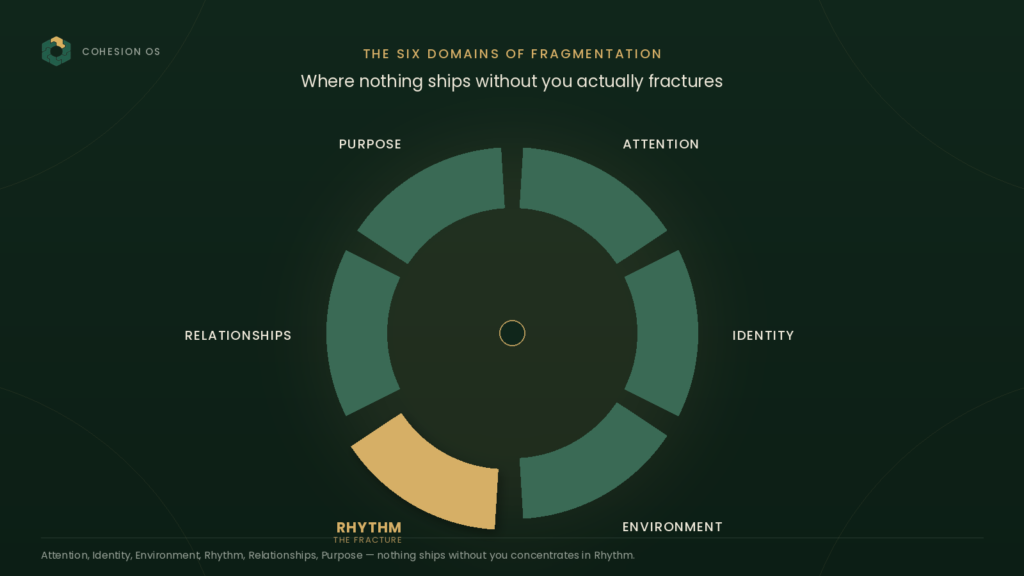
- This is a rhythm fracture: the business can’t establish its own cadence because every cadence currently waits on yours
- Removing yourself as the bottleneck isn’t about trusting the team more emotionally, it’s about defining decision boundaries structurally
- The fix is naming which decisions genuinely require founder sign-off and which don’t, then formally releasing the rest
- Founders who fix this don’t lose control of quality. They gain a business that ships on its own rhythm instead of waiting on theirs
3-Minute Diagnostic
Which of the six domains is actually costing you the most?
What Does “Nothing Ships Without You” Actually Mean?
It’s the pattern where work gets finished and then sits, waiting. The design is done. The proposal is written. The feature is built and tested. And it stalls, not because anything’s wrong with it, but because it’s waiting for you to look at it, approve it, or say the word.
Founders usually read this as a quality control issue: “I need to check it because things go wrong when I don’t.” Sometimes that’s briefly true, early on. But in most businesses running this pattern, the team is fully capable of shipping correct work without you. The actual constraint isn’t their ability. It’s that the release step has been built to require you, regardless of whether your judgment is genuinely needed for that specific decision.
This shows up as delay that’s hard to pin on anyone. Nobody’s working slowly. The work just can’t move past a single gate, and that gate is you.
Cohesion OS treats this as a rhythm fracture. The business can’t establish its own operating cadence, because every cadence currently defers to yours. It’s a structural problem, not a trust problem, and it doesn’t resolve by trying to relax and trust the team more.
Why Doesn’t Trusting Your Team More Fix This?
The common advice is to loosen the grip: trust your team, stop micromanaging, let go a little. Founders try this, genuinely mean it, and the bottleneck barely moves.
Here’s why. Trust is an internal, emotional shift. The approval bottleneck is a structural one. Even a founder who fully trusts their team will still get pinged for sign-off if “get founder approval” is still, formally or informally, a required step in the process. The team isn’t routing decisions to you because they doubt themselves, they’re routing decisions to you because that’s what the process, spoken or unspoken, tells them to do.
Trying to fix a structural gate with an emotional shift doesn’t remove the gate. You can feel completely at ease letting your ops lead ship a client proposal, and it will still land in your inbox for approval anyway, because nobody has actually changed who owns that decision. “I trust my team” and “my team is formally authorised to ship this without me” are two different facts, and only the second one changes what happens on a Tuesday afternoon when something’s ready to go.
The Hidden Mechanism Behind “You Are the Bottleneck”
The approval bottleneck doesn’t get built deliberately. It accumulates through a specific, quiet mechanism.
Early caution becomes permanent policy. In the early days, checking everything made sense, stakes were high and the team was new. That caution never gets formally revisited as the team matures, so “check with me first” just stays the default long after it stopped being necessary.
One bad outcome hardens the gate. A single mistake that slipped through, even a minor one, often triggers a permanent new rule: “run it by me first from now on.” The rule rarely gets re-evaluated once the team has clearly demonstrated it can avoid that mistake going forward.
The team stops proposing ownership because it’s never been offered. Once a gate exists, most team members won’t ask to remove it themselves, that reads as overstepping. The gate persists by default, not because anyone actively wants it there.
Founder identity gets tied to being the final check. Being the person everyone waits on can start to feel like proof of your importance to the business. Removing the gate can unconsciously feel like a loss of relevance, which makes founders slower to dismantle bottlenecks even once they intellectually recognise them.
Why Founders Stay Stuck in This Pattern
The loop looks like this: work piles up waiting on your approval, so you feel pressure to respond faster, which trains the team to send you even more things for sign-off since you’re clearly responsive. The volume of approvals grows, you become more of a bottleneck, not less, and the delay gets blamed on being “too busy” rather than on the structure that’s routing everything through you in the first place. Nobody steps back to ask why the gate exists at all, because everyone, including the founder, is too busy operating inside it.
This is why “I just need to respond to approvals faster” doesn’t fix anything. Faster responses just make the bottleneck more efficient, they don’t remove it. The team still can’t ship without you, they just wait a slightly shorter time before they can.
What Changes When This Is Corrected?
When this fracture is corrected, most work ships without ever touching your inbox. The team knows exactly which categories of decisions are theirs to make and ship, and which small, well-defined set genuinely needs you. Release cadence becomes the team’s own, not a queue that depends on your calendar. You still see the decisions that actually matter, direction, risk, capital, but you stop being the default checkpoint for everything in between.
This isn’t about stepping back from quality. It’s about quality no longer depending on your personal presence in every release.
Founder Field Note
One founder described his team as “great, but slow to ship.” Deadlines kept slipping even though the work itself was consistently solid. His first instinct was to hire a project manager to speed things up.
The real issue was visible in one week of tracking: every single release, big or small, was waiting in his inbox for a “looks good, go ahead.” Some of those approvals took him ninety seconds. Some sat for four days because he was traveling. The team wasn’t slow. The approval gate was the entire bottleneck.
The first correction wasn’t a project manager. It was sorting the last twenty releases into two categories: ones that genuinely needed his judgment, and ones that clearly didn’t. The second category was the overwhelming majority. He formally handed ownership of that category to the team, in writing, with explicit permission to ship without him.
Within three weeks, release cadence roughly doubled, without adding a single person.
This pattern repeats because approval feels like diligence while it’s happening. It’s only visible as the actual constraint once you track how much is genuinely waiting on your judgment versus simply waiting on you.
Common Mistakes with This Pattern
- Assuming the fix is a faster or more responsive you. Speed doesn’t remove a bottleneck, it just makes the same bottleneck slightly less painful.
- Trying to solve it purely through “trusting your team more.” Trust is emotional. The gate is structural. Only removing the gate removes the delay.
- Hiring a coordinator or project manager to chase approvals faster. This adds a layer to manage the bottleneck instead of removing it.
- Removing the gate without defining what the team is now authorised to decide. Silence creates confusion, not autonomy. Be explicit about what’s theirs now.
- Only revisiting this after a major failure. Most founders wait for a crisis to reconsider the gate. It’s cheaper to review it proactively.
- Keeping some approval categories vague “just in case.” Vague boundaries default back to the founder every time. Specificity is what actually releases the bottleneck.
How to Start Correcting This
- Track every approval request for one week. Note what it was, how long it sat, and how much judgment it actually required from you.
- Sort them into two piles: genuinely needed your judgment, and didn’t. Be honest. Most founders are surprised by how small the first pile is.
- For the pile that didn’t need you, name who owns that category now, in writing. Verbal permission gets forgotten. Written ownership doesn’t.
- Tell the team explicitly what’s changing and why. “You no longer need my sign-off on X, it’s yours to ship” removes ambiguity about whether the change is real.
- Track release cadence for the following month. If it hasn’t improved, the gate wasn’t fully removed, go back and check where approval is still quietly required.
Do not try to fix the entire business at once. Start where the fracture is loudest.
FAQ
Doesn’t removing approval gates risk quality dropping?
Rarely, if the split is done honestly. Most approval requests founders receive don’t actually require their specific judgment, they require someone’s judgment, and the team is usually capable of providing it. Quality risk comes from removing gates carelessly, not from removing them at all.
How do I know which decisions genuinely need me versus which just default to me?
Ask whether the decision involves risk, direction, or capital that only you’re positioned to weigh. If the answer is no, and it’s mostly execution quality the team can already judge, it likely doesn’t need you.
What if my team doesn’t want the extra ownership?
That’s worth investigating directly rather than assuming. Sometimes it’s a skills gap that needs closing first. More often, it’s because ownership has never actually been offered clearly before, and hesitation fades once the boundary is explicit.
Is this the same as founder availability or is it a different problem?
Related but distinct. Founder availability is about being constantly reachable for questions. This is specifically about release authority, work being finished and correct, but structurally unable to ship without your sign-off.
3-Minute Diagnostic
Which of the six domains is actually costing you the most?
Next Step
If this sounds familiar, do not add another system yet. First, identify where the fracture is actually happening. Take the Founder Cohesion Assessment to see which domain is creating the most fragmentation and what to correct first.
Dominik Boecker is the creator of Cohesion OS. He helps founder-led companies identify the fracture lines that create overload, dependency, and operational fragmentation, then install the systems that restore cohesion across attention, identity, environment, rhythm, relationships, and purpose.