
Fast Answer
What looks like founder burnout is often something more specific: identity loss. Somewhere along the way, “who I am” and “what my company does” merged into one thing, and the founder stopped being able to tell where the role ends and the person begins. The fatigue that follows isn’t fixed by rest. It’s fixed by rebuilding a self that exists independently of the business.
Key Takeaways
- Founder identity crisis is frequently misdiagnosed as burnout, because the symptoms overlap but the mechanism is different
- Burnout responds to rest. Identity fusion doesn’t, because the exhaustion isn’t from overwork, it’s from having no separate self to rest into
- The fusion happens gradually: every early win reinforces “I am the company,” until the two become indistinguishable
- A threat to the business starts to feel like a threat to the founder’s own existence, which explains the disproportionate panic around setbacks
- Correcting this isn’t about “finding balance.” It’s about deliberately rebuilding parts of identity that don’t depend on company performance
- Founders who correct this don’t become less committed. They become more stable, because their sense of self stops swinging with quarterly results
3-Minute Diagnostic
Which of the six domains is actually costing you the most?
What Is a Founder Identity Crisis?
A founder identity crisis is what happens when a founder’s sense of self becomes fused with their company’s performance. It’s not vanity or ego. It’s a slower, quieter process where the answer to “who am I” gradually narrows down to “the person who built this.”
It shows up in small ways first. You stop introducing yourself by name and start introducing yourself by company. A bad month doesn’t just feel financially stressful, it feels personally destabilising, like something is wrong with you rather than with a line on a spreadsheet. You can’t enjoy time off because some part of you believes that stepping back means you’re not really the person you’ve built your identity around being.
The visible symptom looks like burnout: exhaustion, low motivation, dread around checking the numbers. But burnout is a response to overwork. What’s happening here is different. There’s no separate self left to retreat to when things get hard, because the self and the business have merged.
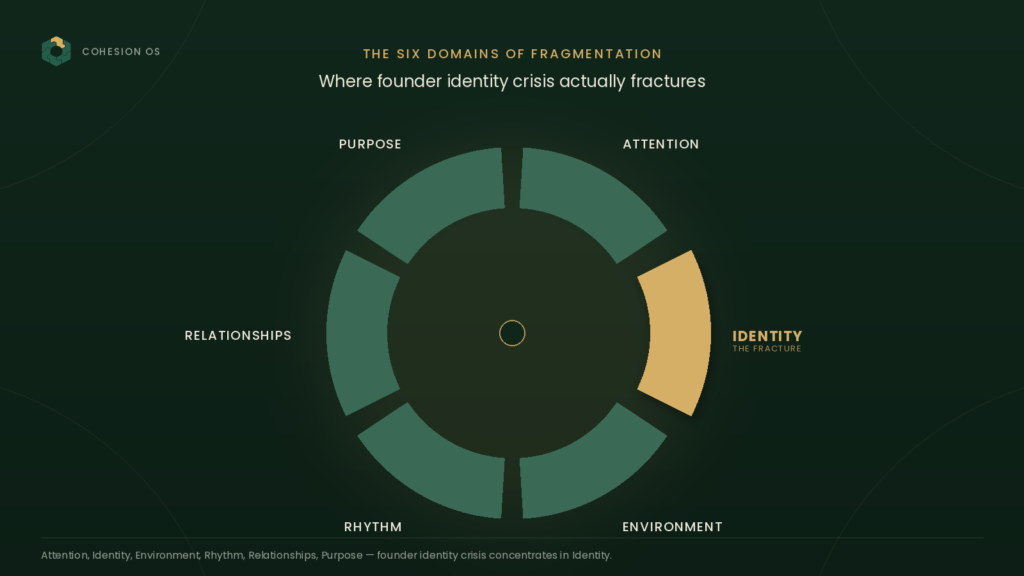
Cohesion OS treats this as an identity fracture. It’s one of the four domains that route into Core OS, alongside purpose, relationships, and structural environment, because it’s a psychological fracture, not an operational one. No calendar change or delegation fixes it.
Why Doesn’t Rest Fix a Founder Identity Crisis?
The standard advice is to take a break. Go on holiday. Delegate more. Get a coach who tells you to “set boundaries.” Founders try this, often more than once, and come back just as fused as before.
Here’s why. Rest works when exhaustion comes from overwork; you deplete a resource, then you refill it. But identity fusion isn’t a depleted resource. It’s a structural condition: your sense of self has no independent footing outside the company. A holiday doesn’t change that. You come back from two weeks away, the business is still the only place your identity lives, and within days you’re right back where you started, often more anxious, because now you’ve also proven to yourself that stepping away doesn’t help.
Delegation has the same problem from a different angle. Founders are often told to hand off tasks to free up headspace. But if your identity is fused to being the person who holds it all together, delegating a task can feel like losing a piece of yourself, not gaining time. That’s why so many founders sabotage their own delegation efforts without meaning to. It’s not a trust issue with the team. It’s an identity issue with the founder.
Rest and delegation are useful tools. They’re just aimed at the wrong layer of the problem.
The Hidden Mechanism Behind Founder Identity Crisis
The fusion doesn’t happen in one dramatic moment. It builds gradually, through a specific mechanism.
Early wins get personalised. In the early days, the business genuinely is an extension of the founder’s judgment, effort, and taste. Every win reinforces the belief “this works because of me,” which is often true at that stage. The problem is the belief doesn’t get revised as the company grows and other people’s contributions start mattering more.
Identity fills the vacuum where structure should be. Without clear systems, rhythms, or defined roles, the founder becomes the operating system by default. Their judgment, mood, and presence hold the business together. Over time, “I am necessary” quietly becomes “I am the business,” and the line between the two disappears.
External validation gets routed entirely through the company. Revenue, press, growth, and investor interest become the primary, sometimes only, source of the founder’s sense of worth. Nothing outside the business generates that same signal anymore, because nothing outside the business has been maintained.
Threats to the business register as threats to the self. Once fusion sets in, a lost client or a bad quarter doesn’t just cost money. It threatens the identity the founder has built everything around, which is why the emotional reaction is often wildly disproportionate to the actual business impact.
Why Founders Stay Stuck in This Pattern
The loop looks like this: the business does well, so the founder’s identity becomes more tied to it. Being tied to it makes a downturn feel more threatening, so the founder works harder to protect the identity, not just the business. Working harder leaves no time to build anything outside the company that could anchor identity elsewhere. With nothing else to anchor to, the next win or loss lands even harder on the founder’s sense of self. Nobody names the pattern, because from the outside it just looks like dedication.
This is why “just take some time for yourself” rarely lands. It’s advice aimed at a person with a self to return to. For a founder deep in this fusion, there’s no separate self waiting on the other side of a long weekend. The correction has to build that separate identity deliberately, not assume it’s already there waiting to be rediscovered.
What Changes When This Is Corrected?
When this fracture is corrected, the founder still cares deeply about the business, that doesn’t go away and shouldn’t. What changes is that a bad quarter becomes a business problem to solve, not an existential threat to survive. The founder has other sources of identity and worth, a role outside the company, relationships, interests, a sense of who they are that doesn’t move when revenue does, so setbacks get processed with more clarity and less panic.
This isn’t about caring less. It’s about your sense of self no longer being the thing absorbing every shock the business takes.
Founder Field Note
One founder came in describing textbook burnout: exhausted, dreading Mondays, unable to switch off. He assumed the fix was fewer hours and a proper holiday.
The real issue surfaced in one question: “if the company failed tomorrow, who would you be?” He couldn’t answer it. Nothing came to mind that wasn’t the company. That was the actual fracture, not overwork, identity fusion.
The first correction wasn’t a lighter schedule. It was rebuilding one thing outside the business that had nothing to do with its performance, in his case, a weekly commitment that existed regardless of how the company was doing that month. Small, deliberately unrelated to output or growth.
Within two months he described handling a client loss that would previously have derailed his week as “annoying, but fine.” Not because the loss mattered less. Because his identity no longer moved when it happened.
This pattern repeats because identity fusion feels like commitment while it’s happening. It’s only visible as a cost once you notice how much of your emotional state is being set by numbers you don’t fully control.
Common Mistakes with Founder Identity Crisis
- Treating it as a burnout problem and prescribing rest. Rest doesn’t touch a structural identity fracture.
- Assuming caring less about the business is the goal. It isn’t. The goal is having a self that doesn’t collapse when the business struggles, not caring less about the business itself.
- Waiting for success to fix it. More wins usually deepen the fusion rather than resolve it, since each one reinforces the same pattern.
- Trying to build outside identity through more work-related achievement. A second business or a bigger title doesn’t create separation, it just widens the fusion.
- Doing this quietly, alone, without naming it to anyone. Identity fusion is hard to see from inside it. Naming it out loud to a partner, coach, or peer is often the first real diagnostic step.
- Expecting a fast fix. This fracture built over years. It corrects in months, not days, and expecting otherwise sets founders up to give up early.
How to Start Correcting a Founder Identity Crisis
- Ask yourself the field-note question directly. If the company failed tomorrow, who would you be? Write down what comes, and what doesn’t.
- Identify one thing outside the business that isn’t currently being maintained. A relationship, an interest, a physical practice, anything that used to exist independently of company performance.
- Rebuild that one thing on a fixed, non-negotiable cadence. Weekly, not “when I have time.” If it’s optional, it will lose to the business every time.
- Notice when a business event triggers a disproportionate personal reaction. That gap between the actual event and your emotional response is where the fusion is showing itself.
- Track your sense of self across a rough month and a good month. If it swings wildly with performance, the fracture is still active. If it holds steadier, the correction is working.
Do not try to fix the entire business at once. Start where the fracture is loudest.
FAQ
Is a founder identity crisis the same thing as burnout?
No, though they’re often confused. Burnout is exhaustion from overwork and responds to rest. A founder identity crisis is a fusion between self-worth and company performance, and it persists even after rest because the underlying structure hasn’t changed.
How do I know if this applies to me versus normal founder stress?
A useful test is the field-note question: if the company failed tomorrow, who would you be? If the honest answer is “I don’t know” or “nothing,” that’s a strong signal of identity fusion rather than ordinary stress.
Won’t caring less about my identity mean I care less about the business?
No. Founders who correct this fracture typically make sharper decisions, not weaker ones, because they’re no longer making calls from a place of existential panic. Separation from identity doesn’t mean separation from commitment.
Can this be fixed while the business is still demanding, or do I need to step back first?
It has to be fixed while things are still demanding. There’s rarely a genuinely quiet period in a founder-led company, and waiting for one is usually just another form of avoidance.
3-Minute Diagnostic
Which of the six domains is actually costing you the most?
Next Step
If this sounds familiar, do not add another system yet. First, identify where the fracture is actually happening. Take the Founder Cohesion Assessment to see which domain is creating the most fragmentation and what to correct first.
Dominik Boecker is the creator of Cohesion OS. He helps founder-led companies identify the fracture lines that create overload, dependency, and operational fragmentation, then install the systems that restore cohesion across attention, identity, environment, rhythm, relationships, and purpose.