
Fast Answer
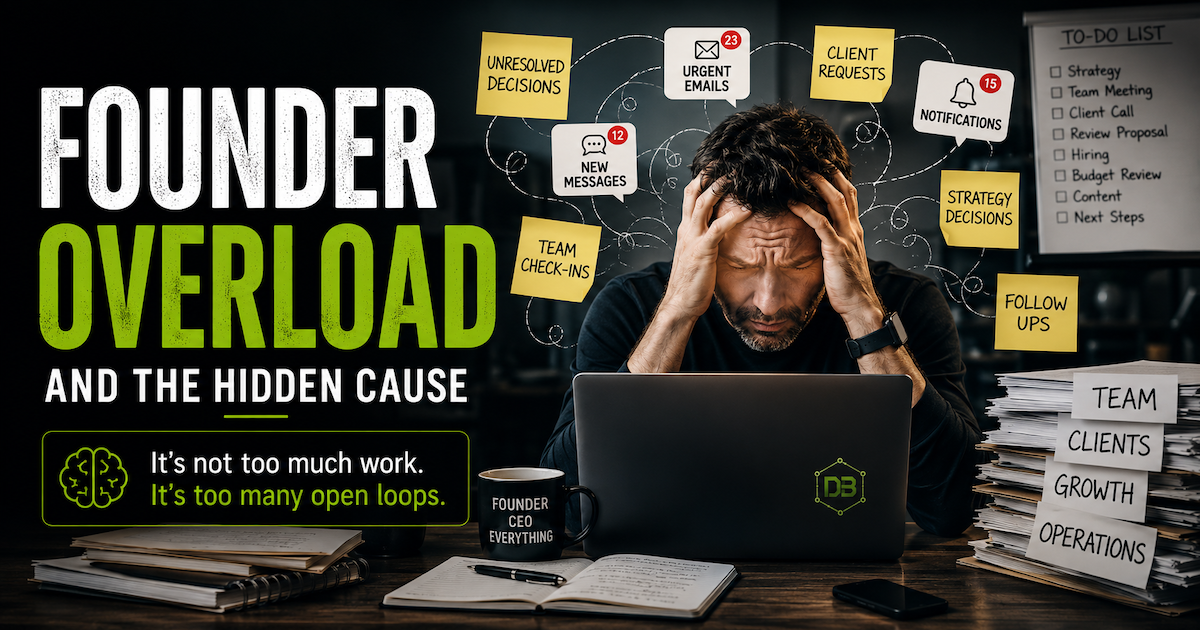
Founder overload isn’t caused by too much work. It’s caused by carrying too many unresolved decisions, conversations, commitments, and mental reminders at once. Every open loop competes for attention, reducing focus and increasing stress. Until your calendar removes cognitive load instead of adding to it, productivity techniques rarely solve the real problem.
Key Takeaways
- Busyness isn’t the same as overload.
- Open loops create hidden mental work.
- Every interruption forces your brain to reload context.
- More productivity often creates more commitments.
- Protected Time reduces cognitive load, not just calendar load.
What is cognitive founder overload?
Most founders assume they’re overwhelmed because they have too much work.
Usually they have too much unfinished thinking.
Every promise.
Every Slack notification.
Every decision waiting for tomorrow.
Every meeting needing preparation.
None of these disappear when you close your laptop.
Your brain keeps tracking them.
That’s cognitive overload.
Why doesn’t working harder fix founder overload?
Working faster clears tasks.
It doesn’t clear mental commitments.
Many founders become extremely efficient while making the underlying problem worse.
The better they become at execution…
the more projects they accept.
The more people depend on them.
The more decisions only they can make.
Productivity becomes fuel for overload instead of a solution.
What are open loops?
An open loop is anything your brain believes still needs attention.
Examples include:
- an unanswered message
- a postponed decision
- a proposal you need to review
- a difficult conversation
- an unfinished strategy
- something you promised your family
Individually they feel small.
Together they create constant background noise.
Why do founders stay in reactive mode?
Reactive work rewards itself.
Someone messages you.
You solve it.
You feel useful.
Repeat.
Eventually your entire week becomes other people’s priorities.
You mistake responsiveness for leadership.
But responsiveness doesn’t create strategic thinking.
Protected thinking time does.
What changes first when founders reduce cognitive overload?
Interestingly, the first improvement isn’t usually productivity.
It’s clarity.
Many founders report:
- making decisions faster
- feeling calmer
- sleeping better
- finishing work earlier
- being more present with family
The workload may stay similar.
The mental load changes dramatically.
Founder Overload Field Note
One founder entered an implementation believing meetings were the problem.
After mapping the week, meetings accounted for less than half the issue.
The real challenge was dozens of unresolved commitments spread across email, Slack, notes, and memory.
Nothing individually felt urgent.
Collectively they consumed attention all day.
The first intervention wasn’t adding another productivity app.
It was systematically closing open loops and protecting uninterrupted thinking time.
This pattern appears repeatedly in founder calendar reviews and illustrates that cognitive load often comes from accumulated commitments rather than total hours worked.
Why calendar management beats time management
Time management asks:
How can I fit more into today?
Protected Time asks:
What deserves my attention at all?
Those are very different questions.
One optimizes activity.
The other protects thinking.
Founders rarely fail because they work too little.
They fail because their attention becomes fragmented.
Common Mistakes with Founder Overload
- Treating every notification as urgent.
- Measuring productivity by hours worked.
- Keeping important decisions in your head.
- Saying yes before checking your calendar.
- Protecting meetings instead of protecting thinking time.
- Assuming burnout starts with long hours instead of accumulated mental load.
FAQ
Is cognitive overload the same as burnout?
No. Cognitive overload often comes first. Burnout may develop if high mental demands continue without enough recovery.
Can productivity apps solve cognitive overload?
They may help organize tasks, but they cannot remove unnecessary commitments. Reducing open loops usually requires changing how work is structured.
What creates the biggest mental load for founders?
Constant context switching, unresolved decisions, and operating without protected thinking time are common contributors.
How do I know if I’m operating with cognitive overload?
If your workday ends but your brain continues reviewing conversations, decisions, and unfinished tasks, you’re likely carrying excessive open loops.
Next Step
If this article sounds familiar, don’t look for another productivity system.
First identify where your attention is leaking.
The Protected Time Scorecard helps founders uncover hidden sources of cognitive overload inside their calendars before they redesign their week.
Take the 7 Point Capacity Audit to identify the hidden calendar, decision, and attention leaks that are keeping you overloaded.
In less than 10 minutes, you’ll see exactly where your capacity is being lost and where you can reclaim it.
Ready to reclaim your capacity?
Author
Dominik Boecker is the founder of dominikboecker.com and creator of the Protected Time OS. He helps founders and CEOs reduce cognitive overload, regain control of their calendars, and design weeks that create more strategic thinking, better decisions, and greater presence at work and at home. His writing focuses on founder productivity, calendar management, leadership, and sustainable business growth.