
Fast Answer
Founder burnout is not mainly caused by working too many hours. It is usually caused by fracture across several domains of the business and the founder’s life at once, each one making the others worse. When attention, identity, rhythm, or relationships crack simultaneously, founders experience exhaustion that rest doesn’t touch. The first correction is not more sleep or a lighter schedule, but locating which domain is actually fractured before you fix anything.
Key Takeaways
- Founder burnout is a fracture problem, not a fuel-tank problem, rest doesn’t fix a structural crack.
- Employee burnout frameworks (Maslach, WHO) assume a bounded role. Founders have no boundary, so the business itself is part of the diagnosis.
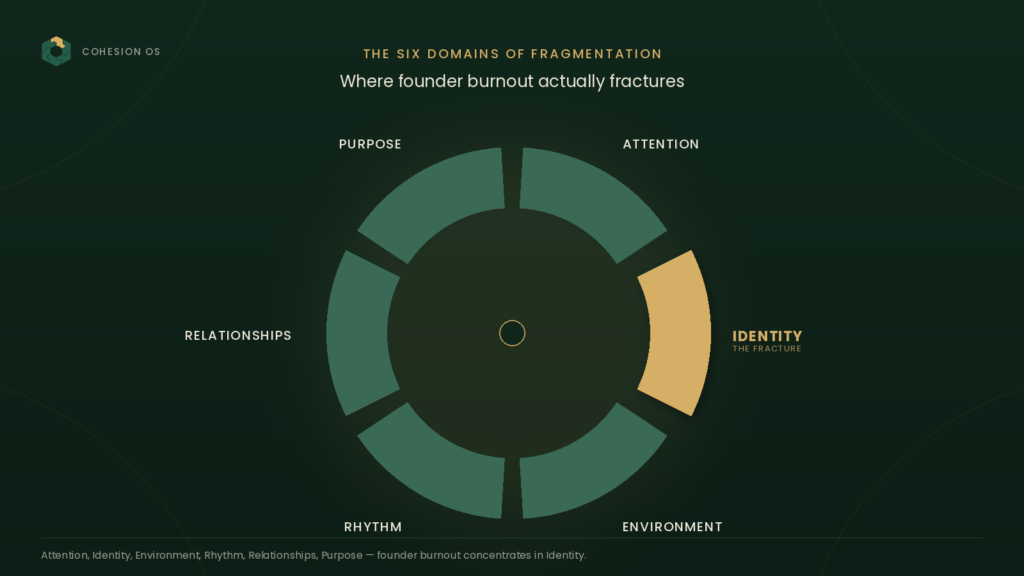
- Burnout shows up when two or three of six domains (Attention, Identity, Environment, Rhythm, Relationships, Purpose) crack at once.
- Willpower-based fixes fail because they target one domain in a problem that’s inherently cross-domain.
- Fixing the wrong domain, attacking Rhythm when the real fracture is Identity, can waste a year without touching the actual problem.
What Is Founder Burnout?
Founder burnout gets diagnosed with the same language as employee burnout, but the mechanism underneath is different.
Employee burnout research assumes a bounded role: fixed hours, a defined scope, an employer who owns the outcome if things go wrong. Founders don’t have that boundary. There’s no shift that ends. There’s no manager absorbing the risk. The business doesn’t run without you in the room, which means every fracture in the system routes back through your nervous system whether you notice it or not.
That’s why generic burnout advice built for employees consistently fails founders. It treats the person as the point of intervention. For a founder, the business itself is part of the diagnosis. You’re not burned out because you’re weak. You’re burned out because six different parts of your business and your life stopped working as one system, and nobody told you that’s what was happening.
Why Doesn’t Rest Fix Founder Burnout?
The standard advice, sleep more, delegate more, take a retreat, doesn’t fix anything, because none of it addresses the actual mechanism. Burnout isn’t a fuel-tank problem where you’re simply running low. It’s a fracture problem, where the parts of your operation that should reinforce each other are pulling against each other instead, and the cost of that friction shows up as exhaustion.
The instinct under pressure is to grind harder: tighter systems, more hustle, a better morning routine. This is the mistake. That kind of tuning assumes the underlying structure is sound and just needs adjustment. Fracture means the structure itself is compromised. Tightening a cracked system just makes it fail faster, and it makes you feel worse when the tightening doesn’t work, because now it looks like a personal failure instead of what it actually is: the wrong intervention entirely.
The Hidden Mechanism Behind Founder Burnout
Burnout rarely comes from one domain collapsing. It comes from cracks running across several at once, each one making the others worse.
Attention. Focus leaks into whatever’s loudest, not whatever matters. Every context switch has a cost you’re not pricing in.
Identity. A self-image still calibrated to an earlier stage of the business, working against the decisions the current stage actually requires.
Environment. Physical and digital surroundings quietly deciding your defaults before willpower ever gets a vote. An inbox that’s always open decides more of your day than your calendar does.
Rhythm. Inconsistent cadence. Output problems that look like a motivation issue are almost always a rhythm issue in disguise.
Relationships. Unspoken expectations from co-founders, team, or family acting as structural load nobody accounted for.
Purpose. The load-bearing reason the whole thing is worth the cost. When it goes quiet, every other domain gets heavier.
Fix one domain in isolation and the other cracks just widen to compensate. That’s why willpower-based fixes don’t hold. They’re targeting a single domain in a problem that’s inherently cross-domain.
Why Founders Stay Stuck in the Burnout Loop
The pattern repeats in a predictable shape:
- Pressure increases somewhere in the business.
- The founder reacts manually, because no structure exists to absorb it.
- The team learns to wait for the founder rather than build capacity of their own.
- The founder becomes more load-bearing, not less.
- The underlying fracture never gets corrected, only patched.
- The same exhaustion returns a few months later, wearing a different symptom.
This is why founders who take a real break come back and crash again within weeks. The break didn’t touch the loop. It just paused it.
Signs you’re fractured, not just tired:
- You take a real day off and come back just as depleted as before it.
- Decisions that used to take minutes now take days, not because they’re harder, but because you can’t locate the part of you that used to make them fast.
- You’re physically present in meetings and mentally somewhere else entirely.
- Small requests from your team trigger a disproportionate response.
- You can’t name what you actually want from the business anymore, only what you’re trying to avoid.
None of these are character flaws. They’re diagnostic signals, telling you exactly where the fracture is, if you know how to read them.
What Changes When Founder Burnout Is Corrected?
Correcting the fracture doesn’t mean everything becomes easy. It means the exhaustion stops being structural. What actually shifts:
- Decisions return to their normal speed because the load isn’t sitting on one cracked domain.
- Rest starts working again, because it’s no longer being asked to fix a structural problem.
- The team stops waiting on you for things they’re capable of owning.
- You can name what you want from the business again, not just what you’re avoiding.
- The next pressure spike doesn’t reopen the same crack.
Founder Field Note
One founder came into the work believing they had a time management problem: too many hours, not enough hands. After mapping the situation, the real issue was Identity, not Rhythm. He was still making decisions calibrated to a five-person team while running twenty-two people, and every decision was taking three times longer than it needed to because part of him hadn’t caught up to the business he’d actually built.
The first correction wasn’t a better calendar. It was naming which decisions belonged to the founder he used to be and which ones belonged to the founder he’d become, then rebuilding his decision rights around the second one.
This pattern appears repeatedly because founders default to fixing the domain that’s loudest (usually time or energy) instead of the domain that’s actually fractured.
Common Mistakes with Founder Burnout
- Treating burnout as a time management issue when the fracture is somewhere else entirely.
- Taking a break and expecting it to fix a structural problem instead of just pausing it.
- Hiring more people before clarifying who owns which decisions.
- Adding more systems or tools to compensate for an unclear rhythm.
- Mistaking responsiveness (answering everything fast) for leadership.
- Attacking the domain that’s easiest to see instead of the one that’s actually cracked.
How to Start Correcting Founder Burnout
- Identify the loudest fracture, where does the exhaustion actually concentrate: decisions, attention, relationships, or something else?
- Name where it shows up concretely: in the calendar, in the team, in the tools, or in specific decisions you keep avoiding.
- Remove one source of unnecessary load this week, not five.
- Install one small structural correction, not a full system overhaul.
- Review what’s actually changed after seven days before adding anything else.
Do not try to fix the entire business at once. Start where the fracture is loudest.
FAQ
Is founder burnout the same as employee burnout?
No. Employee burnout frameworks assume a bounded role with fixed hours and an employer absorbing outcome risk. Founders have no such boundary, the business doesn’t run without them, so every fracture in the operation routes back through the founder directly. The mechanism, and the fix, are different.
What causes founder burnout in founder-led companies?
It’s rarely one cause. Burnout shows up when two or three domains – Attention, Identity, Environment, Rhythm, Relationships, or Purpose — crack at the same time, each one compounding the others. Treating it as a single-cause problem (just hours, just stress) is why generic fixes fail.
How do I know if founder burnout is structural rather than ordinary tiredness?
Ordinary tiredness resolves with rest. If you take real time off and come back just as depleted, or decisions that used to take minutes now take days, that’s a structural signal, not a fatigue signal. The fracture is still there when you get back.
What is the first step to fix founder burnout?
Diagnose before you install anything. Identify which domain is actually fractured rather than which one is loudest, remove one source of unnecessary load, and make one small structural correction. Review after seven days before adding more.
Next Step
You don’t need more discipline. You need to know which domain is cracking, and what to actually do about it, in that order.
The Founder Cohesion Assessment maps all six domains in about five minutes and shows you exactly where your fracture line runs — not a generic burnout score, but a specific point of failure and the one move that addresses it.
Take the Founder Cohesion Assessment →
Author
Dominik Boecker is the creator of Cohesion OS. He helps founder-led companies identify the fracture lines that create overload, dependency, and operational fragmentation, then install the systems that restore cohesion across attention, identity, environment, rhythm, relationships, and purpose.