
Fast Answer
Co-founder alignment is not mainly caused by disagreement. It is usually caused by expectations neither founder ever said out loud. When two people build a company assuming the other agrees with something nobody defined, the gap operates as structural load on decisions, hiring and pace. Founders experience it as slow decisions and meetings that end in “let’s revisit”. The first correction is not another strategy day, but a documented, decision-by-decision conversation both founders actually have.
Key Takeaways
- Co-founder alignment breaks silently, through unstated assumptions, long before it breaks loudly in an argument.
- The visible symptom (tension, slow decisions, a meeting that ends in “let’s revisit”) is rarely the real fracture.
- Co-founder alignment depends on a documented decision, not a shared feeling.
- Most founders wait for a crisis to have the conversation that should happen every quarter.
- Left uncorrected, the gap gets pushed onto the team, who feel it before either founder names it.
What Is Co-Founder Alignment?
It is 4:50pm on a Thursday. You and your co-founder are on a call that was meant to be twenty minutes about a hiring decision. Forty minutes in, you are still circling the same point, not because you disagree on the hire, but because neither of you has said what “moving fast” actually means to the other. You both nod. You both leave the call assuming something got resolved. It did not, and by Monday the offer still has not gone out.
Co-founder alignment is not two people who like each other, share values on a slide, or get along in a Slack thread. It is whether the assumptions each of you is running the company on match, decision by decision, in the moments that actually matter: hiring, pricing, who owns what, how fast is too fast, and what happens when one of you disagrees in front of the team.
When it is missing, the visible symptom is easy to misdiagnose: a slower-moving partnership, a founder who “always circles back”, meetings that end in “let’s take that offline” and never resurface. The real issue sits in the Relationships domain. Expectations between the people carrying the company are unspoken, so each of you is quietly building against a version of the company the other one has not agreed to.
The team sees this before you do. They notice which founder to ask about which topic, and they notice when the two answers differ.
Why Doesn’t Talking It Through Fix Co-Founder Alignment?
Most founder pairs believe they have already had the alignment conversation. They had an offsite. They wrote values on a whiteboard. They said “we are aligned” out loud, which is different from testing it against a real decision. Talking about alignment in the abstract (mission, values, vision) does not surface where two founders actually disagree, because those conversations rarely touch the specific, operational calls: how much runway is “safe”, what counts as underperforming, who has final say on product versus go-to-market.
Working harder on the relationship does not fix this either. More one-to-ones, more check-ins and more “how are we doing” conversations add warmth without adding structure. Another shared Notion page of principles does not help, because a principle is not a decision. The gap is not emotional distance. It is the absence of a small set of decisions that were never actually made together, only assumed.
The Hidden Mechanism Behind Co-Founder Alignment
Two founders start a company with a rough, unspoken contract: who does what, how decisions get made, what “enough” looks like. In year one that contract holds, because most decisions are small and reversible. As the company grows past roughly £3M, decisions get bigger and less reversible: who to hire into leadership, whether to raise, when to let someone go, how much control to give up.
Each founder is still operating on the original unspoken contract, but the company has outgrown it. Founder A assumes final call on anything customer-facing. Founder B assumes they are both deciding everything together. Neither has said this out loud, because it never needed saying when the company was smaller. Now it does, and the first sign is not a fight. It is hesitation: a decision that used to take an hour now takes a week, because neither founder is sure what the other one expects of them.
You will recognise the late-night version. A WhatsApp arrives at 10:47pm: “Can we talk about the hire tomorrow?” It is polite, it is vague, and it means one of you has noticed the gap and is not ready to name it.
Three other domains feed the same fracture. Identity is involved because each founder’s role has drifted from what was agreed. Systems is involved because no one has written down who decides what. Rhythm is involved because there is no fixed slot where the two of you would ever surface it. The Relationships domain is where the cost shows up, but it is rarely the only place the cause sits.
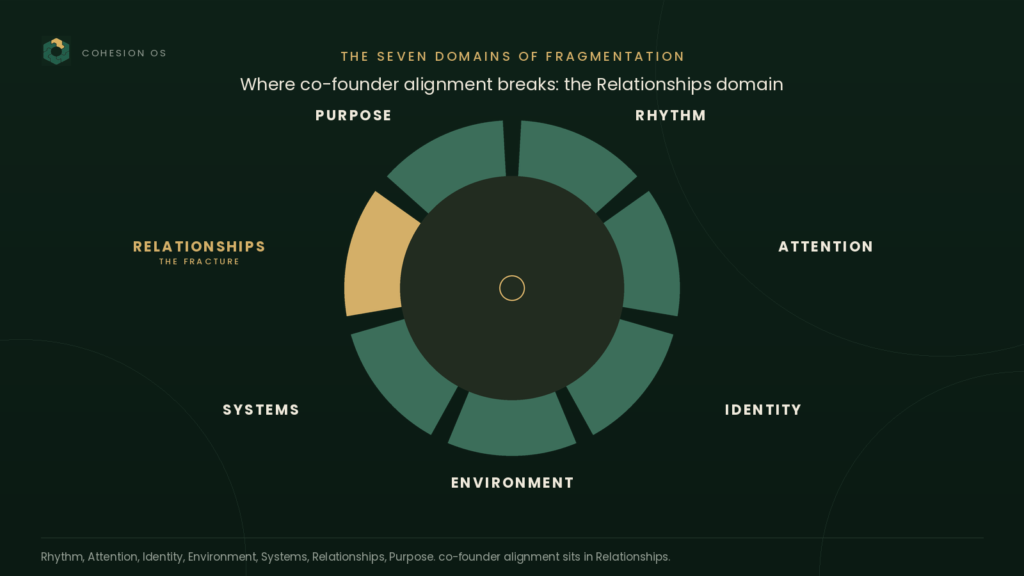
Which of the seven domains is fracturing your company right now?
The Founder Cohesion Assessment takes a few minutes and shows which domain is creating the most fragmentation.
Why Founders Stay Stuck in Co-Founder Misalignment
Pressure builds (a hire is overdue, a customer is churning), and instead of naming the gap, both founders manage around it. One over-communicates to compensate. The other pulls back to avoid stepping on toes. The team notices the hesitation before either founder names it: a leadership hire waits an extra month because nobody will say who is deciding, and a pricing change gets discussed three times because each founder thought the other one owned it.
Nobody schedules the conversation, because it feels like conflict, not maintenance. So the gap widens with every decision that gets made around it instead of through it, and it resurfaces later as something else entirely: a disagreement about a hire that is really a disagreement about control, a fight about runway that is really a fight about risk tolerance nobody has named.
The company absorbs the cost in delay, not in a single visible moment, which is exactly why it goes uncorrected for so long. Every workaround also makes the next one easier to justify, so the pattern hardens.
What Changes When Co-Founder Alignment Is Corrected?
When the unspoken contract becomes a written one, decisions get faster, not because founders agree on everything, but because they know where they disagree and who has the final call when they do. Meetings that used to end in “let’s revisit” end in a decision, because both founders are working from the same map instead of two private ones.
The team stops reading the room for tension and starts getting clear answers, because the founders are no longer quietly negotiating in front of them. Leadership hires stop waiting on an unspoken veto. None of this requires the founders to want the same things. It requires them to have named what each of them wants, in writing, where the other one can see it.
Founder Field Note
One founding pair came in believing their problem was decision speed: everything took too long to agree on. The real issue was that they had never defined who had final say on product versus commercial calls, so every ambiguous decision became a negotiation dressed up as a discussion. The first correction was not a facilitator or an offsite. It was a single working session where they wrote down, decision type by decision type, who calls it and what “good enough to proceed” means. This pattern repeats because founders confirm alignment on values, then assume it extends to operating decisions it was never actually tested against.
Common Mistakes with Co-Founder Alignment
- Treating a values conversation as if it settles operational disagreements.
- Avoiding the conversation because it feels like conflict rather than maintenance.
- Letting the most vocal founder’s assumptions become the default, unspoken.
- Reviewing the partnership only after a crisis forces it.
- Assuming the alignment from year one still applies at three times the size.
- Delegating the conversation to a coach or advisor instead of having it directly.
How to Start Correcting Co-Founder Alignment
- List the five decisions that caused friction in the last quarter. Use real ones: the hire, the price change, the client you kept, the campaign you paused.
- Write down what each of you assumed the other believed. Do this separately first, then compare. The differences are the fracture.
- Name who has final call on each decision type, in writing. One owner per type, and a rule for what happens when the owner is unavailable.
- Put a fixed quarterly slot on the calendar. Ninety minutes, same agenda each time, so it stops feeling like a confrontation.
- Say the hardest assumption out loud first. It is usually the one both of you have been avoiding.
Do not try to fix the entire business at once. Start where the fracture is loudest.
Relationships Fragmentation Domain: Scorecard and Playbook
If Relationships is the domain creating the most friction in your company right now, the Relationships Scorecard and Playbook walk through the correction in detail.
FAQ
How do we know if co-founder misalignment is the real issue?
If the same type of decision keeps taking longer than it should, or keeps resurfacing after it was “settled”, that is usually a sign the underlying expectation was never actually agreed, only assumed. The friction is a symptom, not the cause. Look for decisions that both of you remember differently, because that is where the unspoken contract is doing its damage.
Is co-founder alignment the same as agreeing on everything?
No. Aligned co-founders often disagree, sometimes strongly. What holds the company together is a clear, named process for who decides and how, so disagreement does not stall the business while it gets resolved. The goal is not identical opinions. It is agreed ownership, so a disagreement ends in a decision rather than a stalemate.
What if only one founder is willing to have this conversation?
Start with the decisions, not the relationship. A working session on who owns which decision type is easier to agree to than a conversation framed as “let’s talk about us”, and it produces the same clarity. Bring the list of five recent decisions and ask a practical question: how should we have made this one? That keeps it about the work, not about blame.
How often should founders revisit alignment?
At minimum quarterly, and immediately after any change that shifts the company’s scale, funding or leadership team, since those are exactly the moments the old unspoken contract stops holding. A fixed slot on the calendar matters more than the length of the conversation, because it removes the need for either founder to be the one who raises it.
Next Step
If this sounds familiar, do not add another system yet. First, identify where the fracture is actually happening. Take the Founder Cohesion Assessment to see which of the seven domains is creating the most fragmentation in your company and what to correct first.
Alignment is not a feeling you check for. It is a decision record you keep current.
Find out where the fracture really is.
Take the Founder Cohesion Assessment and see which of the seven domains to correct first.
About the Author
Dominik Boecker is the creator of Cohesion OS. He helps founder-led companies identify the fracture lines that create overload, dependency, and operational fragmentation, then install the systems that restore cohesion across rhythm, attention, identity, environment, systems, relationships, and purpose.