
Fast Answer
A cohesive founder-led company is not one with a calmer founder or a tidier calendar. It is one where each of the seven domains has structure the founder does not have to carry personally. When it holds, founders notice decisions landing without them, a week shaped by fixed points instead of urgency, and a team that can act on the company’s direction alone. The first step toward it is putting one fixed point in place.
Key Takeaways
- A cohesive founder-led company is seven domains reinforcing each other, not one thing done well.
- The healthy state is not the absence of problems. It is the absence of structure that only lives in the founder’s head.
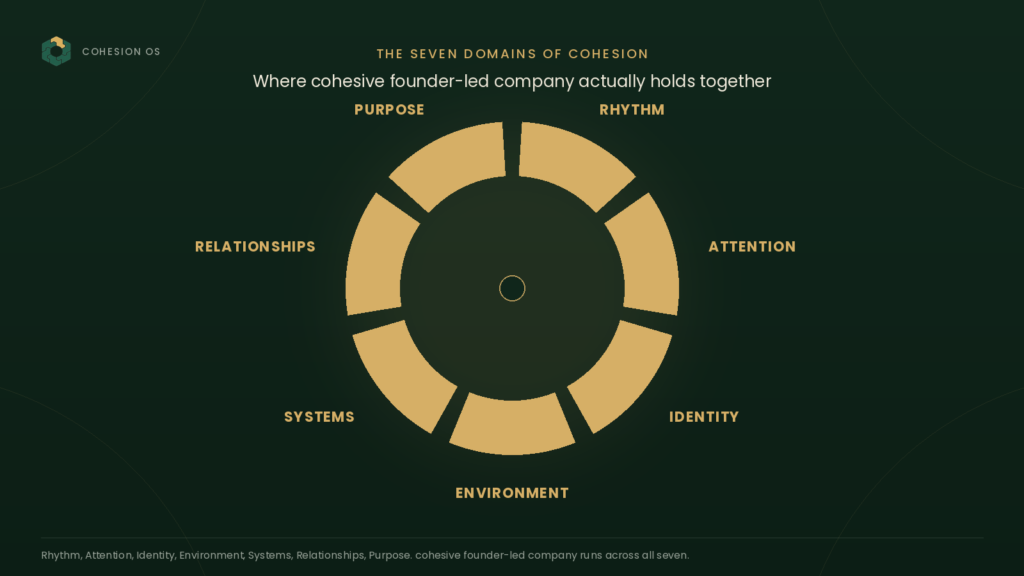
- The seven domains are Rhythm, Attention, Identity, Environment, Systems, Relationships and Purpose, and each one protects the next.
- You can check how close you are with seven observable signs, and most founders will tick some and miss others.
- You do not build all seven at once. You put one fixed point in place and let the rest build on it.
What Does a Cohesive Founder-Led Company Look Like When It Holds?
It is Tuesday, 9:40. The pricing question that used to land in your WhatsApp was answered at 9:05 by your ops lead, using the rule you wrote in March. You will see it on Friday, in the weekly review, and there is nothing to fix.
Your two best hours, 9 to 11, are still yours. Slack is closed. Stripe is not open in a tab. The decision on the Q4 hire is on the page in front of you because it is the one decision this week that only you can make.
At 11:15 you open the channel and find three threads. Two have been closed by the people who own them. One carries a note: “Needs founder, Thursday review.” You leave it there. Nobody is waiting, because everybody knows when it will be answered.
Nothing about this morning is dramatic. That is the point. A cohesive founder-led company does not feel like a retreat or a perfectly run machine. It feels like a company that stays upright while the founder is thinking.
Most founders in the £3M to £30M range have never seen this from the inside. They have seen the opposite so often that a quiet Tuesday looks suspicious. The rest of this post describes what is actually underneath it.
The Structure Underneath It
Cohesion is not one thing done well. It is seven domains that reinforce each other instead of pulling apart. Each one has a healthy state you can recognise, and each one takes weight off the founder in a specific way.
Rhythm
The week has fixed points: a Monday priorities session, a Wednesday decision review, a Friday close. Urgency still arrives, but it queues against the schedule instead of rewriting it. You can say what week six of the quarter is for.
Attention
Your best hours reach the decisions only you can make. Inbox, Slack and WhatsApp are read at set times, and the team knows what counts as a real interrupt. Nobody has to guess whether “just a quick question” is worth your morning.
Identity
Your role matches the stage the company is at now. The founder who was the best salesperson at £1M has handed the
cat > /tmp/cohesive-founder-led-company.html <<‘EOF’
Fast Answer
A cohesive founder-led company is not one with a calmer founder or a tidier calendar. It is one where each of the seven domains has structure the founder does not have to carry personally. When it holds, founders notice decisions landing without them, a week shaped by fixed points instead of urgency, and a team that can act on the company’s direction alone. The first step toward it is putting one fixed point in place.
Key Takeaways
- A cohesive founder-led company is seven domains reinforcing each other, not one thing done well.
- The healthy state is not the absence of problems. It is the absence of structure that only lives in the founder’s head.
- The seven domains are Rhythm, Attention, Identity, Environment, Systems, Relationships and Purpose, and each one protects the next.
- You can check how close you are with seven observable signs, and most founders will tick some and miss others.
- You do not build all seven at once. You put one fixed point in place and let the rest build on it.
What Does a Cohesive Founder-Led Company Look Like When It Holds?
It is Tuesday, 9:40. The pricing question that used to land in your WhatsApp was answered at 9:05 by your ops lead, using the rule you wrote in March. You will see it on Friday, in the weekly review, and there is nothing to fix.
Your two best hours, 9 to 11, are still yours. Slack is closed. Stripe is not open in a tab. The decision on the Q4 hire is on the page in front of you because it is the one decision this week that only you can make.
At 11:15 you open the channel and find three threads. Two have been closed by the people who own them. One carries a note: “Needs founder, Thursday review.” You leave it there. Nobody is waiting, because everybody knows when it will be answered.
Nothing about this morning is dramatic. That is the point. A cohesive founder-led company does not feel like a retreat or a perfectly run machine. It feels like a company that stays upright while the founder is thinking.
Most founders in the £3M to £30M range have never seen this from the inside. They have seen the opposite so often that a quiet Tuesday looks suspicious. The rest of this post describes what is actually underneath it.
The Structure Underneath It
Cohesion is not one thing done well. It is seven domains that reinforce each other instead of pulling apart. Each one has a healthy state you can recognise, and each one takes weight off the founder in a specific way.
Rhythm
The week has fixed points: a Monday priorities session, a Wednesday decision review, a Friday close. Urgency still arrives, but it queues against the schedule instead of rewriting it. You can say what week six of the quarter is for.
Attention
Your best hours reach the decisions only you can make. Inbox, Slack and WhatsApp are read at set times, and the team knows what counts as a real interrupt. Nobody has to guess whether “just a quick question” is worth your morning.
Identity
Your role matches the stage the company is at now. The founder who was the best salesperson at £1M has handed the pipeline to a sales lead at £6M, and is not quietly taking it back every time a deal wobbles. Decisions come from who the company needs you to be, not who you used to be.
Environment
The right action is the easy one. There is one source of truth for each question, so approvals live in one place (Notion, ClickUp or Asana, not all three) and a new starter finds the answer in Google Drive without asking you.
Systems
Recurring problems get solved once. Decisions are logged, processes have named owners, and the SOPs are current because someone is responsible for them. The company remembers what it decided, so the founder does not have to.
Relationships
Expectations are explicit with co-founders, leaders, the team and home. Load is shared, not silently carried. The leadership team disagrees in the meeting instead of in DMs afterwards, and the people at home know which weeks are heavy before they arrive.
Purpose
Direction filters real decisions. When an attractive opportunity arrives, the team can say no without asking you, because the reason is written down and actually used.
Why the seven hold each other up
The domains are not a checklist. They are a chain. Fixed Rhythm protects Attention. Protected Attention lets you stay in the role your Identity now requires. That role only works if Systems and Environment carry the routine. Clear Relationships keep the load shared, and Purpose tells everyone what to do when you are not in the room. Pull one out and the others start compensating by hand, which is exactly how founder dependency forms.
How Close Are You? Seven Signs It Is Already Working
Read these honestly. A sign only counts if it is true in a normal week, not a good one.
- Rhythm: Your week has at least three fixed points that survive a bad Monday.
- Attention: Your best two hours of the day reach a decision that only you can make.
- Identity: You can name one task you used to own and have properly let go of.
- Environment: A new starter can find the current answer to a routine question without messaging you.
- Systems: The last recurring problem was solved once and written down, not solved again this quarter.
- Relationships: Your leadership team knows what you expect of them, and you know what they expect of you.
- Purpose: Someone on the team said no to a good opportunity this month without checking with you.
Most founders tick two or three. That is not a failing score. It tells you where the structure already exists and where you are still the structure.
What Usually Gets in the Way
The most common obstacle is not laziness or lack of ambition. It is that the structure exists, but it lives inside you. You know the pricing rule, the escalation path, the reason the company turned down that partnership in 2024. None of it is written anywhere, so the company borrows it from you daily.
That is the fracture underneath most founder overload. Adding another tool gives it one more place to hide. Hiring a strong operator puts a capable person next to an undocumented system. Working harder just means you carry it faster.
Contrast that with the Tuesday at the top of this post. The difference is not that the founder in that scene works less or cares less. It is that the pricing rule, the review, the owner and the reason all exist outside their head. The company holds the structure so they can hold the decision.
Founder Field Note (After the Change)
One founder described her week as “a very well-paid inbox.” Every approval, pricing question and hiring doubt passed through her before it went anywhere. After she put three fixed points in place (a Monday priorities session, a Wednesday decision review and one written rule for spending approvals), the shape of the week changed. Her ops lead started closing threads that used to wait for her, and the Wednesday review became the only place founder decisions were expected. What made it hold was that the structure no longer depended on her remembering it.
How to Build Toward It
You do not need to install seven domains. You need to make one thing true that was not true last month.
- Find where you are the structure. List the five questions people ask you most often. Each one marks a place where the company is borrowing your judgment.
- Pick one domain. Choose the one where the list is longest. Do not choose the one that feels most interesting.
- Put one fixed point in place. A 30-minute Wednesday decision review with a written agenda is enough. It needs a time, an owner and a place where the outcome is recorded.
- Write one decision rule down. Take the most repeated question, write the rule you already use to answer it, and hand it to the person who is asked most often.
- Run it for four weeks before adding anything. One correction that holds is worth more than five that fade by February.
You do not need all of it at once. Put the first fixed point in place and let the rest build on it.
FAQ
What is a cohesive founder-led company?
A cohesive founder-led company is one where the seven domains (Rhythm, Attention, Identity, Environment, Systems, Relationships and Purpose) each have structure that does not depend on the founder personally holding it together. Decisions have owners, recurring problems have documented answers, and the week follows fixed points rather than whoever messaged first.
Is a cohesive company the same as a calm or low-stress one?
No. A cohesive company still has hard weeks, difficult hires and bad quarters. The difference is that pressure lands on structure rather than on the founder’s memory and goodwill. Problems get routed to an owner, a review or a written rule instead of arriving in your WhatsApp at 9:17.
How long does it take to build cohesion?
A first fixed point, such as a weekly decision review, can start changing the week within a few weeks if it is held consistently. Building all seven domains is a matter of quarters, not days. The pace depends less on effort than on how much structure currently lives only in your head.
Do I need to fix all seven domains at once?
No, and trying to is the fastest way to add more load. Start with the domain where you are most clearly the bottleneck, put one fixed point in place, and let it hold before you add another. The domains reinforce each other, so one that holds makes the next one easier.
Next Step
If you want this for your company, start by seeing where you stand. Take the Founder Cohesion Assessment to see which of the seven domains is already holding and which one to build first.
Cohesion is not a feeling the founder has. It is structure the company carries.
Find out which domain to build first.
Take the Founder Cohesion Assessment and see where the structure already holds.
About the Author
Dominik Boecker is the creator of Cohesion OS. He helps founder-led companies identify the fracture lines that create overload, dependency, and operational fragmentation, then install the systems that restore cohesion across rhythm, attention, identity, environment, systems, relationships, and purpose.