
Fast Answer
Founder burnout is not mainly caused by a lack of discipline or willpower. It is usually caused by fracture across several domains of the business and the founder’s life at once, each one compounding the others. When attention, rhythm, or relationships crack simultaneously, no amount of self-control touches the underlying structure. The first correction is not more discipline, but locating which domain is actually cracked before applying more willpower to a problem willpower was never built to solve.
Key Takeaways
- Founder burnout is not a discipline gap. It’s a structural fracture that willpower cannot close.
- Willpower interventions fail because they ask one part of the founder to compensate for a crack running across multiple domains.
- Burnout shows up when two or three of six domains (Attention, Identity, Environment, Rhythm, Relationships, Purpose) crack at once.
- More discipline applied to a cracked structure produces faster failure, not stability.
- Mistaking a fracture for a willpower gap wastes months “pushing through” a problem that gets worse under pressure.
- Founders who fix the willpower story instead of the fracture usually relapse within a quarter.
What Is Founder Burnout?
Founder burnout gets treated as a character issue. Not disciplined enough. Not resilient enough. Not tough enough to run the business without cracking. That story survives because it’s simple and because founders are trained to believe every problem in the business is a problem they personally failed to solve hard enough.
But discipline is not the variable that’s failing. Discipline assumes the structure underneath it is sound and just needs more force applied consistently. Fracture means the structure itself is compromised. You can be maximally disciplined and still burn out, because discipline was never the layer where the damage occurred.
The willpower story is attractive because it puts the fix entirely inside the founder’s control. Try harder. Wake up earlier. Say no more often. It feels actionable. It is also almost always wrong, because it treats a systems problem as a character problem, and no amount of character correction repairs a system.
Why Doesn’t More Willpower Fix Founder Burnout?
Willpower is a finite resource applied to a single decision at a time. Fracture is a structural condition running across multiple domains simultaneously. Applying more of the first to fix the second is a category error.
Here’s what actually happens when a founder tries to willpower their way out of burnout: they tighten their own behavior (earlier mornings, stricter no-meeting blocks, harder boundaries) while the underlying fracture, in identity, rhythm, or relationships, stays exactly where it was. The tightening produces short-term relief because it feels like action. Within weeks the relief fades, because the crack that was actually causing the exhaustion never got touched.
Worse, the willpower approach adds a second layer of damage. When the discipline eventually fails, and it will, because no one sustains maximum willpower indefinitely, the founder reads the failure as further proof they’re not disciplined enough. This is the trap: a structural problem gets misread as a personal one, and the misreading generates a shame cycle that makes the actual fracture harder to see and address.
The Hidden Mechanism Behind Founder Burnout
Burnout is rarely one domain collapsing. It’s cracks running across several at once, each one making the others worse and each one invisible to a willpower-only diagnosis.
Attention. Focus routes to whatever’s loudest, not whatever matters. No amount of discipline fixes an attention system that’s structurally reactive.
Identity. A self-image still calibrated to an earlier version of the business. Willpower can’t update an identity. Only evidence and deliberate rebuilding can.
Environment. Physical and digital surroundings deciding your defaults before willpower gets a vote. An open inbox will out-discipline your best intentions every time.
Rhythm. Inconsistent cadence disguised as a motivation problem. You don’t need more willpower to show up. You need a rhythm that doesn’t depend on willpower to hold.
Relationships. Unspoken expectations from co-founders, team, or family acting as structural load. No discipline absorbs load that was never named.
Purpose. The load-bearing reason the business is worth the cost. When it goes quiet, willpower has nothing to draw on, because willpower runs on purpose, not the other way round.
Fix one domain with sheer effort and the others don’t wait for you to catch up. They keep cracking. That’s why willpower-based fixes don’t hold: they’re a single-domain intervention aimed at a cross-domain problem.
Why Founders Stay Stuck in the Willpower Loop
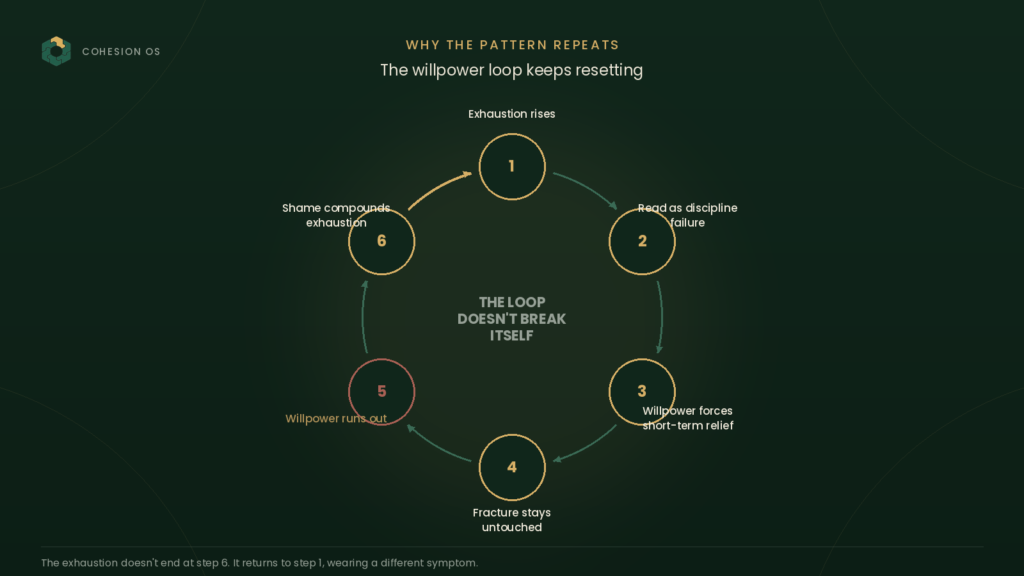
The pattern repeats in a predictable shape:
- Exhaustion increases somewhere in the business.
- The founder interprets it as a discipline failure and tries to will their way through it.
- Short-term effort produces short-term relief, reinforcing the belief that willpower is the right lever.
- The underlying fracture, untouched, keeps generating the same pressure.
- Willpower runs out, as it always does, and the founder reads this as personal weakness.
- The exhaustion returns, now compounded by the shame of “failing” at discipline.
This is why founders who commit to a stricter routine often crash harder than before. The routine didn’t correct the fracture. It just delayed the reckoning and added a layer of self-blame on top.
Signs the problem is fracture, not willpower:
- You’ve tried the stricter routine before, more than once, and it stopped working within a few weeks each time.
- Your discipline is fine in isolated moments but collapses the instant pressure rises anywhere else in the business.
- You can force output for a day or two, then need days to recover what one disciplined day cost you.
- The exhaustion doesn’t correlate with how hard you worked. Easy weeks feel just as heavy as hard ones.
- You’ve started treating your own inconsistency as evidence of character weakness rather than a signal to investigate.
None of these are willpower failures. They’re diagnostic signals pointing at a specific fracture, if you know how to read them instead of pushing through them.
What Changes When Founder Burnout Is Corrected?
Correcting the fracture doesn’t require becoming a more disciplined person. It means the exhaustion stops depending on discipline in the first place. What actually shifts:
- Consistency stops requiring effort because the structure holds it, not your willpower.
- Recovery from a hard week takes hours, not days, because the load isn’t sitting on one cracked domain absorbing everything.
- The shame cycle disappears, because the problem was never a character flaw to begin with.
- Decisions stop draining you at the same rate, because they’re not routing through a compromised identity or unclear ownership.
- The next pressure spike doesn’t require a new round of forced discipline to survive.
Founder Field Note
One founder came into the work convinced he simply lacked discipline. He’d tried three different morning routines that year, each one abandoned within a month, and he’d started to believe the pattern said something true about his character.
After mapping the situation, the real issue was Rhythm, not willpower. His business had no consistent operating cadence at all: no fixed weekly review, no protected planning block, no repeatable structure for how decisions moved through the week. Every “discipline failure” was actually the absence of a rhythm that didn’t depend on him remembering to be disciplined that day.
The first correction wasn’t a stricter morning routine. It was installing one fixed weekly rhythm the business ran on regardless of how motivated he felt on a given Monday. Once the rhythm existed as a structure rather than a personal habit, the “discipline problem” disappeared, because it was never a discipline problem.
This pattern repeats because founders default to blaming the loudest, most personal explanation (I’m not disciplined enough) instead of investigating the structural one (there’s no rhythm here for discipline to attach to).
Common Mistakes with Founder Burnout
- Treating repeated “failed” routines as evidence of weak character instead of evidence the routine was the wrong intervention.
- Adding a stricter schedule on top of an unclear rhythm, which just adds pressure to an already cracked structure.
- Reading willpower failure as proof you need an even harder version of the same fix.
- Ignoring the shame cycle that forms when discipline-based fixes fail, which quietly makes the real fracture harder to name.
- Assuming more accountability (a coach, an app, a tracker) will supply the willpower that was never the missing ingredient.
- Waiting for motivation to return before addressing the fracture, when motivation was never the load-bearing variable.
How to Start Correcting Founder Burnout
- Stop asking “why can’t I stick to this” and start asking “which domain keeps generating this pressure regardless of how disciplined I am.”
- Name where the fracture shows up concretely: which decisions, which relationships, which parts of the week keep cracking no matter how much effort you apply.
- Remove one source of unnecessary load this week, not five, and don’t require willpower to sustain the removal.
- Install one structural correction that holds without daily discipline, not another routine that depends on how you feel that morning.
- Review after seven days what actually changed before adding anything else.
Do not try to fix the entire business at once. Start where the fracture is loudest.
FAQ
Is founder burnout really about willpower at all?
Rarely as the root cause. Willpower can mask a fracture for a while by forcing short-term output, but it can’t repair a structural crack in attention, identity, rhythm, or relationships. When the willpower runs out, which it always does, the fracture is still there waiting.
Why do stricter routines stop working after a few weeks?
Because a routine built on discipline alone has to be actively maintained every single day. A structural correction doesn’t. If your fix keeps collapsing on a predictable timeline, that’s a sign the intervention was aimed at willpower instead of the actual fracture underneath it.
Can more accountability (coaches, trackers, habit apps) fix founder burnout?
Accountability tools can reinforce a fix that’s already structurally sound. They can’t create structure that doesn’t exist. If the underlying rhythm, ownership, or identity issue hasn’t been corrected, accountability just adds pressure to a system that’s still cracked.
How do I know if I have a fracture instead of a discipline problem?
If you’ve genuinely tried to be more disciplined, more than once, and it worked briefly before collapsing again, that’s not a discipline problem. Discipline that repeatedly fails under identical effort is a diagnostic signal pointing at a structural fracture, not a character flaw.
Next Step
If this sounds familiar, do not add another routine yet. First, identify where the fracture is actually happening. Take the Founder Cohesion Assessment to see which domain is creating the most fragmentation and what to correct first.
[Take the Founder Cohesion Assessment →]
Author
Dominik Boecker is the creator of Cohesion OS. He helps founder-led companies identify the fracture lines that create overload, dependency, and operational fragmentation and founder burnout, then install the systems that restore cohesion across attention, identity, environment, rhythm, relationships, and purpose.