
Fast Answer
Time-blocking is not mainly caused to fail by poor discipline. It fails because founder-led companies run on reactive load that no calendar structure controls. When a team defaults to routing decisions through the founder in real time, every protected block gets treated as available time. The first correction is not a stricter calendar, but a redesign of how decisions and escalations move through the business so the founder is no longer the default routing path.
Key Takeaways
- Time-blocking for founders fails structurally, not from a lack of willpower.
- The real problem is founder dependency: the team still routes decisions to the founder in real time.
- A protected block only holds if the team’s operating rhythm treats it as unavailable, not just the founder’s calendar.
- Stricter time-blocking rules without changing decision routing produces the same broken pattern in a new form.
- Correcting time-blocking starts with mapping who interrupts the founder and why, not with better scheduling software.
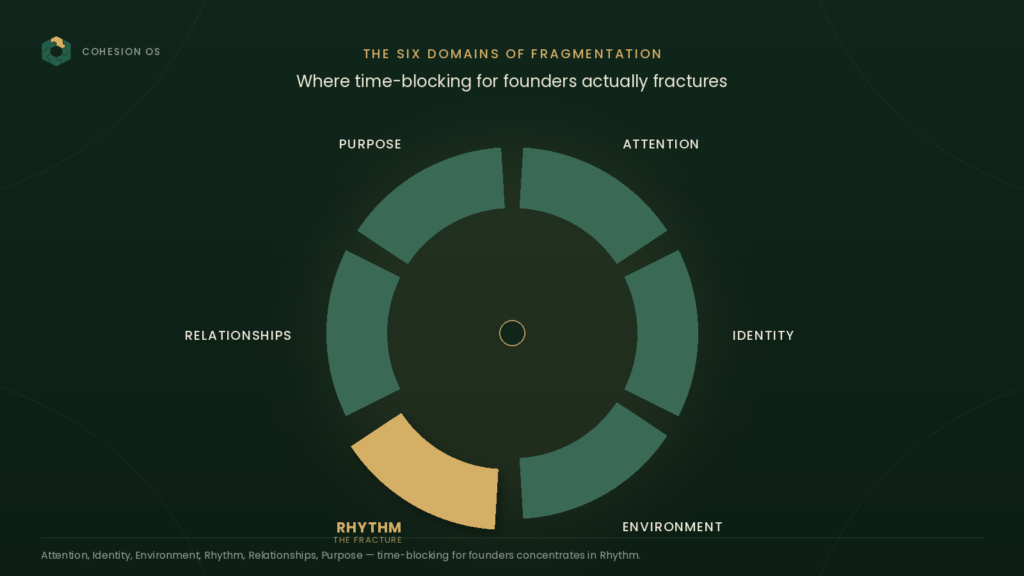
- Cohesion OS treats this as a Rhythm fracture: the operating rhythm of the business, not the founder’s personal habits, needs the correction.
What Is Time-Blocking for Founders?
Time-blocking is the practice of assigning fixed blocks of time on a calendar to specific types of work: deep work, strategy, sales, admin. For most professionals it works reasonably well, because their interruptions are limited and their calendar largely reflects their actual availability.
For founders of founder-led companies, it usually collapses within two to three weeks. The visible symptom looks like a discipline failure: the founder “couldn’t stick to it,” got pulled into Slack, took the call anyway, opened email during the deep work block. That reading is wrong. The founder didn’t fail to follow a system. The system was never designed for the operating conditions of a founder-led company.
In a founder-led company, the founder is usually the default answer to unresolved questions across the business. Pricing exceptions, hiring calls, client escalations, vendor decisions, product tradeoffs: all of it routes back to one person, because no other path has been built. A calendar block cannot override that routing. It can only ask people to wait, and most teams have not been given a structural reason to wait.
Cohesion OS treats this as a fracture in the Rhythm domain: the operating rhythm of the business has never been separated from the founder’s personal availability.
Why Doesn’t Stricter Time-Blocking Fix This?
The standard advice when time-blocking fails is to try harder. Turn off notifications. Block longer stretches. Add a “no meetings” day. Use a different app. Tell the team more firmly to respect the block.
This fails for a structural reason: none of it changes who the team routes decisions to. If Slack pings the founder, closing Slack doesn’t remove the underlying question. It delays it, and the person waiting either escalates harder or works around the founder with a worse decision, which then needs correcting later anyway. Either outcome pulls the founder back in, often at higher cost than if they had just answered in the moment.
Discipline-based fixes assume the founder is the variable that needs to change. In practice, the team’s default behaviour is the variable that needs to change. Protected Time OS states this directly: a protected block isn’t protected if the team still treats it as available time. No amount of founder willpower corrects a routing problem that lives outside the founder’s calendar.
Founders who add more rules to their own schedule without touching this routing usually end up in a worse position: they now feel like they’re failing at time management on top of everything else, when the actual fracture was never personal.
The Hidden Mechanism Behind Failed Time-Blocking
The mechanism has three parts, and they reinforce each other.
First, undocumented judgment. Many decisions that reach the founder don’t actually require the founder. They require judgment that has never been written down, delegated, or tested anywhere else. The team isn’t lazy or overly cautious. They genuinely don’t know what the founder would decide, so they ask.
Second, no escalation path with real thresholds. Most founder-led companies have no defined line between “decide it yourself,” “check with your manager,” and “this needs the founder.” Without that line, everything defaults to the most senior person available, which is usually the founder.
Third, no consequence for interrupting. If interrupting the founder always works, and waiting sometimes means missing a window, the team will always choose to interrupt. There is no cost to breaking the block and a real cost to respecting it.
Put together: the founder blocks time, the team has no other path and no reason to wait, the block gets broken, and the founder concludes the system doesn’t work for someone in their position. The calendar was never the layer where this needed to be fixed.
[Insert in-post mechanism diagram here: The Hidden Mechanism Behind Failed Time-Blocking]
Why Founders Stay Stuck in This Pattern
The loop repeats in a predictable shape. Pressure rises (growth, a hire, a new client segment), the founder reacts manually to keep things moving, the team grows more comfortable routing decisions to the founder because it’s fast and reliable, the founder becomes more overloaded as a result, the underlying system is never corrected, and the problem resurfaces in a new form: a different block gets broken, a different tool gets blamed, a different rule gets added.
Each cycle looks like a new problem. It’s the same fracture, showing up in whichever part of the calendar is currently exposed.
What Changes When This Is Corrected?
When the routing problem is corrected rather than the calendar, three things shift structurally.
Decisions that don’t require the founder stop reaching the founder, because a documented threshold exists for someone else to make the call. The team has an actual reason to respect a protected block, because the business has demonstrated that waiting doesn’t cost them anything. And time-blocking starts working as intended, not because the founder became more disciplined, but because the block is now protected by the operating rhythm of the business, not by willpower alone.
This is not a claim that founders stop being interrupted entirely. It’s a structural reduction: fewer decisions require the founder in real time, so the blocks that remain protected actually hold.
Founder Field Note
One founder came in believing their calendar was the problem. Three separate time-blocking systems had failed in under a year, and they assumed the next one just needed to be stricter.
The real issue was that the founder had never defined which decisions their ops lead was authorised to make alone. Every pricing exception, every client escalation, every vendor call still routed to the founder by default, because no one had ever told the team otherwise.
The first correction wasn’t a better calendar app. It was a one-page escalation threshold: three categories of decision the ops lead could now make without checking in, reviewed weekly for the first month. Within three weeks, the founder’s “protected” mornings stopped getting broken, not because the team respected the calendar more, but because most of what used to interrupt those mornings no longer needed the founder at all.
This pattern repeats because founders instinctively try to fix visible time first, when the fracture is almost always in who the business depends on to make decisions.
Common Mistakes with Time-Blocking for Founders
- Assuming the calendar is the layer to fix. The calendar reflects the fracture. It doesn’t cause it.
- Blocking time without telling the team why. A block with no stated reason gets treated as optional.
- Adding more rules instead of removing dependency. More structure on the founder’s side doesn’t reduce what routes to them.
- Treating every interruption as equally urgent. Without defined thresholds, everything looks equally important, so everything gets escalated.
- Trying to protect every block at once. Fixing the whole calendar in one move usually fails. One loud fracture at a time holds better than a full rebuild.
- Measuring success by “did I stick to the block” instead of “did fewer things need me.” The second is the actual signal of correction.
How to Start Correcting This
- Track interruptions for one week, not to judge them, but to see which ones actually required the founder and which ones didn’t.
- Identify the three most repeated decision types that reach the founder unnecessarily.
- Write a one-page threshold for who else can make those calls, and under what conditions they still escalate.
- Tell the team explicitly that this threshold exists and why, so respecting a protected block has a stated reason behind it.
- Protect one block first, not the whole week. Prove the correction holds before expanding it.
Do not try to fix the entire business at once. Start where the fracture is loudest.
FAQ
Why does time-blocking work for employees but not founders? Employees usually have a defined role with limited decision authority, so their calendar reasonably reflects their availability. Founders are typically the default answer to undefined decisions across the business, so their calendar competes directly with unresolved routing, not just with meetings.
Is time-blocking useless for founder-led companies? No. It’s a useful structure once the underlying routing problem is addressed. Without that correction, it consistently breaks regardless of the specific method or tool used.
How long does it take to see a protected block actually hold? In most cases, once decision thresholds are documented and communicated, founders see fewer unnecessary interruptions within two to three weeks, though the exact timeline depends on how many decisions were previously undocumented.
Should I hire an assistant to protect my calendar instead? An assistant can enforce a calendar. They cannot resolve why the team routes decisions to the founder in the first place. Without the underlying correction, the interruptions usually just move to a different channel.
Next Step
If this sounds familiar, do not add another system yet. First, identify where the fracture is actually happening. Take the Founder Cohesion Assessment to see which domain is creating the most fragmentation and what to correct first.
Author
Dominik Boecker is the creator of Cohesion OS. He helps founder-led companies identify the fracture lines that create overload, dependency, and operational fragmentation, then install the systems that restore cohesion across attention, identity, environment, rhythm, relationships, and purpose.