
Fast Answer
The difference between busy and fractured is not intensity, it’s structure. Busy means your calendar is full. Fractured means your attention, decisions, and judgment are scattered across domains that no longer connect to each other. A founder can clear their calendar and still be fractured. The first correction is not fewer meetings, but reassembling the fracture lines where attention, rhythm, and ownership have come apart.
Key Takeaways
- Being busy is a volume problem. Being fractured is a structural problem, and they require different corrections.
- You can have a light calendar and still be fractured. You can have a packed calendar and not be fractured, if the load is distributed correctly.
- Fragmentation shows up as decision fatigue, unfinished loops, and a felt sense of being pulled in six directions even when nothing urgent is happening.
- Most founders treat fragmentation with busy-person tools (time blocking, better calendars, more focus apps), which explains why those tools stop working after a few weeks.
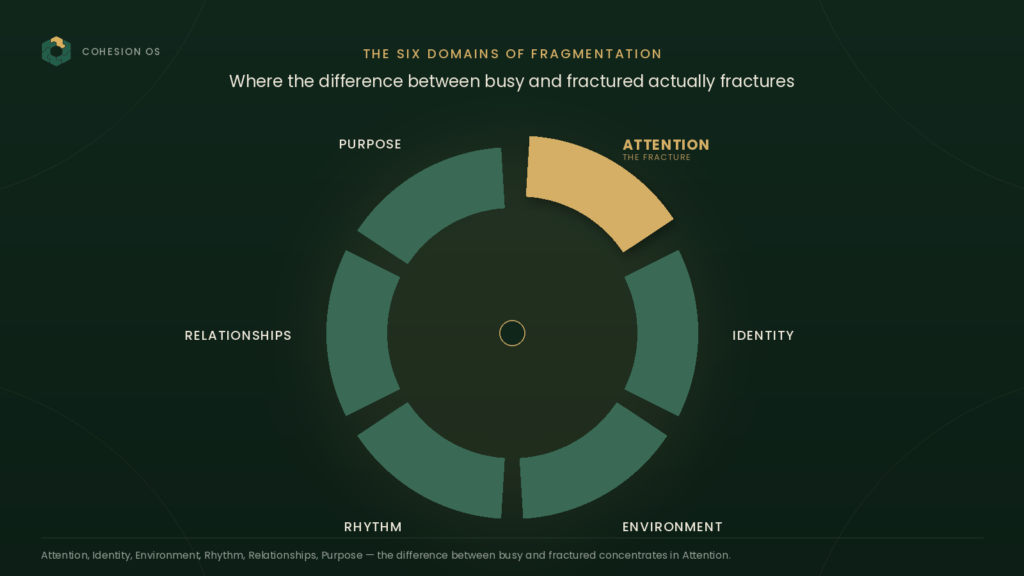
- The six domains where fracture actually lives are Attention, Identity, Environment, Rhythm, Relationships, and Purpose, not your schedule.
- Correcting fragmentation starts with locating which domain is loudest, not by adding more structure everywhere at once.
What is the Difference Between Busy and Fractured?
Busy is a state. Fractured is a structure.
A busy founder has too much on the calendar. A fractured founder has too much living inside them: unresolved decisions, half-delegated tasks, context that only exists in their head, relationships that depend on their constant input to function. You can see busy from the outside, on a calendar. You can’t see fractured from the outside. It shows up in what doesn’t get finished, what silently depends on the founder, and what quietly falls apart the moment they step away for a week.
This is why so many founders “fix” their busyness (cut meetings, block calendars, delegate a task or two) and still feel exactly as overloaded three weeks later. The calendar changed. The fracture didn’t.
Cohesion OS treats these as separate problems on purpose. Busy is a capacity allocation issue. Fractured is a structural one, spread across six domains: Attention, Identity, Environment, Rhythm, Relationships, Purpose. You can be under-scheduled and still fractured if those domains are disconnected from each other.
Why Doesn’t Clearing the Calendar Fix Fragmentation?
Because the calendar was never the source. It was the symptom’s most visible surface.
Clearing meetings, blocking “deep work” time, or hiring an EA to gatekeep the inbox all address volume. None of them touch the actual mechanism: decisions that only the founder can make because nobody else has the context, systems that quietly assume the founder will catch what falls through, or a Slack full of “quick question” messages that exist because ownership was never clearly assigned in the first place.
A founder can protect four hours a day and still spend it context-switching between five unrelated fires, because the fires aren’t a scheduling problem. They’re evidence that Attention, Rhythm, and Relationships in the business were never structurally separated. Protecting time without correcting structure just gives fragmentation a quieter place to keep happening.
This is also why “more tools” rarely helps. A new project management system, a new AI assistant, another calendar app: each one adds a new surface for the same underlying fracture to hide behind. More places to check. More systems that need the founder’s judgment to interpret correctly. The tool count goes up. The fragmentation stays exactly where it was.
The Hidden Mechanism Behind Busy vs Fractured
(Diagram: the six domains and how they compound. See image below.)
Here’s the actual mechanism, stripped of the productivity language.
A founder-led business runs on the founder’s judgment by default, because in the early stage that’s the fastest way to move. That’s correct for a while. The problem starts when the business scales past the point where one person’s attention can hold every open loop, but the operating structure never catches up. Decisions still route through the founder. Ownership is still implicit rather than documented. The team still defaults to “check with [founder]” instead of a clear decision rule.
At that point, the founder isn’t overloaded because they’re doing too much work. They’re overloaded because too many open loops from too many domains are living inside one person, with no structural boundary between them. Attention gets pulled into Environment issues (a tool that’s half set up, a system nobody finished configuring). Identity gets tangled with Relationships (the founder is the only one who can have certain conversations). Rhythm collapses because nothing is protected, everything is negotiable, and every day reshapes itself around whatever’s loudest.
This is fragmentation. It’s not a time management failure. It’s the absence of structural separation between domains that were never supposed to all run through one person’s attention at once.
Why Founders Stay Stuck in the Busy-Fractured Loop
The loop is predictable, and it’s why the same founders keep hitting the same wall every six to twelve months.
Pressure rises (growth, a new hire, a bigger client, a launch). The founder reacts the way that’s always worked: they step in personally, absorb the ambiguity, make the call, hold the exception in their head. The team learns, correctly, that the founder will catch what they don’t. Dependency deepens. The founder becomes more load-bearing, not less. Eventually the pressure returns, in a new form, and the founder is more overloaded than before, because the system was never corrected. Only the founder’s tolerance for the chaos was.
Founders read this as a personal failure: “I need to get better at delegating,” “I need more discipline,” “I need to work on my time management.” It isn’t personal. It’s structural. No amount of individual discipline fixes a system built to route every ambiguous decision through one person.
What Changes When Fragmentation Is Corrected?
Not “more balance.” Not “more time.” A different operating structure.
When fragmentation is corrected, decisions stop defaulting to the founder by habit, because ownership is explicit somewhere else. Open loops get closed at the point they’re created instead of migrating into the founder’s head. Rhythm becomes something the business runs on, not something that gets renegotiated every time something urgent shows up. The founder’s attention gets reserved for the decisions that actually require their judgment, not the ones that route to them out of default.
This doesn’t mean the calendar empties out. Some correctly-structured founders stay busy. The difference is that busy, in a corrected structure, is chosen and load-bearing in the right places. Fractured busy is reactive and load-bearing everywhere at once.
Founder Field Note
One founder came in believing the problem was time. He’d blocked three mornings a week for “strategic work” and still couldn’t protect them; something always broke through. The real issue wasn’t his calendar discipline. It was that four separate people on his team had no clear authority to make calls in their own lane, so everything ambiguous got routed to him by default, calendar block or not.
The first correction wasn’t a better calendar system. It was naming, explicitly, which decisions each of those four people now owned outright, with no check-in required. Within two weeks, the “urgent” interruptions dropped by more than half, not because the business got calmer, but because the fracture line (unclear ownership) had been closed at the source instead of managed around.
This pattern repeats because founders instinctively treat the symptom (a full calendar) as the problem, when the calendar is usually just where an unaddressed fracture becomes visible.
Common Mistakes with Busy vs Fractured
- Assuming a lighter calendar means less fragmentation. Fragmentation lives in decision structure and ownership, not hours booked.
- Treating every overload symptom the same way. Attention fragmentation, Rhythm fragmentation, and Relationship fragmentation need different corrections, not one universal “time management” fix.
- Adding a new tool or system to manage the chaos. Every new system is another surface fragmentation can hide behind unless the underlying structure changes first.
- Confusing personal discipline with structural design. No founder has ever willpowered their way out of a business that routes every ambiguous decision through them by default.
- Trying to fix everything at once. Attempting to correct all six domains simultaneously usually means none of them get corrected properly.
- Waiting for a quieter season to address it. The loop doesn’t resolve itself. It returns in a new form once pressure rises again.
How to Start Correcting Busy vs Fractured
- Name the loudest domain first. Is the fracture mostly in Attention, Identity, Environment, Rhythm, Relationships, or Purpose? Most founders can identify it in under five minutes once they’re asked directly.
- List what only exists in your head. Every decision, exception, or piece of context that nobody else has. This is your open-loop inventory, and it’s usually larger than founders expect.
- Pick one recurring “check with me” pattern and close it. Give someone explicit, no-check-in authority over one category of decision. Don’t delegate the task. Delegate the ownership.
- Protect one block of time and treat interruptions to it as data. What breaks through tells you exactly where the next fracture line is.
- Track whether the same fire returns in a new form. If it does, the fix addressed the symptom, not the structure.
Do not try to fix the entire business at once. Start where the fracture is loudest.
FAQ
Is being busy always a sign of fragmentation?
No. Busy and fractured can exist independently. A founder can be genuinely busy in a well-structured business, where the workload is real but ownership and decisions are correctly distributed. Fragmentation is specifically about structural disconnection between domains, not workload volume itself.
Can a founder be fractured with an empty calendar?
Yes, and this is common right after a founder tries to “fix” overload by cancelling meetings. The calendar clears, but the underlying decision structure, unclear ownership, and dependency on the founder’s judgment stay exactly the same.
How long does it take to correct fragmentation?
It depends on how many domains are involved and how deep the dependency runs, but founders typically see a measurable shift (fewer default escalations, faster team decisions) within two to four weeks of correcting the loudest fracture line, not the whole business at once.
Is this the same as delegation?
Delegation is one tool inside the correction, not the correction itself. Handing off a task without transferring real decision ownership usually just relocates the fragmentation instead of resolving it.
Next Step
If this sounds familiar, do not add another system yet. First, identify where the fracture is actually happening. Take the Founder Cohesion Assessment to see which domain is creating the most fragmentation and what to correct first.
Author
Dominik Boecker is the creator of Cohesion OS. He helps founder-led companies identify the difference between busy and fractured. The fracture lines that create overload, dependency, and operational fragmentation, then install the systems that restore cohesion across attention, identity, environment, rhythm, relationships, and purpose.