
Fast Answer: A founder calendar audit is not mainly about finding wasted hours. It is usually about discovering how much of the week is filled with decisions that never should have reached the founder in the first place. When open loops default back to the founder, the calendar fills with reactive work disguised as strategy. The first correction is not blocking more focus time. It is tracing which fracture line keeps pulling decisions back.
Key Takeaways
- A founder calendar audit reveals decision load, not just time usage.
- Most founders underestimate how much of their week is reactive, not strategic.
- Blocking time doesn’t fix a calendar that the team still treats as available.
- The real leak is usually unclear ownership, not poor time management.
- A calendar audit is a diagnostic step, not the full correction.
- Fixing the leak requires structural change, not better discipline.
What Is a Founder Calendar Audit?
A founder calendar audit is a structured review of where a founder’s time actually goes over a real working week, compared to where the founder believes it goes. Most founders can describe their intended week in one sentence: mornings for strategy, afternoons for the team, Fridays for planning. Almost none can describe their actual week with the same confidence.
The visible symptom is a full calendar. Meetings back to back, an inbox that never empties, a Slack sidebar with unread counts in the double digits. The founder concludes they need better time management or a stricter no-meeting policy.
The Cohesion OS reframe is different. A full calendar is not a time problem. It is evidence of where the business still depends on the founder to hold something together manually. Every unplanned interruption, every “can you just approve this,” every decision that lands in a WhatsApp thread at 9pm is a load-bearing dependency showing up as a calendar event. The audit exists to make that dependency visible, not to optimise the schedule around it.
Why Doesn’t Time Blocking Fix This?
Time blocking is the first thing most founders try, and it is also the first thing that fails, usually within two weeks.
Here is why. A founder blocks 9 to 11am for strategy. By 9:17, they’ve answered a WhatsApp from ops, checked the Stripe dashboard because a payment failed, opened ChatGPT to draft a reply nobody else felt confident sending, and made a decision their operations manager shouldn’t have needed them for. None of these were emergencies. Each one felt small enough to justify in the moment.
The block wasn’t broken by a lack of discipline. It was broken because the team still treats the founder as reachable, because no one else has the authority or the context to make that Stripe call, and because the founder has never actually said out loud which decisions are theirs to keep and which ones belong somewhere else.
A protected block isn’t protected if the team still treats it as available time. Calendar software cannot fix that. Only a change in who owns which decision can.
More meetings don’t fix it either, because meetings are usually where the founder re-absorbs decisions the team was capable of making without them. Neither does hiring, because a new hire without clear ownership just becomes another person routing uncertainty back to the founder, only now through a different channel.
The Hidden Mechanism Behind the Time Leak
The calendar is not the problem. It is the readout.
Underneath a leaking calendar sits a specific mechanism: open loops that have nowhere else to close except in the founder’s head. A loop opens when a decision, a judgment call, or a piece of unwritten context is needed and no one but the founder can supply it. That loop stays open until the founder personally closes it, which means it eventually shows up as an interruption, a message, or an unplanned meeting.
Four conditions keep this mechanism running:
Undocumented judgment. The founder knows how to handle a tricky client, a pricing exception, a vendor negotiation, but none of that judgment has ever been written down or handed off. The team can’t make the call because the reasoning behind it only exists in the founder’s head.
Unclear ownership. Multiple people could technically make a decision, so nobody fully does. It drifts upward by default, not because anyone decided the founder should own it, but because nobody decided anyone else would.
Fragmented attention. Even during “protected” time, the founder is reachable through three or four different channels, so every open loop has a direct line back regardless of what the calendar says.
Missing operating rhythm. Without a regular cadence for reviewing decisions, priorities, and ownership, everything defaults to whenever it happens to reach the founder, which in practice means constantly.
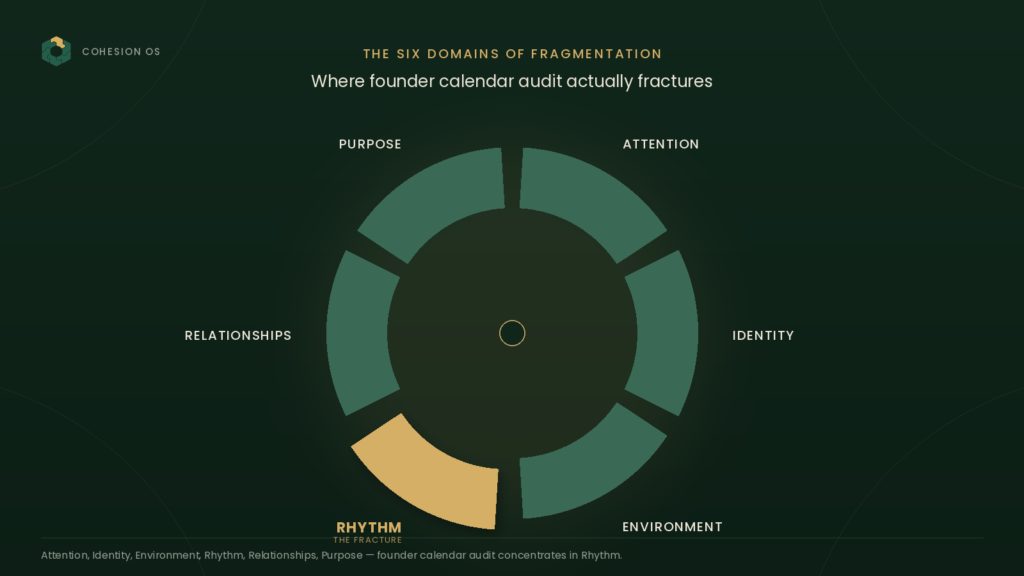
This is the domain of Rhythm: the structure that decides when decisions get made, reviewed, and closed, rather than leaving that timing to whoever messages first. A founder-led company without a working rhythm doesn’t run on a schedule. It runs on interruption.
Why Founders Stay Stuck in This Pattern
The loop repeats in a predictable shape.
Pressure rises, a decision needs to be made faster than the team’s current ownership structure allows, so the founder steps in manually to unblock it. The team learns, correctly, that the fastest path through any ambiguous situation is to route it to the founder. Dependency deepens. The founder becomes more overloaded, has less time to build the systems that would remove the dependency, and the underlying structure never gets corrected. Weeks later, a new version of the same problem appears in a different department, wearing a different name, and the cycle restarts.
This is why a founder can feel simultaneously essential and completely underwater. The company runs, but only because the founder is the connective tissue holding fragmented parts together in real time. That isn’t leadership. It’s load-bearing dependency, and it doesn’t show up on a P&L. It shows up on a calendar.
What Changes When the Leak Is Corrected?
Correcting the leak doesn’t produce a lighter calendar overnight, and it shouldn’t be sold as if it will. What changes structurally is different.
Decisions that used to route to the founder by default start resolving without them, because ownership has actually been assigned rather than assumed. Protected time starts holding because the team has been told, explicitly, what “protected” means and what happens instead of interrupting. The founder’s judgment gets documented in enough places that it stops being a single point of failure. And the operating rhythm, weekly reviews, clear escalation paths, defined decision windows, starts absorbing what used to land as unplanned interruptions.
None of this requires the founder to work less in the short term. It requires the founder to stop being the default answer to every open question.
Founder Field Note
One founder came in convinced the problem was time management. His calendar was full six weeks out, he’d tried three different scheduling tools, and he’d started waking up at 5am to get “real work” done before the interruptions started.
The real issue wasn’t his schedule. It was that four separate people on his team, across ops, sales, and delivery, had no clear authority to make calls in their own areas without checking with him first. Not because he’d told them to check with him. Because nobody had ever formally told them they didn’t need to.
The first correction wasn’t a new calendar system. It was a single afternoon spent explicitly assigning decision ownership across those four areas, in writing, with the boundaries of each person’s authority stated plainly enough that “just checking with you” stopped being the safe default.
Within three weeks, his 5am wake-ups stopped being necessary, not because his calendar had less on it, but because the decisions filling it had actually moved. This pattern repeats because founders instinctively treat a full calendar as a scheduling problem, when it is almost always an ownership problem wearing a scheduling disguise.
Common Mistakes With a Founder Calendar Audit
Auditing time instead of decisions. Tracking hours spent in meetings tells you very little. Tracking which decisions arrived unplanned, and why they had nowhere else to go, tells you everything.
Assuming the fix is fewer meetings. Some meetings are the rhythm working correctly. Cutting them without replacing what they do just pushes the same decisions back into ad hoc interruptions.
Blocking time without changing what the team is told. A calendar block is a note to the founder. It is not an instruction to the team unless it’s communicated as one.
Treating the audit as a one-time fix. A single week of tracking reveals a pattern. It doesn’t correct it. Without a rhythm to keep reviewing ownership, the leak reopens within a month.
Confusing being busy with being load-bearing. A full calendar can mean the business is genuinely growing. It can also mean too much still depends on one person holding it together. The audit’s job is to tell the two apart.
Skipping the documentation step. If the judgment behind a decision only exists in the founder’s head, ownership can be assigned on paper and the loop will still come back, because the person who owns it has nothing to make the call with.
How to Start Correcting Where Your Time Goes
Track for one real week, not an idealised one. Log every unplanned interruption, meeting add, or “quick question” as it happens, along with who it came from and what decision it required.
Sort by decision type, not by time spent. Group the interruptions into categories: pricing, hiring, client exceptions, operational judgment calls. Patterns emerge fast.
Ask, for each category, who else could own this. Not who could be trained eventually. Who already has enough context to own it now, if given explicit authority.
Write the ownership down and say it out loud. Verbal permission fades. A written, communicated decision boundary is what actually changes team behaviour.
Set a review rhythm, not a one-off fix. Revisit ownership monthly. Dependencies re-form quietly if nothing checks for them.
Do not try to fix the entire business at once. Start where the fracture is loudest.
FAQ
How long should a founder calendar audit take?
One full working week is usually enough to see the pattern clearly. Shorter periods miss recurring weekly rhythms like Monday planning chaos or Friday client fires. Longer periods add detail without changing the diagnosis.
Is a founder calendar audit the same as time blocking?
No. Time blocking schedules intended activity. A calendar audit examines what actually happened and why, which is usually a very different picture from the intended week.
What if the team genuinely needs the founder for most of these decisions?
That’s worth testing directly rather than assuming. Most founders overestimate how much genuinely requires their specific judgment, and underestimate how much just requires someone being given explicit permission to decide.
Can this be fixed without hiring anyone new?
Often, yes. Most of the leak comes from unclear ownership among people already on the team, not from a missing headcount. Hiring without fixing ownership just adds another person routing decisions upward.
Next Step
If this sounds familiar, do not add another system yet. First, identify where the fracture is actually happening. Take the Founder Cohesion Assessment to see which domain is creating the most fragmentation and what to correct first.
Author
Dominik Boecker is the creator of Cohesion OS. He helps founder-led companies identify the fracture lines that create overload, dependency, and operational fragmentation, then install the systems that restore cohesion across attention, identity, environment, rhythm, relationships, and purpose.