
Fast Answer
Company purpose is not usually missing in a founder-led company. It is usually sitting on a slide, a website page or a founder’s memory, and never translated into the choices people make each week. When purpose has no route into daily decisions, teams stay busy but scatter their effort across whatever is loudest. Founders experience it as a full calendar that does not compound. The first correction is not a better mission statement, but one decision rule that turns purpose into a yes or a no.
Key Takeaways
- Company purpose fails in the gap between the statement and the weekly decision, not in the wording of the statement.
- A busy team with no direction is a structure problem. Effort is real, but nothing tells it where to go.
- When purpose does not filter decisions, every choice returns to the founder, because only the founder knows what it was for.
- A rewrite of the mission fixes the language once. A decision rule fixes the behaviour every week.
- You do not need a new strategy. You need three decisions a month that visibly use the purpose as the deciding factor.
What Is Company Purpose, and Why Does It Stop Reaching the Work?
It is Wednesday, 11:20am. Your ops lead messages: a large client wants a rush project, the margin is thin, and it would pull two people off the work you said mattered this quarter. She is asking you, again, because the all-hands slide on Monday said “our purpose is to help independent practices run without chaos”, and that did not tell her what to do. You reply with a thumbs up and “go for it, we need the revenue”. By Friday, nobody remembers the slide.
Company purpose is the reason the business exists and the direction its effort is meant to compound in. In a working company, it shows up as a filter: it makes some choices obvious and others unattractive. In a fractured one, it lives in a document, and the daily work runs on whatever arrives first.
The visible symptom is a team that is busy and a founder who cannot say what moved the business forward. The real issue sits in the Purpose domain. Direction exists, but nothing connects it to Tuesday morning.
Why Doesn’t a Better Mission Statement Fix Company Purpose?
The usual response is a purpose workshop. A day away, sticky notes, a refined statement, a new slide. It feels like clarity, and for a few weeks the language is quoted in meetings.
Then a rush client arrives, a hire needs a decision, a new tool looks promising. Each is judged on its own, on urgency and on the founder’s mood, because the statement does not say how to decide. A sentence that inspires is not a sentence that decides.
Working harder does not close the gap. Hiring more people spreads the drift across more desks. A new planning tool records the activity without ranking it. And more all-hands meetings repeat the statement without changing a single choice. The problem was never the words. It was the missing route between the words and the work.
The Hidden Mechanism Behind Purpose Drift
Purpose becomes a filter only when it is translated into rules the team can use without asking. Most companies skip that step. The statement is written at the level of the whole business, while decisions are made at the level of a Wednesday message.
Three things then compound. First, decisions get judged on short-term pressure, because there is no longer-term test to apply. Second, the team learns that the founder’s mood is the real strategy, so they check with the founder instead of with the purpose. Third, effort scatters: ten reasonable projects each move a little, and none of them moves far enough to compound.
Then the loop closes. Because decisions return to the founder, the founder has no time to translate the purpose into rules. Because no rules exist, decisions keep returning to the founder. The statement stays on the wall, and the business is steered by whoever messaged last.
Other domains feed the same fracture. Rhythm is involved because no weekly review asks whether the work matched the direction. Systems is involved because there is no decision log showing how past choices connected to purpose. Relationships carry the load, because the leaders closest to the founder are the ones who guess what it was for. Purpose is where the cost shows up, but it is rarely the only place the cause sits.
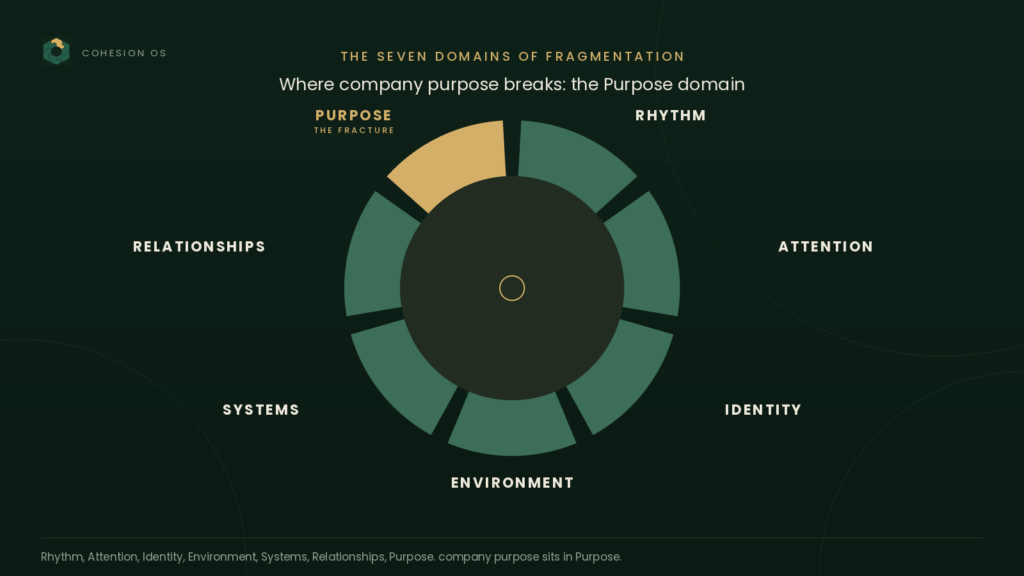
Which of the seven domains is fracturing your company right now?
The Founder Cohesion Assessment takes a few minutes and shows which domain is creating the most fragmentation.
Why Founders Stay Stuck in a Busy Team With No Direction
Pressure rises, so the founder steers by hand. A client is unhappy, so they take the call. A new opportunity appears, so they say yes. Each answer is reasonable on its own, and each one teaches the team that direction is something you ask for, not something you apply.
The team grows more dependent, because the fastest route to a decision is still the founder. The founder grows more overloaded, because every new project adds new questions to the same inbox. The pattern is never corrected, because correcting it means deciding what the purpose rules out, and that decision keeps losing to the week’s urgent request.
It also stays hidden because the output looks like progress. A scattered quarter is full of delivered work, happy clients and new initiatives. Only when the founder asks what compounded does the gap become visible.
What Changes When Company Purpose Is Corrected?
Structural improvements, not miracles. Decisions that used to travel to the founder get answered where they arise, because the team has a test to apply. The rush client with the thin margin gets a quick no, or a quick yes, using a rule written once and understood by everyone.
Effort starts to stack. Projects that point the same way build on each other, and the ones that do not are visible early. The founder stops being the only place where the direction lives. None of this needs a new strategy. It needs the existing purpose translated into a few rules the company can carry without the founder in the room.
Founder Field Note
One founder came in believing his team lacked ambition, because projects kept stalling after the quarterly planning day. The real issue was that the plan named goals but never named what the company would refuse. The first correction was not a new plan. It was one written rule: any project that did not serve repeat clients waited for the next quarter. Within two months the team was declining work on their own and bringing him fewer decisions. This pattern repeats because founders state a direction and never say what it excludes.
Common Mistakes with Company Purpose
- Rewriting the mission statement and expecting behaviour to follow.
- Stating what the company is for without stating what it will refuse.
- Repeating the purpose at all-hands instead of using it in decisions.
- Keeping the translation in the founder’s head, where nobody else can apply it.
- Setting goals every quarter that do not trace back to the purpose.
- Treating drift as a team attitude problem instead of a missing route.
How to Start Correcting Company Purpose
- List the last ten decisions you made. The rush client, the hire, the tool, the discount. Write what each was based on.
- Mark which ones the purpose actually decided. Most will be urgency or mood. Those are the gaps.
- Write one decision rule. One sentence: “We say yes to work that does X, and wait on work that does not.” Put it where the team makes decisions.
- Test it on three live decisions this month. Let someone other than you apply it, and note the result.
- Add one question to the weekly review. “Which work this week served the direction, and which did not?” Same question every time.
Do not try to fix the entire business at once. Start where the fracture is loudest.
Purpose Fragmentation Domain: Scorecard and Playbook
If Purpose is the domain creating the most friction in your company right now, the Purpose Scorecard and Playbook walk through the correction in detail.
FAQ
Why does company purpose stop guiding daily work?
Because it is written at the level of the whole business while decisions are made at the level of a single message. Without a rule that translates one into the other, the team falls back on urgency and on the founder’s judgement. The statement stays accurate, but it is never consulted.
How is a decision rule different from a mission statement?
A mission statement describes where the company is going. A decision rule tells someone what to do on a Wednesday when two options compete. It is short, specific, and can say no. A statement can inspire a team, but only a rule lets them act without asking the founder.
Do I need to rewrite our purpose to fix this?
Usually not. Most purposes are good enough. The fracture is in the translation, not the wording. Start with the existing statement, write one rule that follows from it, and test the rule on live decisions before changing any language.
How long before the team uses the purpose in decisions?
Expect about a month of testing the rule on real choices. The common failure is overriding it in the first difficult week, which teaches everyone it was never binding. Once people see it hold under pressure, they begin applying it without being asked.
Next Step
If this sounds familiar, do not add another system yet. First, identify where the fracture is actually happening. Take the Founder Cohesion Assessment to see which of the seven domains is creating the most fragmentation in your company and what to correct first.
A purpose that cannot say no is only a slogan.
Find out where the fracture really is.
Take the Founder Cohesion Assessment and see which of the seven domains to correct first.
About the Author
Dominik Boecker is the creator of Cohesion OS. He helps founder-led companies identify the fracture lines that create overload, dependency, and operational fragmentation, then install the systems that restore cohesion across rhythm, attention, identity, environment, systems, relationships, and purpose.