
Fast Answer
Documentation erosion is not mainly caused by lazy teams or the wrong tool. It is usually caused by processes that were written once and never owned, so the business moves on while the document stays still. When the gap grows, people stop trusting the page and ask the founder instead. Founders experience it as solving the same problem again and again. The first correction is not a documentation sprint, but an owner and a review date on the few processes the company runs most.
Key Takeaways
- Documentation erosion is gradual. Every change is made in practice first and in the document never.
- Once a process document is wrong in one place, people stop trusting all of it, and then nobody updates it.
- The founder becomes the living documentation, which is the dependency the documents were meant to remove.
- A documentation sprint fixes the pile once. Without owners and review dates, the pile erodes again.
- You do not need to document everything. You need five processes with an owner, a date and a habit of updating.
What Is Documentation Erosion?
It is Thursday, 4:05pm. A new starter asks how refunds are handled. You say it is in Notion and send the link. She comes back ten minutes later: the page mentions a tool you stopped using in March, a person who left in the summer, and a threshold that is no longer the rule. It was last edited fourteen months ago. You record a voice note explaining what actually happens, and tell her you will update the doc later.
Documentation erosion is the slow drift between how a process is written down and how it actually runs. It is not a single failure. It happens through dozens of small changes, each made in conversation, a Slack thread or someone’s head, and none of them reaching the page.
The visible symptom is a team that asks the founder questions that were answered last quarter. The real issue sits in the Systems domain. Recurring problems are supposed to get solved once and stay solved. When the document drifts from reality, they get solved again, usually by the same person.
Why Doesn’t Writing More SOPs Fix Documentation Erosion?
The usual response is a documentation push. An intern, a long weekend or a new tool, and a folder of tidy process pages by the end of the month. It feels like progress, because it is: for a few weeks the documents are right.
Then the business changes. A supplier is replaced, a rule is tightened, a step is dropped because nobody needed it. Each change is made where the work happens, not where the document lives. Within a quarter, a handful of pages are wrong. Within a year, nobody is sure which.
More writing does not fix this, because the problem was never a shortage of documents. It was the absence of anyone responsible for keeping them true. A better tool does not help either. A tidy workspace with stale pages simply makes the staleness look official. And working harder at it, with the founder updating pages at weekends, turns documentation into another task only the founder holds.
The Hidden Mechanism Behind Documentation Erosion
A process document is a snapshot. It is accurate on the day it is written and starts ageing immediately. The business keeps changing, so the distance between the page and the practice only grows.
Three conditions let it happen. First, nobody owns the document, so updating it is everyone’s job and therefore no one’s. Second, there is no review date, so a page can be wrong indefinitely without anyone being prompted to check it. Third, changes happen in conversation, and the conversation is complete before anyone thinks to touch the page.
Then a feedback loop sets in. The first time a team member follows a document and finds it wrong, their trust drops. The second time, they stop reading it. Once nobody reads it, nobody notices when it is wrong, and nobody has a reason to update it. The document is not just stale. It is abandoned.
The founder fills the gap. Someone has to know how things really work, and the person who set it up, changed it, and remembers why is usually the founder. Other domains feed the same fracture. Attention is drained by repeated questions. Rhythm is involved because no recurring slot exists for review. Environment is involved because documents are scattered across tools, so even the owner cannot find the current one. Systems is where the cost shows up, but it is rarely the only place the cause sits.
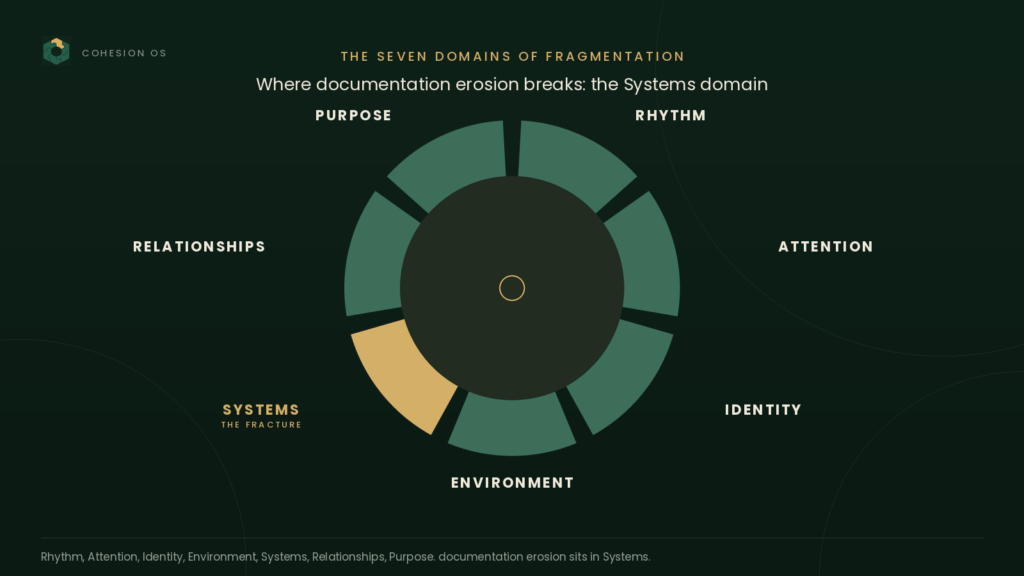
Which of the seven domains is fracturing your company right now?
The Founder Cohesion Assessment takes a few minutes and shows which domain is creating the most fragmentation.
Why Founders Stay Stuck in the Documentation Loop
Pressure builds, and a repeated question becomes the trigger. The same refund query arrives for the fourth time, so the founder decides it is time to document everything. A few weeks later the folder looks impressive and the team is told to use it.
Nobody has been given ownership, so nothing changes in how the documents are maintained. The business moves. The first stale page is found and ignored, then the second. By the end of the year the founder is answering the same questions again, and the documentation project is quietly written off as something that did not stick.
It repeats because the cycle looks like a motivation problem. In practice it is a structure problem: the project was treated as a one-off job, and a process is a living thing that needs a keeper.
What Changes When Documentation Erosion Is Corrected?
A small set of documents becomes trustworthy, and that changes behaviour more than a large set of uncertain ones. Each has a named owner and a date it was last checked. When something changes, the owner changes the page the same day, so the document and the practice move together.
The team starts reading the documents, because they have learnt they are right. Questions that used to reach the founder get answered by a link. Solved problems stay solved, and the company starts to remember what it has learnt. None of this needs a big programme. It needs a handful of owners and one habit.
Founder Field Note
One founder came in believing his team would not follow the processes he had paid someone to write. The real issue was that half of them were out of date, and the team had learnt to ask him instead. The first correction was not a rewrite. It was choosing the five processes the company ran most, giving each an owner, and adding a “last checked” line at the top of every page. Within six weeks the number of process questions reaching him dropped sharply, because the five pages were finally right and people knew it. This pattern repeats because founders document once and never appoint anyone to keep it true.
Common Mistakes with Documentation Erosion
- Running a one-off documentation sprint with no owners afterwards.
- Documenting everything instead of the five processes that run most often.
- Treating a stale page as harmless, when people still follow it.
- Keeping the updating job with the founder.
- Choosing a new tool as the fix, without deciding who maintains what.
- Making changes in Slack or in conversation and leaving the page for later.
How to Start Correcting Documentation Erosion
- Pick the five processes the company runs most. Refunds, onboarding, hiring, invoicing, a client handover. Ignore the rest for now.
- Give each one an owner. One named person, not a team. They are responsible for it being true.
- Add a “last checked” line to the top of each page. The owner’s name and a date. It tells every reader how far to trust it.
- Make the update the last step of any change. When a process changes, the owner updates the page that day. A change is not finished until the page matches.
- Review one process a week. Twenty minutes, in a fixed slot. Five weeks later, every page has been checked.
Do not try to fix the entire business at once. Start where the fracture is loudest.
Systems Fragmentation Domain: Scorecard and Playbook
If Systems is the domain creating the most friction in your company right now, the Systems Scorecard and Playbook walk through the correction in detail.
FAQ
What causes documentation erosion in a growing company?
Change without ownership. Processes shift in practice, in a message or a decision, while the document stays as written. With no owner and no review date, nothing prompts anyone to bring the page back in line. The longer it runs, the less anyone trusts the page, and the less likely it is to be updated.
How many processes should a founder-led company document?
Fewer than you think. Start with the five that run most often or cost the most when they go wrong. A small set that is correct and trusted does more for the company than a large library nobody believes. Add more only when the first five are being kept up.
Should the founder write the documentation?
The founder can supply the first draft, but should not be the owner. The owner should be whoever runs the process, because they are the first to notice when it changes. If the founder keeps the maintenance, the documents become one more thing that depends on them.
How often should process documents be reviewed?
Once a quarter at a minimum for each process, which a weekly twenty-minute slot covering one document achieves comfortably with about a dozen pages. The key is a fixed slot, so the review does not depend on anyone remembering it.
Next Step
If this sounds familiar, do not add another system yet. First, identify where the fracture is actually happening. Take the Founder Cohesion Assessment to see which of the seven domains is creating the most fragmentation in your company and what to correct first.
A document nobody trusts is not documentation. It is a rumour with a title.
Find out where the fracture really is.
Take the Founder Cohesion Assessment and see which of the seven domains to correct first.
About the Author
Dominik Boecker is the creator of Cohesion OS. He helps founder-led companies identify the fracture lines that create overload, dependency, and operational fragmentation, then install the systems that restore cohesion across rhythm, attention, identity, environment, systems, relationships, and purpose.