
Fast Answer
A weak founder operating rhythm is not mainly caused by a messy calendar or a lack of discipline. It is usually caused by the absence of fixed points: nothing in the business has a set time, so whichever issue is loudest sets the agenda. When decisions, reviews and priorities have no home, founders experience a week that is full but never lands. The first correction is not better time management, but one fixed point the business can rely on, held every week without negotiation.
Key Takeaways
- A weak founder operating rhythm is not a discipline problem. It is a structure problem: nothing is fixed, so everything is negotiable.
- A reaction pattern feels like busyness, which is why founders rarely question it.
- Rhythm is not a calendar. It is a small set of fixed points (a decision slot, a weekly review, a planning block) that the team can rely on.
- Every unfixed decision becomes an interruption, and the founder is usually the one interrupted.
- You do not need a full operating cadence on day one. You need one fixed point that survives a bad week.
What Is a Founder Operating Rhythm?
It is Monday, 8:42am. You opened your laptop to plan the week. By 8:55 you have answered a WhatsApp about a supplier, approved a refund in Stripe, skimmed a Slack thread you were tagged in, and replied to a “quick question” about a client proposal. The plan for the week is still a blank page. By Friday you could not say which of your five priorities moved, but you could list thirty things you handled.
A founder operating rhythm is the set of fixed points that decide when the business makes decisions, reviews progress and plans ahead. It is not a to-do list, a morning routine or a calendar full of recurring meetings. It is the answer to a simple question: when does this kind of thing get decided, and does everyone know?
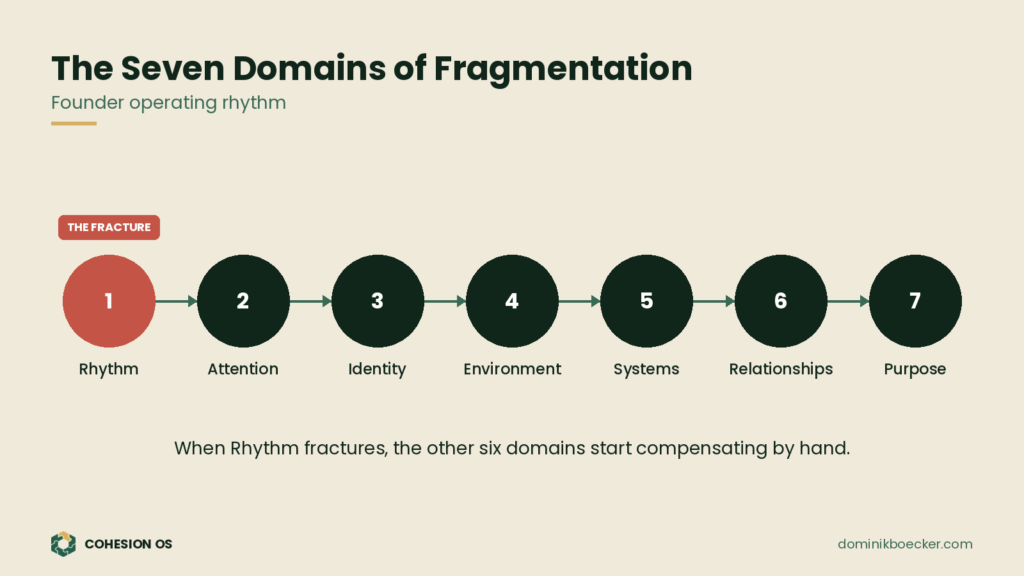
When that answer is missing, the visible symptom is a week that feels reactive. The real issue sits in the Rhythm domain, the first of the seven domains. Without fixed points, the business has no way to hold a decision until its proper moment, so every issue arrives at the founder immediately and demands a response now.
Why Does a Better Calendar Not Fix Your Founder Operating Rhythm?
Most founders try to fix a reactive week by rearranging it. They colour-code the calendar, block out deep work from 9 to 11, add a morning routine, or download a new planning app. For about nine days it works. Then a customer escalates, a hire falls through, or a co-founder needs an answer, and the blocks are the first thing to go.
The calendar was never the problem. A protected block is not protected if the team still treats it as available time. A block is a promise only the founder knows about, so a message lands in the middle of it and the founder answers, because answering is easier than explaining why they should not.
Working harder fails for the same reason: more effort inside a structure with no fixed points just means reacting faster. More meetings do not help either, because a meeting without a fixed decision slot is simply another place for urgency to arrive.
The Hidden Mechanism Behind a Reaction Pattern
A reaction pattern forms when decisions have no home. In the early days that is fine: the company is small, the founder is in every conversation, and answering immediately is the fastest way to move. As the business grows past roughly £3M, the number of decisions grows faster than the founder can hold. Each one still arrives the way it always did, as a message, a tap on the shoulder or a call, and each one still gets answered on arrival.
Three things then compound. First, the team learns that the fastest route to an answer is the founder, so they stop holding questions until a proper moment. Second, the founder learns that the day is only manageable if they respond quickly, so they stay in reactive mode. Third, nothing is ever scheduled for thinking, so strategic work gets whatever is left, which is usually nothing.
Other domains feed the same fracture. Attention is drained because every input is treated as urgent. Systems are thin because no decision rule exists that would let the team answer without asking. Relationships carry the load, because the people closest to the founder get the unscheduled version of every conversation. Rhythm is where the cost shows up, but it is rarely the only place the cause sits.
Founder Cohesion Assessment
Find out where your company is fracturing first.
See which of the seven domains is creating the most fragmentation in your company, and what to correct first.
Why Founders Stay Stuck in Reactive Mode
Pressure rises, so the founder reacts manually. A supplier is late, so they call. A hire is wavering, so they step in. A client is unhappy, so they take the meeting themselves. Each response is reasonable on its own, and each one teaches the company that this is how things get solved.
The team grows more dependent, because the fastest route to a decision is still the founder. The founder grows more overloaded, because every new person adds new questions to the same channel. The pattern is never corrected, because correcting it would mean deciding what gets decided when, and that decision itself needs a fixed slot nobody has made. So the problem returns in a new form: a bigger team, a bigger inbox, the same reaction pattern.
Founders also stay stuck because the pattern feels productive. A reactive week is full of visible output: replies sent, fires put out, people helped. It is only on the Friday review, if there is one, that the missing movement on the work that matters becomes visible.
What Changes When Founder Operating Rhythm Is Corrected?
Structural improvements, not miracles. The week stops being shaped by whoever messaged first. Decisions that are not urgent wait for their slot, and the team learns to hold them, because they know the slot is real. The founder reaches the end of the week able to say what moved.
The company also becomes easier to run without the founder in the room. When a decision has a home, someone else can prepare it. When a review is fixed, problems surface early instead of in a crisis. None of this requires the founder to become more disciplined. It requires the business to carry a small amount of structure so the founder does not have to carry all of it personally.
Founder Field Note
One founder came in believing the problem was time management: too many tasks and not enough hours. The real issue was that nothing in the company had a fixed time. Pricing questions, hiring decisions and client escalations all arrived whenever they arose and were answered whenever they arrived.
The first correction was not a new planner. It was one fixed 45-minute decision slot on Tuesdays and Thursdays, where everything non-urgent was held and cleared. Within a month the team stopped sending the “quick one” and started saving it. This pattern repeats because founders try to manage time when the problem is that decisions have no place to land.
Common Mistakes with Founder Operating Rhythm
- Building a perfect weekly schedule that only the founder knows about.
- Protecting deep work in the calendar while the team still treats it as available time.
- Adding more recurring meetings without deciding what each one is for.
- Letting the review slip in a busy week, which is exactly the week it matters most.
- Waiting until the business is “calmer” before installing any structure.
- Copying another company’s cadence instead of fixing the one decision type that is hurting most.
How to Start Correcting Your Founder Operating Rhythm
- List the ten interruptions from last week. Use the real ones: the WhatsApp about the supplier, the refund, the “can you just approve this”.
- Sort them into urgent and merely arrived. Most are the second kind, and they are the ones a fixed slot can absorb.
- Create one decision slot. Forty-five minutes, twice a week, same time. Tell the team that non-urgent questions are held for it.
- Add one weekly review. Thirty minutes on Friday: what moved, what did not, what is decided next week. Same agenda every time.
- Hold both for four weeks before adding anything. A fixed point earns trust by surviving a bad week.
Do not try to fix the entire business at once. Start where the fracture is loudest.
Rhythm Fragmentation Domain
Rhythm Fragmentation Scorecard + Playbook Bundle
Score where your operating rhythm is breaking, then follow the playbook to install the fixed points your business can rely on.
FAQ
How do I know if my week runs on reaction rather than rhythm?
Look at last Friday. If you cannot name which priorities moved, but you can list dozens of things you handled, the week was shaped by arrival order, not intent. Another sign is that your best hours reach decisions only you can make less than once a week. Reaction patterns feel busy, which is why they go unquestioned for so long.
Is a founder operating rhythm the same as a routine?
No. A routine is a personal habit, such as a morning workout or a planning session before the inbox opens. A founder operating rhythm is a set of fixed points the business relies on: when decisions get made, when progress is reviewed, and when priorities are set. A routine only holds the founder. A rhythm holds the company.
Will fixed decision slots slow the business down?
For urgent issues, no. They still reach you straight away. For everything else, a held decision is usually a better decision, because it arrives with context and alongside related questions. Most teams find that response times on real emergencies stay the same while the volume of interruptions drops noticeably.
How long does it take to install a founder operating rhythm?
The first fixed point can be in place this week. Trust takes longer. Expect about four weeks of holding the slot before the team stops testing it. The common failure is abandoning the slot in the first busy week, which teaches everyone it was never real.
Next Step
If this sounds familiar, do not add another system yet. First, identify where the fracture is actually happening. Take the Founder Cohesion Assessment to see which of the seven domains is creating the most fragmentation in your company and what to correct first.
A week without fixed points is not a flexible week. It is an unowned one.
Founder Cohesion Assessment
Find out where your company is fracturing first.
See which of the seven domains is creating the most fragmentation in your company, and what to correct first.
About the Author
Dominik Boecker is the creator of Cohesion OS. He helps founder-led companies identify the fracture lines that create overload, dependency, and operational fragmentation, then install the systems that restore cohesion across rhythm, attention, identity, environment, systems, relationships, and purpose.