
Fast Answer
The real discipline problem is not a willpower failure, it is a missing structural standard nobody built. Founders blame themselves for inconsistency, missed workouts, abandoned habits, half-finished initiatives, when the actual issue is that no system exists to hold the standard for them. Willpower was never designed to carry that weight alone. The fix is building the structure, not trying harder to be disciplined.
Key Takeaways
- What looks like a personal discipline failure is usually a structural gap, no system exists to hold the standard, so willpower has to carry the entire load
- Willpower is a finite, depleting resource. Structure does not deplete the same way, which is why disciplined-looking people usually have more structure, not more willpower
- Founders default to self-blame because naming the structural gap feels like making excuses, even when it is the accurate diagnosis
- Trying harder rarely closes this gap, because effort applied to a missing system does not create the system
- The fix is building the structure that removes the need for willpower in the first place, not motivational pushes
- Founders who correct this stop describing themselves as undisciplined, because the standard finally holds without needing constant personal effort
3-Minute Diagnostic
Which of the seven domains is actually costing you the most?
What Is the Real Discipline Problem?
Almost every founder has a private list of things they think reveal a personal discipline failure. The workout routine that fell apart after two weeks. The morning routine abandoned by week three. The strategic initiative that started strong and quietly died under the weight of daily fires. Each one gets filed under the same explanation, “I am just not disciplined enough.”
That explanation is almost always wrong. The actual pattern is structural, not personal. In every one of these cases, the standard was being held entirely by willpower, a daily act of personal effort, with no system, cue, or structure doing any of the work. Willpower is a real but finite resource. Asking it to carry an entire standard, indefinitely, with no structural support, is not a discipline test. It is a design flaw.
The visible symptom is a founder who feels chronically inconsistent and privately ashamed of it. The real mechanism is the absence of a system that would make the standard hold without requiring constant personal effort. Disciplined-looking people are rarely relying on more willpower than everyone else. They usually have more structure quietly doing the work willpower would otherwise have to do alone.
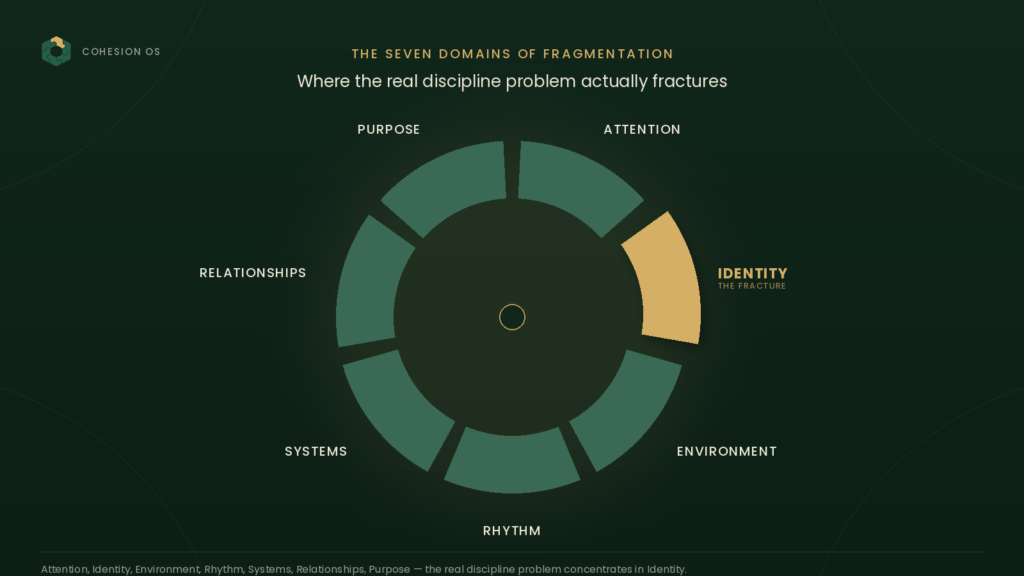
Cohesion OS treats this as an identity and alignment fracture. Founders internalise inconsistency as a character flaw when it is actually a missing structural layer, and that misdiagnosis is exactly what keeps the pattern from ever getting fixed.
Why Doesn’t Trying Harder Fix This?
The standard response to a discipline failure is to try harder next time, more willpower, more motivation, a fresh start on Monday. Founders do this repeatedly and the pattern returns almost every time.
Here is why. Trying harder is an attempt to generate more of a resource that is inherently limited and that depletes further under stress, exactly the conditions most founders operate under daily. If the standard has no structural support, “trying harder” just means asking an already-strained resource to do even more work than before. It rarely holds for long, and when it inevitably fails again, the founder reads the failure as further proof of a personal flaw, rather than confirmation that the approach itself was never going to hold.
This is the same trap as trying to fix a capacity leak through longer hours, or an approval bottleneck through faster responses. The intervention targets personal effort when the actual gap is structural. No amount of willpower creates a system that was never built.
The Real Mechanism Behind the Discipline Problem
There is a specific, repeatable pattern behind why this gets misdiagnosed so consistently.
Willpower is treated as infinite when it is actually finite and depleting. Every act of self-control draws on the same limited resource. Standards that rely entirely on willpower are structurally guaranteed to fail once that resource runs low, which happens regularly for anyone running a business.
Structure removes the need for willpower, it does not compete with it. A genuinely disciplined-looking habit usually has cues, defaults, and friction removed from it, an environment built to make the standard the easy path. Willpower barely gets called on, because the structure is doing the actual holding.
Self-blame feels more comfortable than naming the structural gap. Blaming personal discipline keeps the story simple and avoids the harder work of admitting no system was ever built. Naming the structural gap can feel like making excuses, even when it is the more accurate and more actionable diagnosis.
The pattern repeats because the diagnosis never changes. As long as inconsistency gets filed under “I need to be more disciplined,” the actual fix, building structure, never gets attempted, and the same standard fails the same way every time.
Why Founders Stay Stuck in This Pattern
The loop looks like this: a standard fails because it was relying entirely on willpower, the founder interprets this as a personal discipline failure, they recommit with more willpower and motivation, the new attempt also has no structural support, it fails again under the same conditions, and the founder concludes even more firmly that they lack discipline. Nobody stops to examine whether the standard was ever structurally supported in the first place, because the explanation has already been settled as personal.
This is why fresh starts, new year, new quarter, new Monday, rarely hold. A fresh start with the same lack of structure just resets the clock on the same guaranteed failure, dressed up as renewed motivation.
What Changes When This Is Corrected?
When this fracture is corrected, standards stop depending on daily willpower and start depending on structure, defaults, cues, removed friction, that holds the standard automatically. The founder is not becoming a fundamentally more disciplined person. They are removing the need for the kind of constant personal effort that was always going to run out eventually.
This is not about lowering standards. It is about building the structure that lets a standard survive contact with a genuinely demanding week.
Founder Field Note
One founder described himself as chronically undisciplined, unable to stick to any personal standard longer than a few weeks, despite running a genuinely successful business. He assumed the fix was more accountability, a coach, a tracking app, something to force the discipline.
The real issue surfaced when he mapped exactly what each failed standard had actually relied on. Every one of them depended entirely on remembering and choosing to do it, in the moment, with no structural support at all. Nothing made the standard the default or easy option. Everything required active willpower, every single time.
The first correction was not more accountability. It was redesigning one standard, a specific weekly review, so it happened automatically inside an existing routine he never skipped, rather than as a separate thing requiring a fresh decision each week.
Within two months, that one standard had held consistently for the first time in years, not because he had become more disciplined, but because it had finally stopped requiring discipline to maintain.
This pattern repeats because self-blame feels like the responsible explanation. It is only visible as a misdiagnosis once you check whether the standard ever had structural support, or was always running on willpower alone.
Common Mistakes with the Discipline Problem
- Treating every inconsistency as evidence of a personal character flaw. Most inconsistency traces back to a missing structure, not a missing trait.
- Responding to failure with more motivation instead of more structure. Motivation is a limited resource. Structure is not, once it is built.
- Assuming a fresh start will succeed where the last attempt failed. Without structural change, a fresh start just repeats the same failure on a new timeline.
- Adding accountability without addressing the missing structure underneath. Accountability without structure is still asking willpower to do the entire job.
- Comparing yourself to people who look more disciplined without examining their actual structure. They likely have more support built in, not more raw willpower.
- Giving up on the standard entirely after repeated failure. The standard was rarely the problem, the missing structure underneath it was.
How to Start Correcting This
- Pick one standard you have repeatedly failed to maintain. Choose something specific, not a vague general intention.
- Map exactly what currently holds that standard. Be honest about whether anything beyond memory and willpower is actually supporting it.
- Identify what structural change would remove the need for willpower. A default, a cue, a removed friction point, something that makes the standard the easy path.
- Build that structural change before attempting the standard again. Do not restart the same unsupported version and expect a different result.
- Track whether the standard holds for a month with the new structure in place. If it does, you have found the actual fix. If not, the structure needs further adjustment, not more willpower.
Do not try to fix the entire business at once. Start where the fracture is loudest.
FAQ
Does this mean discipline does not matter at all?
Discipline still matters, but it is not meant to carry an entire standard alone indefinitely. The goal is reducing how much willpower a standard requires, not eliminating discipline as a concept.
How do I know if my problem is structural or genuinely about effort?
Ask whether the standard has any support beyond your own memory and motivation in the moment. If the answer is no, the gap is almost certainly structural, not a matter of insufficient effort.
Isn’t naming a structural gap just an excuse for lack of discipline?
It is only an excuse if nothing changes afterward. Naming the actual gap accurately, and then building the structure to close it, is the opposite of an excuse, it is the correction.
Can this apply to business standards, not just personal habits?
Yes, the same mechanism applies to business standards that rely entirely on someone remembering and choosing to follow them, without any structural support, documentation, defaults, or checks built in.
3-Minute Diagnostic
Which of the seven domains is actually costing you the most?
Next Step
If this sounds familiar, do not add another system yet. First, identify where the fracture is actually happening. Take the Founder Cohesion Assessment to see which domain is creating the most fragmentation and what to correct first.
Dominik Boecker is the creator of Cohesion OS. He helps founder-led companies identify the fracture lines that create overload, dependency, and operational fragmentation, then install the systems that restore cohesion across attention, identity, environment, rhythm, systems, relationships, and purpose.