Fast Answer
Worse decisions under load aren’t a sign of a worse founder, they’re what happens to any brain running past its capacity. Intelligence doesn’t protect against decision fatigue, it just delays when the drop becomes visible. The correction isn’t trying harder to think clearly. It’s reducing the number of decisions your brain is carrying before it has to make the one that actually matters.
Key Takeaways
- Decision quality degrades predictably under cognitive load, and intelligence doesn’t prevent it, it just masks it for longer
- Smart founders often notice the drop last, because they’re skilled at rationalising a worse decision after making it
- The mechanism is depletion, not stupidity: each decision draws down the same finite resource, regardless of how minor
- Willpower and “thinking harder” don’t restore decision quality once load is high, the resource has to be protected before it runs out
- The fix is reducing decision volume before high-stakes moments, not improving decision-making skill in the moment
- Founders who correct this don’t make fewer decisions overall, they make the important ones from a much cleaner starting point
3-Minute Diagnostic
Which of the six domains is actually costing you the most?
What Does “Worse Decisions Under Load” Actually Mean?
It’s the pattern where a founder who’s genuinely sharp, good judgment, strong instincts, sound track record, starts making calls that don’t hold up. Not because they got dumber. Because the number of decisions stacked up before that moment quietly wore down the quality of the one that mattered.
Founders tend to explain this away individually. “That was a bad call because I didn’t have all the information.” “I should have slept on it.” Each explanation is plausible on its own. What gets missed is the pattern across them: the bad calls cluster on days with the most decisions already made, not on the days with the hardest single decision.
Intelligence doesn’t prevent this. If anything, it can hide it longer, smart founders are better at constructing a reasonable-sounding justification for a decision that was actually made on a depleted brain. The visible symptom is “I made a bad call.” The real mechanism is “I made my fortieth call of the day, and it happened to be the one that mattered.”
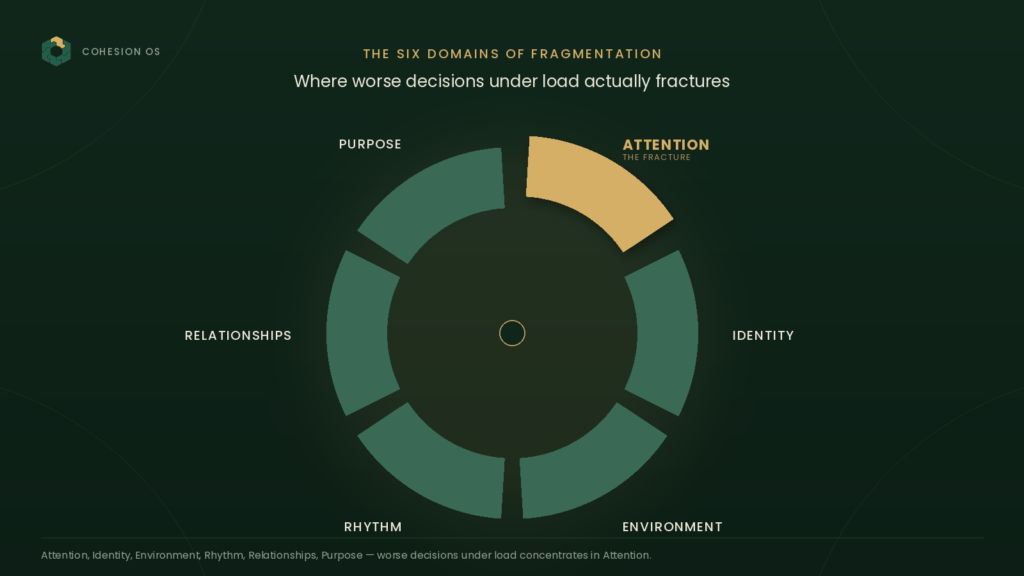
Cohesion OS treats this as an attention fracture. Decision-making draws on the same finite resource as focus and judgment. Once that resource is spent, quality drops regardless of how capable the person is.
Why Doesn’t “Just Think It Through Carefully” Fix This?
The standard advice for a bad decision is to slow down and think it through more carefully next time. Founders take this seriously, genuinely try to be more deliberate, and the pattern continues anyway.
Here’s why. “Think it through carefully” assumes the problem is effort or attention applied to that specific decision. But the actual constraint isn’t effort, it’s a depleted resource that more effort can’t restore. Trying to think harder when the resource is already spent is like trying to run faster on an empty tank, the intention is right, the mechanism doesn’t have anything left to draw on.
This is well documented outside the founder world too: judges hand down harsher sentences later in the day, and more lenient ones right after a break, regardless of case merits. Doctors make measurably different diagnostic choices depending on how many decisions they’ve already made that shift. None of these professionals are less capable later in the day. Their decision-making resource is simply lower.
Founders aren’t exempt from this because they’re driven or experienced. Trying harder on the decision itself doesn’t address a resource that was already spent on the twenty decisions before it.
The Hidden Mechanism Behind Decision Fatigue
There’s a specific, well-established mechanism at work here.
Every decision draws on the same resource, regardless of size. Choosing a vendor, approving a hire, picking a font for the deck, deciding what to have for lunch, they all pull from the same pool. The brain doesn’t meaningfully distinguish between “important” and “trivial” decisions when it comes to depletion.
The resource depletes across the day, not just during hard decisions. By the time a founder reaches an actually important call, dozens of smaller ones have already drawn the resource down, often without the founder tracking it at all.
Depletion produces two failure modes, not one. Either the founder makes an impulsive, under-considered call to get the decision over with, or they avoid deciding altogether, deferring or defaulting to the status quo. Both look different on the surface but come from the same underlying depletion.
Rationalisation hides the drop from the founder themselves. After a depleted decision goes badly, the brain constructs a plausible story for why it happened, bad luck, bad information, external factors. This is exactly why smart, self-aware founders often don’t notice the actual pattern for years.
Why Founders Stay Stuck in This Pattern
The loop looks like this: a founder makes dozens of small decisions across the day, arrives at an important one already depleted, makes a worse call than their actual judgment would produce, then spends time and energy managing the consequences of that call, which adds more decisions to the load, further depleting the resource for the next important call. Nobody names the pattern because each individual bad call has its own plausible story.
This is why “just be more careful with big decisions” doesn’t work. It assumes the founder can identify in advance which decision is the important one and save their resource for it. In practice, load accumulates from dozens of unglamorous decisions that don’t announce themselves as significant, until the founder is depleted before the moment that actually mattered even arrives.
What Changes When This Is Corrected?
When this fracture is corrected, founders don’t necessarily make fewer decisions overall, they protect the resource before the ones that matter. Low-stakes decisions get delegated, defaulted, or batched, so they stop quietly draining the same resource the important calls need. The founder arrives at the decisions that genuinely require their judgment with something left to draw on.
This isn’t about becoming a more decisive person. It’s about your decision-making resource no longer being spent before you reach the moment that actually needs it.
Founder Field Note
One founder prided himself on being decisive, he made dozens of calls a day without hesitation and saw it as a strength. But his biggest strategic decisions, the ones with real consequences, kept going worse than his track record suggested they should.
The pattern only became visible once he tracked, for two weeks, what time of day his major decisions actually happened. Almost every one of them landed late afternoon, after a full day of smaller approvals, hiring questions, and vendor calls. His “decisiveness” on small things was quietly costing him the resource he needed for the big ones.
The first correction wasn’t becoming more careful in the moment. It was moving his one or two genuinely important decisions to the first hour of his day, before the smaller ones had a chance to drain anything, and deliberately batching or delegating the small stuff to the afternoon instead.
Within a month, he described his big calls as “the same instinct I always had, just with something left in the tank when I need it.”
This pattern repeats because each individual decision feels fine in isolation. It’s only visible as a structural cost once you track where the important ones actually land in your day.
Common Mistakes with Decision Fatigue
- Assuming the fix is trying harder on the important decision. The resource is already spent by the time you reach it, effort can’t restore what’s depleted.
- Believing intelligence or experience makes you immune. It doesn’t prevent depletion, it just makes the resulting bad calls sound more reasonable after the fact.
- Scheduling important decisions late in the day “when things are quieter.” Quieter doesn’t mean less depleted, the resource has usually already been spent by then.
- Treating every decision as equally deserving of full deliberation. This burns the resource on low-stakes choices that didn’t need it.
- Not tracking when bad calls actually happen. Without tracking, the pattern stays invisible and each bad decision gets explained away individually.
- Assuming rest alone fixes this. Rest helps refill the resource generally, but it doesn’t address the daily accumulation pattern that depletes it before your important decisions arrive.
How to Start Correcting This
- Track the time of day for your last 10 major decisions. Look for clustering, most founders find their worst calls land in a specific window.
- Count how many decisions typically precede that window. This reveals how depleted you usually are before the moment that matters.
- Move your one or two most important decisions earlier in the day. Protect the resource for them before smaller decisions have a chance to spend it.
- Delegate, default, or batch the smallest decisions. Anything that doesn’t need your specific judgment shouldn’t be drawing on the same resource as the decisions that do.
- Re-check your decision quality after two weeks of this change. The difference is usually noticeable well before it’s dramatic.
Do not try to fix the entire business at once. Start where the fracture is loudest.
FAQ
Is this the same as being tired or needing more sleep?
Related but distinct. Sleep affects your overall capacity, but decision fatigue accumulates within a single day regardless of how rested you started it. A well-rested founder can still deplete their decision-making resource by mid-afternoon through sheer decision volume.
Does this mean I should make fewer decisions overall?
Not necessarily fewer, more sequenced. The goal is protecting the resource for decisions that genuinely need your judgment, not reducing your total decision-making footprint across the business.
How do I know if a decision actually needs my judgment or can be delegated?
Ask whether the outcome depends on context, risk tolerance, or judgment only you’re positioned to weigh. If it’s mostly a matter of applying a known standard, it’s a strong candidate for delegation or a default rule.
Can caffeine or breaks restore decision quality mid-day?
Breaks help somewhat, but they don’t fully substitute for reducing decision volume ahead of the moments that matter. The structural fix, sequencing important decisions earlier, is more reliable than trying to recover mid-depletion.
3-Minute Diagnostic
Which of the six domains is actually costing you the most?
Next Step
If this sounds familiar, do not add another system yet. First, identify where the fracture is actually happening. Take the Founder Cohesion Assessment to see which domain is creating the most fragmentation and what to correct first.
Dominik Boecker is the creator of Cohesion OS. He helps founder-led companies identify the fracture lines that create overload, dependency, and operational fragmentation, then install the systems that restore cohesion across attention, identity, environment, rhythm, relationships, and purpose.