Fast Answer
Most founders believe that once they have a founder diagnostic result, the fix will follow. A founder diagnostic shows the opposite is closer to true: knowing where the fracture is adds one more open loop unless it arrives with an order of operations. The difference matters because open loops live inside the founder. The first shift is to turn the result into one domain, three corrections, and a re-score date.
Key Takeaways
- A founder diagnostic names the fracture. It does not install the structure that fixes it.
- Insight feels like progress, which is why most results are screenshotted and never revisited.
- An unactioned result becomes an open loop, and open loops are the raw material of founder overload.
- One domain first beats seven at once, because the primary fracture usually loads the others.
- A fix is only real when a second score, on a fixed date, says so.
The Belief Every Founder Repeats
It is Sunday night, 21:40. You finish a founder diagnostic on your laptop. The result is sharp. It names the domain that is quietly costing you the most and, annoyingly, it is right. You screenshot it, send it to yourself on WhatsApp, and think: Monday, I will deal with this.
Monday, 8:52. Slack is already moving. A client asks for “just a quick call”, your ops lead wants a decision on a supplier, and the result is now somewhere between tab 14 and a half-written email. By Thursday it is a thing you meant to do.
The belief underneath is simple: once I know what is wrong, I will fix it. Founders repeat it because it has worked before. You spot a pricing error, you correct it. You see a hiring gap, you fill it.
Why It Feels True
The belief earns its place in problems with a single cause and a single owner. Diagnose the pricing error and one decision removes it. Knowledge converts directly into action because nothing stands between them.
Fragmentation does not behave that way. It sits across how the week is shaped, where attention goes, which decisions are written down and who holds authority. Knowing it exists changes none of those. Insight also feels good. Naming a pattern gives a small hit of relief, and that relief is easily mistaken for movement.
What Is Actually Happening
A founder diagnostic creates a new loop at the exact moment the founder has the least capacity to close it. The result adds an item to a head that already holds the unanswered messages, the half-built automation and the conversation you keep postponing.
Research on unfinished goals supports this. Masicampo and Baumeister found that unfulfilled goals keep intruding on attention during unrelated tasks, and that making a specific plan for the goal reduced that intrusion, even before the goal was completed. The plan, not the awareness, is what lets the mind put the loop down.
This is the mechanism behind Cohesion OS across all seven domains. When a domain fractures, the founder compensates manually. Reading about the fracture does not remove the compensation. Only a structural correction does, and a structural correction needs three things the result alone cannot provide: an order, a time, and a way to see whether it held.
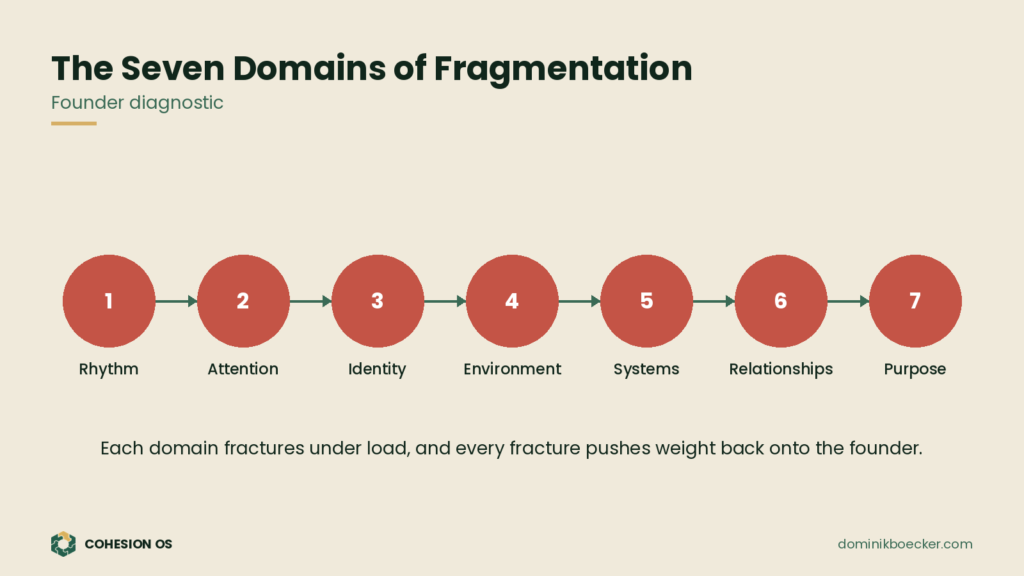
How an unactioned result shows up in each of the seven domains
Rhythm. The result never gets a fixed slot in the week, so it waits for a quiet day that does not come.
Attention. It becomes one more background tab, pulling a little focus every time you remember it.
Identity. You now know what the company needs you to stop doing, and you keep doing it, which quietly erodes trust in your own decisions.
Environment. The result lives in a screenshot, a WhatsApp note to yourself and an email draft. Three places, no source of truth.
Systems. Nothing is documented or owned, so the same problems keep landing on your desk.
Relationships. The team senses something has been named but nothing changes, and expectations stay implicit.
Purpose. The direction is clearer on paper, but daily decisions are still filtered by urgency.
So a result without an install plan does something worse than nothing. It raises awareness of the problem while leaving the load exactly where it was.
Founder Cohesion Assessment
Find the fracture before you try to fix it.
Score all seven domains and see which one is creating the most fragmentation in your company, and what to correct first.
Take the AssessmentThe Better Question to Ask
Replace “now that I know, what should I do?” with: what is the first correction, when exactly will it happen, and when will I measure whether it held?
That question forces three things into the open. A specific action, a slot in the real week, and a date for the second score. If any of the three is missing, the result is still just information. Ask it every Friday until the answer is boring.
The question also changes what you do with the result on Sunday night. Instead of a screenshot and a promise, you leave with a calendar entry for Tuesday at 8:00, a one-line definition of done, and a re-score date thirty days out. That is three decisions made once, rather than one vague intention you carry all week. The result stops being something you hold and becomes something the week holds for you.
Founder Field Note
One founder came in believing the problem was that he had not made time to act on his result. The real issue was that the result listed seven things and sequenced none of them. The first correction was not a new routine. It was choosing the single lowest domain, writing three corrections in order, one per week, and booking the re-score thirty days out. He fixed less than he thought he needed to, and the number moved. This pattern repeats because founders try to act on a diagnosis without ever deciding what comes first.
Common Mistakes with a Founder Diagnostic
- Treating a high-quality result as the finish line instead of the starting line.
- Trying to correct all seven domains in the same month.
- Choosing corrections that rely on effort rather than on a change to the week.
- Setting no date for a second score, so there is no way to tell whether anything changed.
- Waiting for a quiet fortnight that does not arrive.
- Sharing the result with the team without agreeing what it changes for them.
How to Apply the Reframe This Week
- Pick one domain. The lowest scoring one. Ignore the rest for thirty days.
- Write three corrections in order. One per week, each with a day, a time and a line describing what done looks like.
- Add a Friday report. Two lines to yourself or someone you trust: what held, what broke.
- Book the second score. A fixed date, thirty days out, using the same questions.
- Write the fallback. One rule for a heavy week, decided now while the week is calm.
Do not try to fix the entire business at once. Start where the fracture is loudest.
FAQ
What is a founder diagnostic?
A founder diagnostic is a structured set of questions that scores how well the parts of your operating system hold together. The Cohesion OS version scores seven domains, so you can see which one is creating the most strain. The value is the sequence it points to, not the number itself.
Why do most founders do nothing with their result?
Because a result is information, and information does not change the shape of a week. Without a set order, a time and a date to measure again, the result competes with everything else for attention and loses. It becomes one more open loop, carried quietly alongside the rest.
Do I need to fix every domain the diagnostic flags?
No. The primary fracture usually loads the secondary ones, so stabilising it often eases the others. Starting with one domain also makes the progress measurable, because you know exactly what changed and when. The other domains wait their turn rather than competing for the same thirty days.
How soon should I re-score?
Thirty days is long enough for three corrections to settle and short enough to keep the memory of the starting point. Use the same questions so the comparison is fair, and book the date when you set the corrections, not when you remember.
Next Step
If this changed how you see the problem, find out where it applies most. Take the Founder Cohesion Assessment to see which of the seven domains is shaping your company right now and what to correct first.
A result you do nothing with is just a better-described problem.
Founder Cohesion Assessment
See which of the seven domains is shaping your company.
Get your score across all seven domains and the one correction to make first.
Take the AssessmentAbout the Author
Dominik Boecker is the creator of Cohesion OS. He helps founder-led companies identify the fracture lines that create overload, dependency, and operational fragmentation, then install the systems that restore cohesion across rhythm, attention, identity, environment, systems, relationships, and purpose.