
Fast Answer
Founder attention is not mainly lost to distraction or weak willpower. It is usually lost to arrival order: whatever reaches you first sets the agenda before you have decided what matters. When inputs arrive before intent, founders experience a day that feels full by 9am and empty by 5pm. The first correction is not a stricter phone rule, but a protected first hour, with one decision made before anything is opened.
Key Takeaways
- Founder attention is rarely spent by choice. It is allocated by whoever messaged first.
- The first hour of the day sets the frame for every decision that follows, which is why it is the most expensive hour to give away.
- An inbox, a Slack workspace and a WhatsApp thread are lists of other people’s priorities, not yours.
- Phone-free mornings fail because the structure around the founder still expects an instant reply.
- You do not need a perfect morning. You need one decision made before anything is opened.
What Is Founder Attention, and Where Does It Go Before 9am?
It is 7:10am. The alarm is still going and your phone is already in your hand. A WhatsApp from a supplier about a delayed delivery. Fourteen unread Slack messages, two of them tagged. Three client emails, one marked urgent. A Stripe notification about a failed payment. You have not had a coffee yet, and you have already begun deciding things.
By 8:45 you have replied to six people, approved one refund, and redirected a delivery. None of it was wrong. None of it was what you meant to spend your best hour on. The strategic question you carried to bed last night, the pricing decision or the hire you keep delaying, has not been touched.
Founder attention is the finite amount of focused judgement a founder can bring to the decisions only they can make. It is not the same as time. A founder can have a free calendar and no attention left. When it is spent before the real work starts, the visible symptom is a day that feels busy and a week that does not move. The real issue sits in the Attention domain: nothing decides where the first hour goes, so the inbox does.
Why Doesn’t a Phone-Free Morning Fix Founder Attention?
Most founders have tried the obvious fixes. Phone in another room. No email until 10. A meditation app, a morning journal, a new focus tool. For a week or two it works. Then a supplier problem hits at 7:30, a client escalates at 8, and the rule gives way, because someone needed an answer and you were the only one who could give it.
The rule was never the problem. It was a personal rule inside a structure that did not change. The team still expects a reply within minutes. Clients still know your WhatsApp. Nothing in the business can absorb a question for two hours without the founder, so the founder keeps checking. Willpower cannot hold a boundary the company is built to cross. Hiring an assistant or adding another tool will not fix it either, because the underlying pattern, everything routes to the founder on arrival, stays exactly where it was.
The Hidden Mechanism Behind Lost Founder Attention
An inbox is a list of other people’s priorities. Slack is the same, and so is a WhatsApp thread. Each message arrives with its own urgency, written by someone who is not looking at the rest of your day. Open any of them before you have set your own priority, and you will form your priority in reaction to theirs.
Three conditions let this happen. First, there is no rule about which channel is for what, so a trivial question and a real emergency look identical on a lock screen. Second, the team has learned that the founder replies fast, so the expectation is set for them and cannot be undone by a founder who is silent for two hours. Third, nothing is decided before the first input arrives, so the day starts with no intent to compare incoming requests against.
A protected block is not protected if the team still treats it as available time. That is why the fix cannot live inside the founder alone. Other domains feed the same fracture. Environment is involved because notifications are on by default and every tool is built to pull you back. Rhythm is involved because no fixed point exists where the team’s non-urgent questions are held. Identity is involved because being instantly available has become part of how the founder sees their own role. Attention is where the cost shows up, but it is rarely the only place the cause sits.
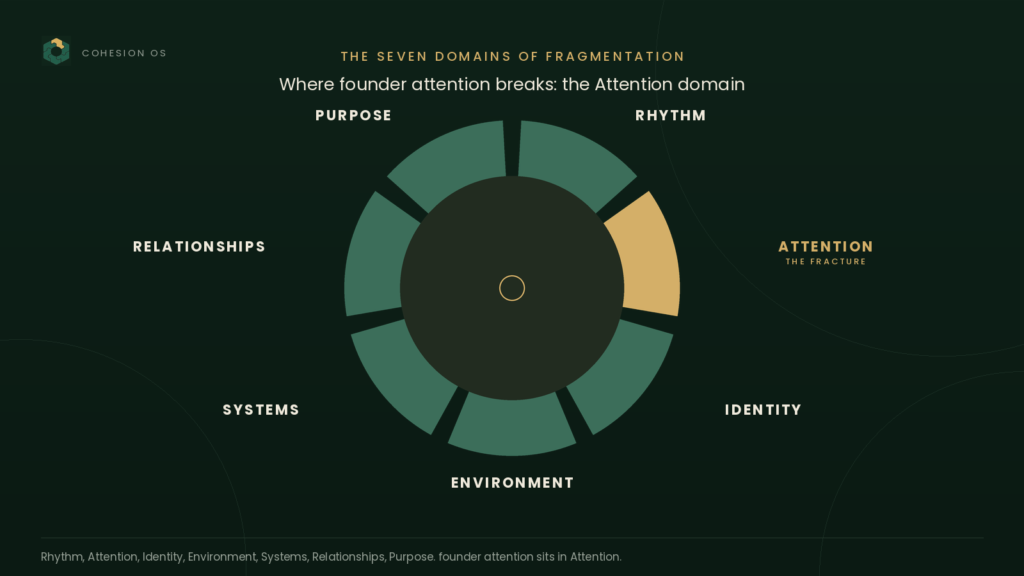
Which of the seven domains is fracturing your company right now?
The Founder Cohesion Assessment takes a few minutes and shows which domain is creating the most fragmentation.
Why Founders Stay Stuck Giving Away the First Hour
Pressure builds, so the founder checks in earlier. A late delivery becomes a reason to look at WhatsApp before breakfast. A nervous client becomes a reason to stay in the inbox. Each check is reasonable on its own, and each one confirms that the first hour belongs to whoever needs something.
The team learns the pattern and adapts to it. Questions that could wait are sent immediately, because immediate works. The founder grows more overloaded, the first hour disappears earlier each month, and the problem returns in a new form: a bigger team, more channels, the same inherited morning.
Founders also stay stuck because availability feels like leadership. Replying quickly is visible, appreciated and rarely questioned. The cost is invisible: the decision that needed your best hour, quietly postponed again.
What Changes When Founder Attention Is Corrected?
The first hour stops being inherited and becomes chosen. The founder opens the inbox after the day’s one important decision has been made or at least started, and what arrives is sorted against an intent, not accepted as the agenda.
The team changes too. When the founder is predictably unavailable between 8 and 9, the team learns what can wait and what cannot. Channels start to mean something, because a real emergency has a route that is different from a routine question. None of this requires the founder to become more disciplined. It requires the company to carry a small amount of structure, so the founder’s attention is not the only thing holding the morning together.
Founder Field Note
One founder came in believing the problem was an addiction to checking his phone. The real issue was that the company routed every question to him on arrival, and the team had never been told which things could wait. The first correction was not an app blocker. It was a single written rule: urgent means a phone call, everything else is held for a daily 9:30 review. Within three weeks the volume of morning messages halved, because the team stopped sending questions they could answer themselves. This pattern repeats because founders treat a structural problem as a personal one.
Common Mistakes with Founder Attention
- Treating attention as a willpower problem and adding another personal rule.
- Protecting a morning block without telling the team what it means for them.
- Leaving every channel open for every kind of message.
- Replying instantly to prove availability, then wondering why everything arrives instantly.
- Starting the day in the inbox instead of with one decision made on paper.
- Fixing the morning without fixing the fixed point where held questions get answered.
How to Start Correcting Your Founder Attention
- Write the one decision that matters today before opening anything. One line on paper or in Notion. It is the filter for everything that arrives afterwards.
- Take notifications off the lock screen. Keep calls on. Everything else waits for you to open it.
- Name what each channel is for. For example: urgent means a call, WhatsApp is for logistics only, Slack is held until the daily review.
- Tell the team what the protected hour means. A block is not protected until they know what to do instead of messaging you.
- Review the first hour on Friday. Where did it go, who decided that, and what is the one channel rule to change next week?
Do not try to fix the entire business at once. Start where the fracture is loudest.
Attention Fragmentation Domain: Scorecard and Playbook
If Attention is the domain creating the most friction in your company right now, the Attention Scorecard and Playbook walk through the correction in detail.
FAQ
Is founder attention the same as focus?
Not quite. Focus is the act of concentrating on one thing. Founder attention is the limited supply of judgement available for decisions only you can make. You can focus hard on the wrong task and still have spent your attention badly. The aim is not more focus. It is making sure your best hours reach the decisions that need you.
Should founders stay out of email and Slack in the morning?
Not necessarily. The point is not to avoid them, but to open them after you have set an intent. A founder who has written down the day’s one decision can scan an inbox without being steered by it. The order matters more than the abstinence.
What if my business genuinely needs me available early?
Then build a route for real emergencies and protect the rest. A phone call for anything urgent, a named person to cover, and a held review for everything else. Most founders find that true emergencies are rarer than the morning inbox suggests, and the route handles them better than constant availability does.
How long before the team adjusts?
Usually about three to four weeks of holding the rule consistently. The common failure is breaking it in the first busy week by replying instantly to something that could have waited, which teaches everyone the rule is optional.
Next Step
If this sounds familiar, do not add another system yet. First, identify where the fracture is actually happening. Take the Founder Cohesion Assessment to see which of the seven domains is creating the most fragmentation in your company and what to correct first.
Your first hour is either chosen or inherited.
Find out where the fracture really is.
Take the Founder Cohesion Assessment and see which of the seven domains to correct first.
About the Author
Dominik Boecker is the creator of Cohesion OS. He helps founder-led companies identify the fracture lines that create overload, dependency, and operational fragmentation, then install the systems that restore cohesion across rhythm, attention, identity, environment, systems, relationships, and purpose.