
Fast Answer
A founder identity shift is not a confidence problem or a letting-go problem. It is the gap between the role the company needs from you now and the self-image you built when it was five people. When that self-image does not update, you keep making the decisions the earlier company needed, and the current one pays for it. Founders experience it as being needed everywhere and trusted nowhere. The first correction is not delegating more, but defining the role the company needs from you this year.
Key Takeaways
- A founder identity shift lags the company. The business changes stage faster than the founder’s picture of their own job.
- This is stage lag, not low self-worth. It affects confident founders as much as anyone.
- The self-image that built the company at five people becomes load-bearing in the wrong place at twenty-five.
- Hiring senior people does not fix it if the founder still feels responsible for every detail.
- The first move is a written definition of what only you do now, not another handover plan.
What Is a Founder Identity Shift?
It is Wednesday, 11:20am. Your ops lead messages you about a supplier invoice query worth £340. She has the authority to settle it. You answer in four minutes, rewrite her reply to the supplier because it is not quite how you would put it, and go back to a strategy document you have been meaning to finish since Monday.
You still read the customer support tickets. You still approve the small spends. You still know the name of every client and what they were promised in the first call. None of it feels like a problem. It feels like care. It is also the reason the strategy document is on its fourth week.
A founder identity shift is the change in role the company requires as it grows, and the lag between that change and the founder’s own view of their job. The visible symptom is overload, a team that waits, and a founder who is simultaneously essential and frustrated. The real issue sits in the Identity domain: decisions are still being made from who the company needed you to be at five people, not who it needs you to be now.
Why Doesn’t Hiring Senior People Fix the Founder Identity Shift?
The usual response to overload is to hire. A head of operations, a finance lead, a senior account manager. It is the right instinct, and it often fails for a reason founders do not see: the new hire arrives into a company where the founder still behaves as the owner of every detail.
So the head of ops makes a call and you override it, kindly, because you know the supplier. The finance lead sets a rule and you grant an exception because the client is a friend. Each override is small and reasonable. Together they teach the new hire that their authority is provisional, and teach the founder that the hire was not quite enough.
More effort does not help either. Working harder at being across everything is the original identity under pressure. Another tool, a new dashboard or a better handover document will not touch the cause, because the cause is not a skill gap. It is the question of what feels like your job.
The Hidden Mechanism Behind Founder Identity Lag
In the early company, being closest to every detail was genuinely the value. You were the best salesperson, the best operator and the only person who knew the whole picture. That was true, it was rewarded, and it shaped how you see your own role.
As the company grows past roughly £3M, that picture stops being accurate, but it does not announce itself as wrong. It keeps showing up as instinct. It decides what feels safe (checking the detail), what feels like neglect (not being in the room), and what feels like your job (solving the problem yourself).
Three signs show the lag. You check things to feel useful, not because anyone asked. You take work back under pressure, because pressure returns you to the older role. You feel a small guilt when a day passes without you touching the operational detail. None of these are character flaws. They are an identity doing the job it was built for in a company that no longer exists.
Other domains feed the same fracture. Systems is involved because decision authority was never written down, so the founder’s self-image fills the gap. Relationships carry the cost, because the team learns to wait for you. Attention is drained by details that belong to someone else. Purpose gets crowded out, because there is no room left for the work only the founder can do. Identity is where the cost shows up, but it is rarely the only place the cause sits.
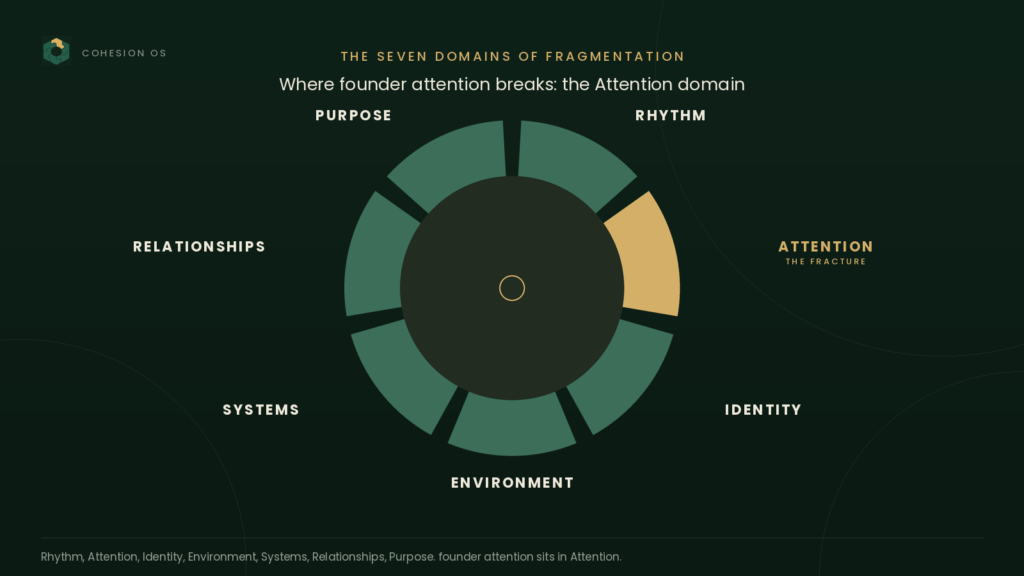
Which of the seven domains is fracturing your company right now?
The Founder Cohesion Assessment takes a few minutes and shows which domain is creating the most fragmentation.
Why Founders Stay Stuck in the Earlier Role
Pressure rises, and the founder reaches for what has always worked. A client is unhappy, so they take the call. A launch is slipping, so they write the copy. Each rescue succeeds, and each success confirms the older self-image: when it matters, I am the one who fixes it.
The team adapts. Why escalate less when escalating works? Why own a decision that the founder will probably revisit? The founder grows more overloaded, the team more dependent, and the pattern is never corrected, because from the inside it feels like commitment, not a role mismatch.
It stays invisible because it is flattering. Being needed is a form of status. The cost is paid elsewhere: in the strategy not written, the leader not developed, and the decision that only you could make, postponed for another week.
What Changes When the Founder Identity Shift Is Made?
The founder stops being the default answer and becomes the owner of a short list of decisions. Everything else has a name next to it. The team learns that authority is real, because it stops being overridden, and starts bringing problems with a recommendation attached.
The founder’s days change in kind, not only in volume. More time goes to the questions the company genuinely cannot answer without them: direction, key hires, the few relationships that matter, and the structure around them. None of this requires the founder to care less. It requires the company to know what the founder is for.
Founder Field Note
One founder came in believing the problem was a team that would not take ownership. The real issue was that she still saw herself as the person who knew every client best, so every meaningful client decision came back to her. The first correction was not a handover plan. It was a one-page statement of the three decisions only she would make, and a rule that everything else belonged to the named lead, including the ones she would have made differently. Within two months her account leads stopped escalating routine calls, and she finished the strategy work that had been stuck since the spring. This pattern repeats because founders try to delegate tasks without ever redefining the role.
Common Mistakes with the Founder Identity Shift
- Treating it as a confidence or self-worth issue instead of a role mismatch.
- Hiring a senior leader and then overriding their decisions.
- Delegating tasks but keeping the right to revisit every outcome.
- Defining the founder’s role by what they stop doing, not by what they own.
- Waiting until burnout makes the role change necessary.
- Updating the org chart without updating the founder’s own habits.
How to Start Correcting Your Founder Identity Shift
- Write the three decisions only you make this year. Not tasks. Decisions: direction, key hires, major commitments. Keep it to one page.
- List the last ten things you did outside that list. Use last week’s calendar, inbox and Slack. Be literal.
- Pick one and hand it over in writing. Name the owner, the decision rule they use, and the point at which they should involve you.
- Do not revisit the outcome. If you would have decided differently, adjust the rule, not the decision.
- Review the one-page role monthly. The company will keep changing stage. Your definition has to keep up.
Do not try to fix the entire business at once. Start where the fracture is loudest.
Identity Fragmentation Domain: Scorecard and Playbook
If Identity is the domain creating the most friction in your company right now, the Identity Scorecard and Playbook walk through the correction in detail.
FAQ
How do I know if I am experiencing a founder identity shift?
Look at where your time went last week. If most of it went to decisions a capable person on your team could own, and you can name the moment you took each one back, the company has outgrown the role you are still playing. Another sign is guilt on days you are not involved in the detail.
Is this the same as imposter syndrome or tying your worth to the company?
No. Those are about self-worth. A founder identity shift is about stage lag: the role was right once and has not been updated. Confident, secure founders experience it as much as anyone, because the self-image was built on something that genuinely worked.
Does it mean I should step back from the business?
Not step back, step up. The aim is not less involvement but different involvement: owning direction, key hires and the structure around them, instead of the operational detail the company can now carry without you.
How long does the shift take?
The written role definition can exist this week. The habit change usually takes a few months, because each instinctive override has to be noticed and replaced with a decision rule. Most founders see the team’s behaviour change first, within about six weeks.
Next Step
If this sounds familiar, do not add another system yet. First, identify where the fracture is actually happening. Take the Founder Cohesion Assessment to see which of the seven domains is creating the most fragmentation in your company and what to correct first.
The company grew. Your job description did not.
Find out where the fracture really is.
Take the Founder Cohesion Assessment and see which of the seven domains to correct first.
About the Author
Dominik Boecker is the creator of Cohesion OS. He helps founder-led companies identify the fracture lines that create overload, dependency, and operational fragmentation, then install the systems that restore cohesion across rhythm, attention, identity, environment, systems, relationships, and purpose.