Fast Answer
Your founder tool stack is not mainly a software problem. It is usually a defaults problem: every tool added to solve one urgent need brings its own inbox, notifications and version of the truth. When tools are added one at a time and never removed, founders experience a day pulled in more directions than any calendar can control. The first correction is not a better tool or a full migration, but naming one job for each tool and removing one that duplicates it.
Key Takeaways
- A founder tool stack sets defaults long before willpower gets a vote. The tool in front of you decides what you do next.
- Tools are almost always added to solve one urgent need and almost never removed afterwards.
- Every tool carries its own inbox, its own notifications and its own version of the truth, which is how sprawl becomes fragmentation.
- Buying a better tool without retiring the old one adds another place for work to hide.
- You do not need to rebuild your stack. You need one job per tool and one source of truth per type of information.
What Is a Founder Tool Stack, and How Does It Decide Your Day?
It is Tuesday, 2:15pm. You need the latest version of the client onboarding checklist. You search Notion and find one. You check Google Drive and find a slightly different one. A Slack pin links to a third, and an old ClickUp template holds a fourth. Each is nearly right. You ask in Slack which is current, and while you wait, you open the inbox, and then WhatsApp, and forty minutes pass.
The founder tool stack is the set of tools a founder and their team use to run the company: messaging, project management, documents, CRM, payments, automations, and whatever AI tools have been added this year. It is rarely designed. It accumulates, one reasonable decision at a time, each made to fix something that was hurting that month.
The visible symptom is a day that feels scattered and a team that cannot say where anything lives. The real issue sits in the Environment domain. Physical and digital defaults decide where attention goes, and a stack that was never designed has defaults nobody chose.
Why Doesn’t a Better Tool Fix Your Founder Tool Stack?
When the stack feels messy, the instinct is to buy the tool that finally fixes it. A better project manager, an all-in-one workspace, a new automation layer. The pitch is always the same: put everything in one place.
It rarely works, for a simple reason. The new tool arrives, but the old ones do not leave. Half the team migrates, half does not, and there are now five places instead of four. The migration itself takes weeks, during which both systems are partly true. Meanwhile, the underlying habits are unchanged: work still gets started wherever the person happens to be, and information still lands wherever it was first typed.
Working harder at being organised does not help either. Colour-coded folders and naming conventions are a personal fix inside a shared structure. They hold for as long as the founder maintains them, which is exactly the dependency the founder was trying to escape.
The Hidden Mechanism Behind a Reactive Tool Stack
Every tool comes with defaults. It has an inbox, a notification setting, a place where things get stored, and a way of saying that something needs you. Add a tool and you add all four, whether you wanted them or not.
Three conditions let sprawl take hold. First, tools are added to solve the loudest problem this month, so each one is chosen in isolation. Second, nothing is ever removed, because removing a tool feels risky and adding one feels like progress. Third, nobody owns the question of where something should live, so information is stored wherever the person who created it was working.
The result is that the founder’s day is shaped by the tools, not by priorities. A notification pulls you into Slack. A dashboard shows a metric that is slightly red. An automation fires and creates a task you did not ask for. Each is small, and together they are a day set by defaults.
AI tools do not fix this. They multiply the operating condition already present. Add one to a stack with four versions of the checklist, and you get four versions faster. Other domains feed the same fracture. Attention is drained by every extra inbox. Systems is thin because documentation is scattered and untrusted. Rhythm suffers because there is no single place a weekly review can start from. Environment is where the cost shows up, but it is rarely the only place the cause sits.
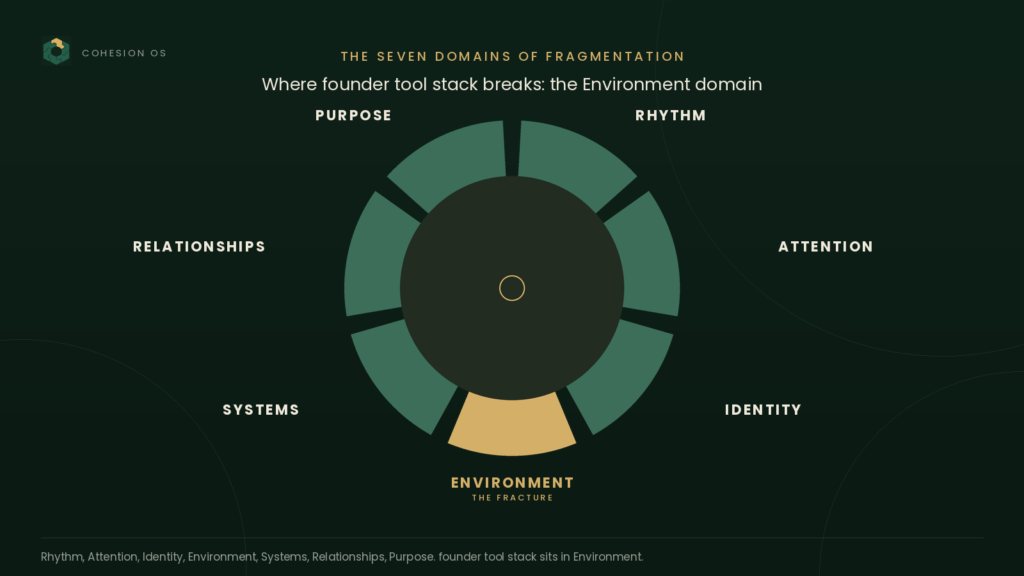
Which of the seven domains is fracturing your company right now?
The Founder Cohesion Assessment takes a few minutes and shows which domain is creating the most fragmentation.
Why Founders Stay Stuck with Too Many Tools
Pressure rises, and a new problem appears: leads are falling through, the team is missing deadlines, someone wants a better report. The founder reaches for a tool, because a tool feels like action. It gets set up in an afternoon, and for a few weeks it helps.
Then the next problem arrives, and so does the next tool. The old ones stay because someone still uses them, or because the data inside them is too awkward to move. The team learns that the stack is a set of places to check, not a system to trust, so they check them all, or they ask the founder.
It persists because buying a tool is visible and decisive, while removing one is invisible and uncomfortable. Nobody celebrates a cancelled subscription. The cost of the stack, in switching, searching and second-guessing, is never itemised.
What Changes When the Founder Tool Stack Is Corrected?
The stack becomes smaller and quieter. Each tool has one job, and everyone can say what it is. Questions like “where is the latest version?” stop being asked, because there is one place, and it is known.
The founder’s day changes in a way that is easy to underrate: fewer inboxes to check, fewer notifications competing, and fewer small decisions about where something goes. The team stops asking the founder to arbitrate between systems. None of this requires a rebuild. It requires someone to decide where things live and to retire what duplicates it.
Founder Field Note
One founder came in believing the problem was that her team did not use the tools properly. The real issue was that the company had three places to track client work, and each had been the right choice at the time it was adopted. The first correction was not a new platform. It was a one-page list stating what each tool was for, and a decision to archive two of the three trackers once their open items were moved across. Within a month the team stopped asking where things were, and her Monday review started from one list instead of three. This pattern repeats because founders add tools to fix symptoms and never retire the tools the symptoms came from.
Common Mistakes with Your Founder Tool Stack
- Buying a new tool to fix a problem caused by having too many.
- Migrating to a new platform without a date to switch the old one off.
- Leaving notifications on defaults in every tool.
- Letting each person choose where their own work lives.
- Treating the stack as an IT question instead of a founder-attention question.
- Adding AI tools to a stack that already has no single source of truth.
How to Start Correcting Your Founder Tool Stack
- List every tool you opened last week. Use your browser history and phone screen time. Include the ones you only check, not just the ones you use.
- Write the one job each tool does. One line each. If you cannot say the job in one line, the tool is doing too much or too little.
- Find the jobs with two tools. These are the duplicates, and they are where the sprawl is.
- Retire one this month. Move the open items, archive rather than delete, and tell the team the date.
- Name one source of truth for each type of information. Checklists, client records, decisions. Put it on a single page everyone can find.
Do not try to fix the entire business at once. Start where the fracture is loudest.
Environment Fragmentation Domain: Scorecard and Playbook
If Environment is the domain creating the most friction in your company right now, the Environment Scorecard and Playbook walk through the correction in detail.
FAQ
How many tools is too many for a founder-led company?
There is no magic number. The better test is whether anyone on the team can say, without looking, where a given type of information lives. If the answer is “it depends who you ask”, the stack has outgrown its design, whether it holds six tools or sixty.
Should I move everything onto one all-in-one platform?
Not as a first step. A consolidation that does not retire the old tools simply adds another one. Decide what each tool is for first, then retire duplicates, and only then ask whether a single platform would genuinely simplify things.
What about the AI tools we have added?
Treat them like any other tool: one job, one owner, one place the output goes. AI does not fix a scattered stack, it speeds up whatever is already there, including the duplication. Tidy the operating condition first, then add AI where a job is clearly defined.
How do I get the team to stop using the old tool?
Set a date, move the open items for them, and archive the old tool rather than deleting it. Most resistance comes from not knowing where things went. A fixed switch-off date and a single page saying what lives where removes most of it.
Next Step
If this sounds familiar, do not add another system yet. First, identify where the fracture is actually happening. Take the Founder Cohesion Assessment to see which of the seven domains is creating the most fragmentation in your company and what to correct first.
Every tool you add is a decision you have to keep making.
Find out where the fracture really is.
Take the Founder Cohesion Assessment and see which of the seven domains to correct first.
About the Author
Dominik Boecker is the creator of Cohesion OS. He helps founder-led companies identify the fracture lines that create overload, dependency, and operational fragmentation, then install the systems that restore cohesion across rhythm, attention, identity, environment, systems, relationships, and purpose.