
Founder availability is not mainly a responsiveness problem. It is usually a structural signal that decisions haven’t been pushed down into the business. When a founder stays reachable on Slack, WhatsApp, and email at all hours, the team learns that waiting for the founder is faster than deciding without them. The first correction is not more discipline around checking your phone less. It is removing the reasons the team still needs you reachable in the first place.
Key Takeaways
- Founder availability trains the team to route decisions through you instead of building the judgment to make them
- The cost isn’t your time in the moment. It’s the compounding dependency that builds every time you answer instead of redirecting
- “Being responsive” and “being load-bearing” look identical from the outside, but only one of them scales
- Protected time fails when the team still treats the founder as reachable during it
- Fixing founder availability starts with identifying which decisions still require you, not with a stricter calendar
- The Capacity Audit shows where your presence is propping up gaps that should be closed structurally
What Is Founder Availability?
Founder availability is the pattern where a founder remains reachable across every channel, at almost any hour, for almost any question. It shows up as the WhatsApp that gets answered from the school run, the Slack thread you jump into “just to unblock it,” the voice note you send back within the hour because it felt faster than writing a full explanation.
From the outside it looks like commitment. It looks like a founder who cares enough to stay close to the business. And in the early days, it usually is exactly that: necessary, even correct.
The visible symptom is a founder who never seems to switch off. The real issue is different. Founder availability isn’t a time management failure. It’s a structural signal that too many decisions in the business still require the founder’s judgment to move forward, and nobody has built the system that would let them move without you.
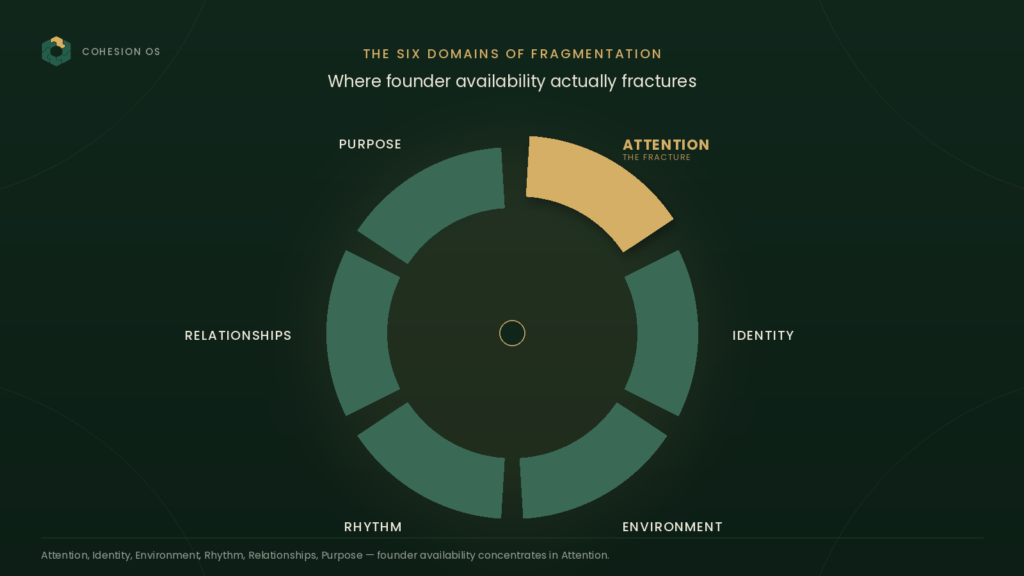
Cohesion OS treats this as an attention fracture, not a discipline gap. Your attention is a load-bearing part of the business. Every time it’s available by default, the business builds around that availability instead of around clear ownership.
Which of the six domains is actually costing you the most?
Why Doesn’t Setting Boundaries Fix Founder Availability?
The standard advice is to set boundaries: turn off notifications after 6pm, block “deep work” time, tell the team you’re “offline” on Fridays. Founders try this. It rarely holds.
Here’s why. A boundary is a rule about your behaviour. It does nothing to change the conditions that made your availability necessary in the first place. If your ops manager still can’t approve a £2,000 spend without you, if your head of sales still can’t close a deal without your sign-off on pricing, if your team still doesn’t know what “good” looks like without you checking it, then the boundary just delays the interruption. It doesn’t remove it.
You block 9 to 11 for strategy. By 9:17 you’ve answered a WhatsApp about a client escalation, checked Stripe because a payment failed, and replied “yes go ahead” to a decision your ops lead should never have needed you for. The block wasn’t broken because you lack discipline. It was broken because the team still treats your time as available, and they’re right to, because functionally it still is.
More rules around your calendar don’t fix this. A protected block isn’t protected if the team still treats it as available time. The block only holds once the decisions that used to interrupt it have somewhere else to go.
The Hidden Mechanism Behind Founder Availability
Founder availability persists because of a specific mechanism, and it’s worth naming precisely.
Decisions have nowhere else to land. When ownership of a decision is unclear, the default owner becomes whoever is reachable and has enough context to answer fast. That’s you. Every “quick question” is really a symptom of a decision with no other home.
Speed gets mistaken for structure. Answering a Slack message in four minutes feels efficient. But every fast answer teaches the team that asking you is faster than building the judgment or documentation that would let them answer it themselves. You’re solving today’s problem while manufacturing tomorrow’s.
Availability becomes the undocumented system. In a business with no clear operating rhythm, your responsiveness is the operating rhythm. The team doesn’t need a decision-making framework because they have you. That’s not a compliment to your work ethic. It’s a warning sign that your attention is doing the job a system should be doing.
The loop reinforces itself. The more available you are, the more the team relies on that availability. The more they rely on it, the harder it becomes to withdraw it without things visibly breaking, which makes you feel like you can’t stop being available. This is founder dependency, and it’s built one quick reply at a time.
Why Founders Stay Stuck in This Pattern
The loop looks like this: pressure rises, so the founder becomes more reachable to keep things moving. The team, sensing the founder is close and responsive, routes more decisions through them rather than fewer. The founder becomes more overloaded as a result. Nobody stops to correct the underlying structure, because there’s never a quiet moment to do it in. The overload eventually shows up somewhere else, a missed deadline, a burnt-out ops hire, a strategic decision made at 11pm on a phone, and the founder responds by becoming even more available to catch it.
This is why “just be more disciplined about your time” doesn’t work as advice. Discipline is being asked to solve a structural problem. The pattern doesn’t break because you try harder to resist your phone. It breaks when the decisions that made you reachable in the first place get relocated somewhere else.
What Changes When Founder Availability Is Corrected?
When this fracture is corrected, the founder isn’t unreachable. They’re reachable for the right things. Day-to-day decisions get made without a founder sign-off because ownership and judgment have been pushed down to where the decision actually happens. Protected time holds because the team has somewhere else to take a question, not because the founder is harder to reach. The founder’s attention becomes available for the decisions that actually require it: direction, capital, hiring, the handful of calls only they can make.
This isn’t about working less for the sake of it. It’s about your attention being spent on load-bearing decisions instead of propping up gaps in the operating system.
Founder Field Note
One founder came in believing the problem was time management. He was answering messages until midnight most nights and felt he simply needed better boundaries.
The real issue was that four separate roles in his business, from client escalations to vendor approvals to basic pricing exceptions, had no defined decision authority. Every one of them defaulted back to him because nobody else had been given the judgment or the permission to decide.
The first correction wasn’t a stricter calendar or a “do not disturb” policy. It was mapping which decisions genuinely required him and which ones didn’t, then explicitly assigning ownership of the ones that didn’t, including the authority to get them wrong occasionally.
Within a few weeks, the volume of “quick questions” dropped by more than half, not because the team asked less, but because most of what used to get asked now had a clear answer that didn’t run through him.
This pattern repeats because availability always looks like the generous choice in the moment. It’s only structurally visible as a cost once you track what it’s quietly training your team to do.
Common Mistakes with Founder Availability
- Assuming the fix is a stricter calendar. A calendar change doesn’t remove the reasons people need to reach you.
- Treating every fast reply as a win. Speed in the moment often means slower capability-building for the team long term.
- Confusing being liked for being reachable with being effective as a leader. These aren’t the same thing, and founders often conflate them.
- Setting a boundary without telling the team what to do instead. If you go quiet without redirecting decisions somewhere else, the business stalls rather than adapts.
- Trying to fix availability and ownership at the same time as everything else. This is a specific fracture. Treat it as one, not as a general “I need better work-life balance” problem.
- Waiting for a quiet period to fix it. There won’t be one. The correction has to happen inside the current level of busyness, not after it.
How to Start Correcting Founder Availability
- List every “quick question” you answered this week. Don’t filter them. Just capture what actually landed on you.
- Sort them into two piles: decisions that genuinely need your judgment, and decisions that don’t. Be honest about the second pile. It’s usually bigger than founders expect.
- For the decisions that don’t need you, name who should own them and what authority they now have. Ownership without authority just creates a new bottleneck one level down.
- Tell your team explicitly what’s changing. Silence reads as inconsistency. Say directly: “these decisions no longer come to me, here’s who they go to now.”
- Track what still interrupts you after two weeks. That remaining list is your real fracture map, not your assumptions about it.
Do not try to fix the entire business at once. Start where the fracture is loudest.
FAQ
Is founder availability always a bad thing?
No. In the earliest stage of a business, high availability is often correct and even necessary. It becomes a problem when the business has grown past the point where it should still depend on your constant presence, but the operating structure hasn’t caught up.
How do I know if my availability is a symptom of fragmentation rather than good leadership?
Ask whether decisions stall or get worse when you’re unreachable for a day. If they stall, the dependency is structural. If they proceed with reasonable judgment, your availability is a choice, not a load-bearing requirement.
Won’t my team feel unsupported if I become less available?
Usually the opposite happens once the transition is explicit. Teams often feel more supported when they have clear authority and defined decision paths, rather than an availability that’s actually inconsistent and unpredictable.
What’s the difference between founder availability and founder responsiveness in a genuine crisis?
Responsiveness in a real crisis is appropriate and expected. Founder availability, as described here, is the default state applied to routine decisions that shouldn’t require a founder at all. The distinction is whether the decision is exceptional or routine.
Next Step
If this sounds familiar, do not add another system yet. First, identify where the fracture is actually happening. Take the Founder Cohesion Assessment to see which domain is creating the most fragmentation and what to correct first.
Dominik Boecker is the creator of Cohesion OS. He helps founder-led companies identify the fracture lines that create overload, dependency, and operational fragmentation, then install the systems that restore cohesion across attention, identity, environment, rhythm, relationships, and purpose.