
Fast Answer: Your company is fracturing in more than one place at once, which is why it rarely feels like a single problem. It shows up as six separate fracture points inside a founder-led company: Attention, Identity, Environment, Rhythm, Relationships, and Purpose. Each one fractures quietly and gets blamed on something else, usually workload or a weak hire. The first correction is not working harder or hiring faster. It is identifying which of the six domains is actually cracking under you right now.
Key Takeaways
- Founder-led companies rarely break from one big failure. They break from six small fractures compounding at once.
- Attention, Identity, Environment, Rhythm, Relationships, and Purpose are the six domains where fragmentation hides.
- Most founders treat every fracture as a workload problem, which is why the fixes never hold.
- Each domain has its own visible symptom and a different hidden cause underneath it.
- You don’t need to fix all six at once. You need to know which one is loudest.
- Naming the fracture correctly is the entire diagnostic. Everything else is just the correction.
Why “Just Work Harder” Never Fixes This
Most founders experience fragmentation as a single, vague sensation of being stretched too thin. So the default response is a single, vague solution: work more hours, hire someone, buy another tool, block out more focus time.
None of these fix anything, because fragmentation is not one problem. It is six structurally different problems wearing the same symptom. A founder whose calendar is fractured needs a different correction than a founder whose identity is fused to every decision in the business. Treating both with “just work harder” doesn’t fail because the founder lacks discipline. It fails because the diagnosis was wrong before the correction even started.
This is the pattern behind most failed fixes in a founder-led company: the visible symptom gets treated, the hidden fracture stays exactly where it was, and the problem returns in a different shape a few months later.
Which of the six domains is actually costing you the most?
The Six Domains Where Fragmentation Hides
1. Attention
The visible symptom is a founder who is constantly interrupted and never finishes a deep block of work. The hidden fracture is that attention has no protected boundary. Nothing in the business signals that the founder’s focus is off limits, so everything routes to them by default. This isn’t a time management problem. It’s a structural one: without protection, attention gets treated as always-available inventory.
2. Identity
The visible symptom is a founder who can’t step back without the business visibly wobbling. The hidden fracture is that the founder’s identity and the company’s operations have fused into one thing. Decisions aren’t made by the system, they’re made by the founder’s judgment in the moment, which means the business literally cannot run without them present. This looks like dedication. It’s actually founder dependency wearing a good outfit.
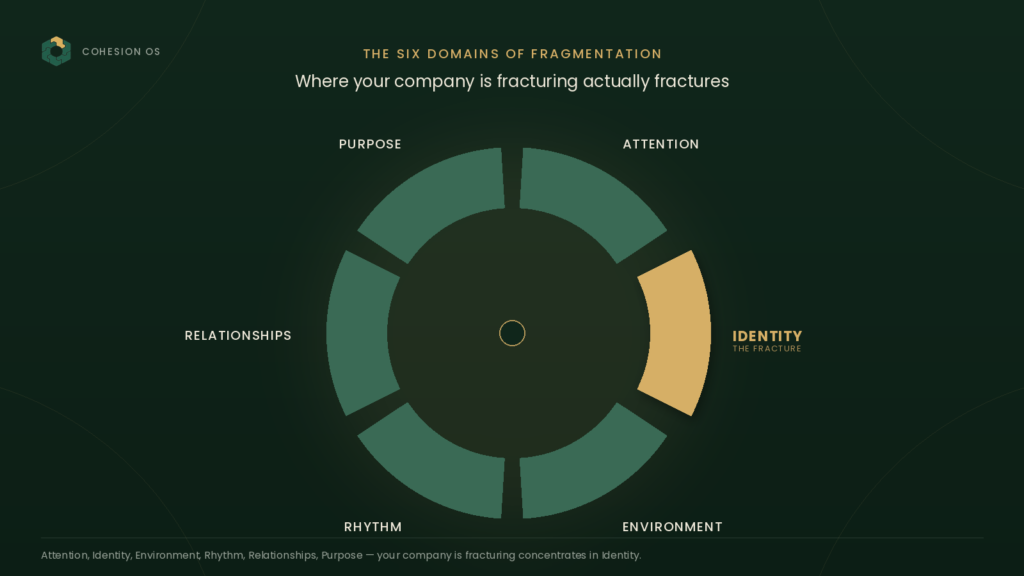
3. Environment
The visible symptom is tool sprawl, duplicate systems, and a workspace that’s technically full of infrastructure but practically held together by memory. The hidden fracture is that the environment was built reactively, one urgent need at a time, with no one ever going back to make it cohesive. More tools get added to solve fragmentation and end up creating more places for it to hide.
4. Rhythm
The visible symptom is a business that’s always in reactive mode, jumping between whatever feels most urgent that hour. The hidden fracture is the absence of a repeating operating rhythm, no fixed cadence for decisions, reviews, or priorities. Without rhythm, urgency fills the vacuum, and the loudest problem always wins regardless of whether it’s actually the most important one.
5. Relationships
The visible symptom is that everyone still checks with the founder before moving, even people who technically own the decision. The hidden fracture is unclear ownership. Roles exist on paper, but authority hasn’t actually transferred, so every relationship in the company quietly routes back through the founder as the real decision-maker.
6. Purpose
The visible symptom is a team that’s busy but somehow not moving the business forward. The hidden fracture is that daily activity has disconnected from the actual strategic direction. People are executing tasks, but the tasks aren’t tied to a shared, current picture of where the company is going, so effort scatters instead of compounding.
Why Founders Stay Stuck in the Same Pattern
Here’s the loop that keeps repeating: pressure rises somewhere in the business, the founder reacts manually to relieve it, the team gets a little more dependent on the founder solving things directly, the founder gets a little more overloaded, and the underlying system never actually gets corrected. A few months later, the same pressure resurfaces, usually in a different domain, and it feels like a brand new problem.
It isn’t new. It’s the same fragmentation finding a different fracture line to leak through, because the founder corrected the symptom last time, not the structure.
Founder Field Note
One founder came in believing his problem was that his ops manager wasn’t stepping up. The real issue wasn’t the hire. It was that every operational decision still legally and practically required the founder’s sign-off, even the ones his ops manager was hired to own. The first correction wasn’t a performance conversation. It was rebuilding the decision-rights map so authority actually matched the job title. This pattern repeats constantly because founders default to blaming the person closest to the visible symptom, when the fracture is almost always upstream in how the role was structured.
Common Mistakes Founders Make Here
- Assuming fragmentation is one problem instead of six separate, distinct ones.
- Fixing the domain that’s loudest emotionally instead of the one that’s actually costing the most.
- Adding more tools or process to fix an Environment fracture that was actually a Rhythm fracture.
- Hiring to solve an Identity fracture, which just gives the founder one more person to personally manage.
- Treating “protected time” as a calendar block instead of an actual structural boundary the team respects.
- Trying to correct all six domains simultaneously, which spreads the fix as thin as the original problem.
How to Start Correcting It
- Pick the domain that’s currently loudest, not the one that sounds most impressive to fix.
- Name the visible symptom and the hidden fracture separately, in writing. If you can’t separate them, you haven’t diagnosed it yet.
- Identify one decision or task currently routing through you that shouldn’t be.
- Make one structural change, not a behavioural promise. A boundary, a rhythm, a transferred decision right.
- Watch what happens over two weeks before touching a second domain.
Do not try to fix the entire business at once. Start where the fracture is loudest.
FAQ
Is fragmentation the same as being disorganised?
No. Disorganisation is a symptom that can show up in any of the six domains. Fragmentation is the underlying condition, a founder-led company running without cohesive structure across attention, identity, environment, rhythm, relationships, and purpose.
Can one domain fracturing cause another to fracture?
Yes, and it usually does. An Identity fracture, where the founder is fused to every decision, almost always produces a Relationships fracture, since no one else can hold real ownership while the founder still signs off on everything.
How do I know which domain is fracturing the most right now?
Look at where you’re personally absorbing the most pressure this month. That’s rarely a coincidence. It’s usually the domain with the loudest active fracture.
Do I need to fix all six domains before anything improves?
No. Correcting the loudest fracture first usually relieves pressure across the others too, since the domains are connected, not independent.
Next Step
If this sounds familiar, do not add another system yet. First, identify where the fracture is actually happening. Take the Founder Cohesion Assessment to see which domain is creating the most fragmentation and what to correct first.
Author
Dominik Boecker is the creator of Cohesion OS. He helps founder-led companies identify the fracture lines that create overload, dependency, and operational fragmentation, then install the systems that restore cohesion across attention, identity, environment, rhythm, relationships, and purpose.