
Fast Answer
Still cannot delegate, even after automating everything? That is the tell. Automation solves the wrong problem when the real fracture is delegation, not workload. A founder can build the most sophisticated AI workflow in the business and still be the only person who can actually make the call, because automation moves work around, it does not move ownership. The bottleneck was never the task. It was always the decision.
Key Takeaways
- Automating a task does not delegate the decision behind it, ownership and execution are two separate things
- A founder can have AI handling dozens of workflows and still be the single point of failure for every judgment call inside them
- Automation without delegation just relocates the bottleneck, it does not remove it
- The visible symptom is a founder who looks incredibly efficient and still cannot take a real day off
- The fix is naming who owns the judgment behind each automated task, not adding another tool
- Founders who correct this end up delegating less through tooling and more through explicit, named ownership
3-Minute Diagnostic
Which of the seven domains is actually costing you the most?
What Does “Automated Everything, Still Cannot Delegate” Actually Mean?
It is a specific, disorienting pattern: a founder builds out genuinely impressive automation, AI handling client intake, workflows running reports, tools drafting proposals, and still cannot take a real day off without everything routing back to them. From the outside, the business looks like a delegation success story. From the inside, the founder is still the single point of failure for almost every decision.
The mistake is treating automation and delegation as the same correction. Automation moves the execution of a task off the founder’s plate. Delegation moves the ownership of a decision off the founder’s plate. A founder can automate the task entirely and still retain full ownership of every judgment call the task requires, in which case nothing has actually been delegated, the workflow just runs faster while still waiting on the founder’s input at every decision point.
This shows up as a founder who is, by any visible measure, running an efficient, tech-forward operation, and is still personally exhausted and irreplaceable. The tools worked exactly as designed. They just were not solving the actual constraint.
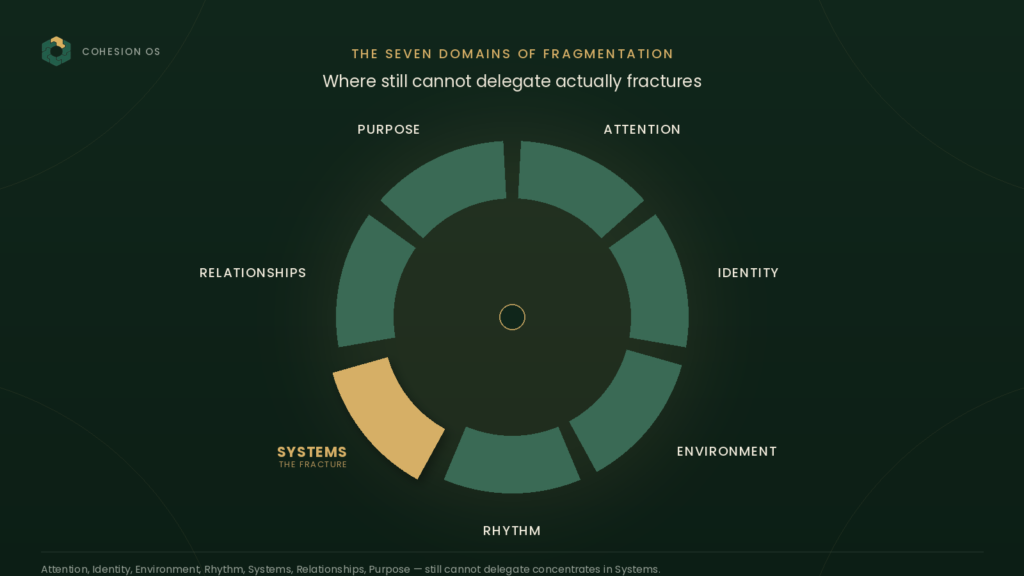
Cohesion OS treats this as an operational fragmentation pattern, the domain that routes into Founder AI OS. Automation exposes the fracture instead of fixing it, because automation cannot invent ownership that was never explicitly assigned.
Why Does Automation Fail to Fix a Real Delegation Gap?
The instinct, once a founder notices they are still the bottleneck, is to automate more. Add another AI tool, another workflow, another integration. Founders do this seriously and the underlying constraint does not move.
Here is why. Automation is fundamentally about execution speed. It answers “how fast can this task run,” not “who decides what happens when the task hits an edge case.” If the founder is still the one who approves the output, resolves the exception, or makes the judgment call the automated workflow cannot make, then the automation has simply made the founder’s bottleneck faster to reach, not smaller. The task runs in seconds. The decision still waits on the same person it always did.
This is the same trap as hiring for capacity without redefining ownership, adding a person does not remove a bottleneck if that person still has to check every decision with the founder. Automation is the same pattern wearing different clothes. More tooling on top of an undefined ownership structure just produces a faster, shinier version of the same constraint.
The Real Mechanism Behind This Pattern
There is a specific structure to why automation and delegation get confused this often.
Automation is visible, delegation is not. A new AI workflow is easy to point to and demonstrate. Ownership transfer is invisible, it is a change in who is authorised to decide, not a change anyone can see running on a dashboard. Founders naturally gravitate toward the visible fix.
Automating a task can feel like delegating it, even when it is not. Handing a task to a tool has the emotional texture of letting go. But if the founder is still reviewing every output before it ships, ownership never actually moved, only the mechanical execution did.
Tools cannot make judgment calls that were never defined. An AI workflow can execute a documented process flawlessly. It cannot decide what to do in a situation nobody specified, so those situations still route back to the founder by default, regardless of how much of the surrounding process is automated.
Efficiency masks the unresolved ownership question. A founder running fast, AI-powered workflows looks and feels productive, which makes it easy to overlook that the actual constraint, who is allowed to decide, was never addressed.
Why Founders Stay Stuck in This Pattern
The loop looks like this: a founder feels overloaded, adds automation to reduce the load, the automation genuinely speeds up execution, the founder feels temporarily relieved, and then discovers they are still fielding every exception and approval the automated workflow generates. The relief reads as proof the fix worked, so the founder automates the next process the same way, repeating the pattern without ever naming that ownership, not execution speed, was the actual constraint.
This is why adding a fourth or fifth AI tool rarely resolves the underlying fatigue. Each new tool makes the same unaddressed ownership gap run faster, which can even make the problem feel more urgent, since decisions that used to trickle in now arrive at automation speed.
What Changes When This Is Corrected?
When this fracture is corrected, automation and delegation start working together instead of one substituting for the other. The founder identifies specifically which decisions inside each automated workflow still require their judgment, and which ones can be formally handed to someone else, a team member, a documented rule, or a default. The tools keep running fast. The founder stops being the required checkpoint for everything that runs through them.
This is not about automating less. It is about automating on top of clear ownership instead of automating around the absence of it.
Founder Field Note
One founder had built out an impressively automated operation, AI handling lead qualification, proposal drafts, and client onboarding sequences. He described feeling like he had delegated most of the business, and was confused why he still could not disconnect for even a weekend.
The real issue surfaced once he tracked what actually interrupted him during a supposedly automated week. Every single interruption was an exception the AI workflows had correctly flagged and routed to him, a proposal that needed a judgment call on pricing, an onboarding edge case nobody had defined a rule for. The automation was working exactly as built. It had simply been built to route every undefined decision straight back to him.
The first correction was not another tool. It was going through the three most common exception types and explicitly assigning ownership of each to a specific team member, with the authority to decide without checking in first.
Within a month, his actual interruption volume dropped by more than half, using the exact same automated workflows he already had.
This pattern repeats because automation genuinely does reduce visible workload, which makes it easy to mistake for delegation. It is only visible as incomplete once you track what is still routing back to you despite everything running automatically.
Common Mistakes with Automation and Delegation
- Assuming more automation will eventually solve founder overload. It usually just makes the unaddressed ownership gap run at a faster pace.
- Confusing task execution with decision ownership. A tool handling the task does not mean anyone has been authorised to own the decisions inside it.
- Reviewing every automated output personally out of habit. This keeps ownership with the founder even after the execution has technically moved elsewhere.
- Building automation before defining who owns the exceptions. Exceptions always exist. Without a named owner, they default straight back to the founder.
- Treating this as a technology problem and shopping for a better tool. The correction is organisational, naming ownership, not technical.
- Waiting for exhaustion to force the ownership conversation. It is cheaper and less disruptive to define ownership before automating, not after burnout forces the issue.
How to Start Correcting This
- List every automated workflow currently running in the business. Include anything AI or software handles without you personally doing the task.
- For each one, identify what still routes back to you. Approvals, exceptions, edge cases, anything that still requires your personal sign-off.
- Name a specific owner for each category of exception. Not “the team,” a specific person with explicit authority to decide without checking with you first.
- Tell that person directly what they now own. Ambiguity defaults back to you, clarity is what actually releases the bottleneck.
- Track your interruption volume for two weeks after the change. Confirm the ownership transfer actually reduced what reaches you, not just what the automation executes.
Do not try to fix the entire business at once. Start where the fracture is loudest.
FAQ
Does this mean automation is not worth investing in?
No, automation is genuinely valuable, it just solves execution speed, not ownership. The correction is pairing automation with explicit delegation, not choosing one over the other.
How do I know if a decision genuinely needs me or if it just defaults to me?
Ask whether it requires judgment, risk tolerance, or context only you are positioned to weigh. If it is mostly a matter of applying a documented standard, it is a strong candidate for named ownership elsewhere.
Is this the same as the general founder approval bottleneck problem?
Closely related. This is the AI-specific version, automation makes the same approval bottleneck run faster and feel more constant, since automated workflows generate exceptions at a higher volume than manual processes did.
Can a small team actually absorb this kind of delegated ownership?
Usually yes, more often than founders expect. The limiting factor is rarely team capability, it is that ownership was never explicitly offered or defined in the first place.
3-Minute Diagnostic
Which of the seven domains is actually costing you the most?
Next Step
If this sounds familiar, do not add another system yet. First, identify where the fracture is actually happening. Take the Founder Cohesion Assessment to see which domain is creating the most fragmentation and what to correct first.
Dominik Boecker is the creator of Cohesion OS. He helps founder-led companies identify the fracture lines that create overload, dependency, and operational fragmentation, then install the systems that restore cohesion across attention, identity, environment, rhythm, systems, relationships, and purpose.
The Cohesion Letter
Get the Rhythm Fragmentation Scorecard, Free
Plus the 4-Week Cohesion Reset: one practical fix each week to help you find and repair the fracture that’s running your business through you.