
Fast Answer
Does not feel like yours anymore, even after hitting every target you set out to hit? That’s not ingratitude, and it’s not a mood you need to push through. It’s a real alignment gap: you built the company you said you wanted, but nobody checked along the way whether the day-to-day reality still matched what you actually valued. Success and alignment are two different things, and only one of them was being tracked.
Key Takeaways
- Hitting your targets doesn’t guarantee the business still feels like yours, success and personal alignment are measured completely differently
- The gap forms gradually: each individual decision to prioritise growth over fit seemed reasonable at the time
- Founders often mistake this disconnection for ingratitude or burnout, when it’s actually a structural alignment fracture
- More success doesn’t close the gap, it usually just adds more of a business that doesn’t feel aligned
- The fix isn’t gratitude practice or a mindset shift, it’s a structural audit of where the business diverged from what you actually value
- Founders who correct this don’t necessarily change the business dramatically, they change what they measure alongside revenue
3-Minute Diagnostic
Which of the seven domains is actually costing you the most?
What Does “Doesn’t Feel Like Yours” Actually Mean?
It’s the specific, disorienting experience of hitting the goal and not feeling what you expected to feel. Revenue’s up. The team’s grown. The business looks, by every external measure, exactly like what you set out to build. And somewhere in there, it stopped feeling like something you’d have chosen, if you were choosing fresh today.
Founders usually process this as guilt first. “I should be grateful, this is what I wanted.” That framing skips past the actual question, which isn’t whether you’re grateful, it’s whether the business as it currently operates still reflects what you actually value. Those are different things. You can be genuinely thankful for the outcome and still feel disconnected from the day-to-day reality that produced it.
The visible symptom is a vague, hard-to-name flatness, success without the expected satisfaction. The real mechanism is an alignment gap: somewhere along the way, the business optimised for growth, revenue, or scale in ways that quietly diverged from what you personally valued, and nobody was tracking that divergence because it wasn’t on any dashboard.
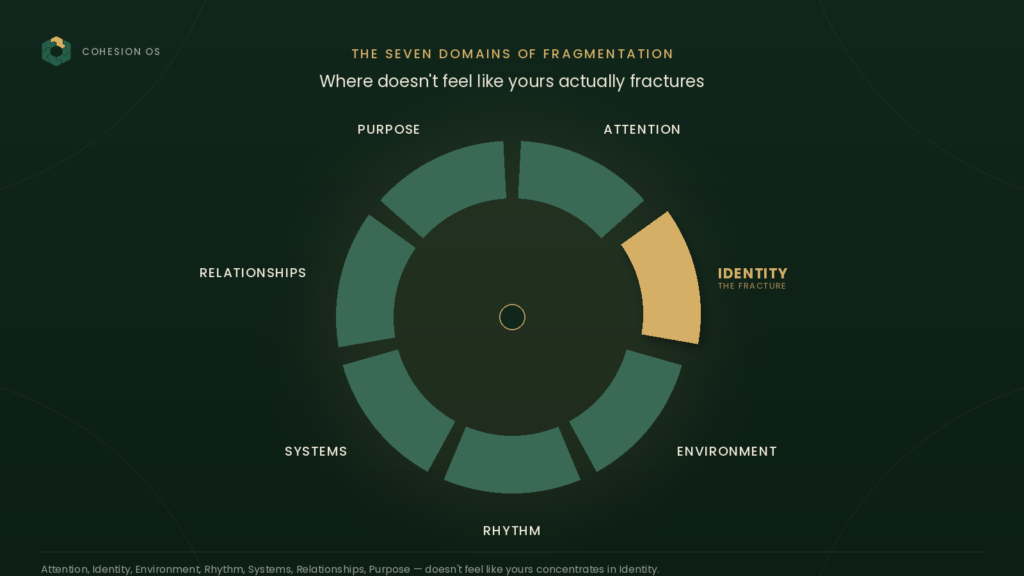
Cohesion OS treats this as an identity and purpose fracture, one of the four domains that route into Core OS. It’s not a mindset problem. It’s a structural one, and structural problems don’t resolve through gratitude practice.
Why Doesn’t “Just Be Grateful” Fix This?
The common response, from well-meaning advisors, peers, or the founder’s own inner critic, is some version of “you should be grateful, this is what you wanted.” Founders try to feel grateful, genuinely want to, and the disconnection persists anyway.
Here’s why. Gratitude is an emotional response to an outcome. Alignment is a structural relationship between the business and what you actually value. You can be fully grateful for your revenue and still be structurally misaligned, because gratitude doesn’t touch the actual gap, it just asks you to feel differently about a business that hasn’t changed. Trying to feel your way out of a structural mismatch is like trying to feel your way out of a broken process, the feeling might shift temporarily, but the underlying divergence is still there the next morning.
This is also why success doesn’t fix it either. More revenue, more team, more scale, these amplify whatever the business currently is. If what it currently is has drifted from your values, growth just produces more of the misalignment, not less. “You should be grateful” treats the symptom as the problem. The actual problem is upstream of feeling.
The Hidden Mechanism Behind the Alignment Gap
The gap doesn’t open all at once. It forms through a specific, repeatable pattern.
Individual trade-offs seem reasonable in isolation. Taking the bigger client that isn’t quite the right fit. Hiring for speed over cultural alignment. Saying yes to the opportunity that doesn’t match your actual interests, because it’s growth. Each decision makes sense on its own terms.
Nobody tracks the cumulative drift. Revenue gets tracked relentlessly. Alignment with what the founder actually values almost never does. There’s no dashboard for “does this still feel like mine,” so the drift accumulates invisibly while every other metric looks fine.
Success provides cover for the growing gap. As the numbers improve, it becomes harder to justify stopping to ask whether the business still fits, questioning something that’s “clearly working” feels ungrateful or self-indulgent, so the question rarely gets asked out loud.
The disconnection surfaces as vague dissatisfaction, not a clear diagnosis. Because the gap built gradually through many small trade-offs, it doesn’t announce itself as one identifiable event. It shows up as a persistent, hard-to-name flatness that founders often misattribute to burnout, ingratitude, or simply needing a vacation.
Why Founders Stay Stuck in This Pattern
The loop looks like this: a small trade-off away from alignment gets made in service of growth, the business performs well, which reinforces that the trade-off was correct, which makes the next trade-off easier to justify, and each one compounds the gap a little further while every visible metric keeps improving. Nobody stops to ask whether the business still matches what the founder actually values, because there’s no natural prompt to ask that question when things look like they’re working.
This is why “just take some time to reconnect with why you started” rarely resolves it on its own. That reflection can surface the feeling, but without a structural audit of where the specific divergences actually happened, the founder is left knowing something feels off without being able to name or correct what caused it.
What Changes When This Is Corrected?
When this fracture is corrected, success and alignment start being tracked as two separate signals, not assumed to be the same thing. The founder can name specifically where the business drifted from what they value, and make deliberate choices about which parts to correct and which trade-offs they’re genuinely willing to keep. The business doesn’t necessarily become smaller or simpler. It becomes something the founder can recognise as theirs again, on purpose, rather than by accident.
This isn’t about blowing up what you’ve built. It’s about the business you built actually reflecting the person who built it.
Founder Field Note
One founder, five years and several million in revenue past his original goal, described feeling “weirdly numb” about a milestone he’d once have celebrated hard. He assumed it was burnout and planned a long break to reset.
The real issue surfaced when he mapped his last twenty major business decisions against what he’d said mattered to him when he started, direct client relationships, creative control over the product, a small, close-knit team. Almost every recent decision had traded one of those three away in service of scaling faster. Each trade had been individually defensible. Together, they’d built a business that ran well but barely resembled what he’d actually set out to create.
The first correction wasn’t a break. It was naming, explicitly, which of those three values he wanted to reintroduce and which he was genuinely willing to have traded away for good. He kept the scale but rebuilt one direct client relationship channel that had been fully outsourced.
Within a few months, he described the shift as “still the same business on paper, but it’s mine again.”
This pattern repeats because each trade-off felt reasonable at the time. It’s only visible as a gap once you compare the accumulated decisions against what you actually said you valued from the start.
Common Mistakes with the Alignment Gap
- Treating this as gratitude problem and trying to feel differently. Feeling grateful doesn’t touch a structural divergence between the business and your actual values.
- Assuming more success will eventually fix the disconnection. Growth usually amplifies the existing gap rather than closing it.
- Waiting for burnout-level exhaustion before investigating the feeling. The signal is often present much earlier as a quieter, persistent flatness.
- Trying to solve it with one big change instead of naming specific trade-offs. Broad gestures like “sell the business” or “pivot everything” skip past identifying exactly where the gap opened.
- Assuming the fix means shrinking or simplifying the business. Sometimes it does, but often it’s about reintroducing one or two specific things that were traded away, not undoing everything.
- Never naming your original values explicitly. Without a clear baseline, it’s impossible to measure how far the business has actually drifted.
How to Start Correcting This
- Write down what you actually valued when you started the business. Be specific, not aspirational, name the real things that mattered to you at the time.
- List your last fifteen to twenty significant business decisions. Don’t filter for the dramatic ones, include the ordinary trade-offs too.
- Check each decision against your original values. Note which ones moved the business closer to what you valued and which moved it further away.
- Identify the pattern in what got traded away most often. That’s usually where the current disconnection is concentrated.
- Choose one specific thing to reintroduce deliberately. Not a full reversal, one concrete correction that closes part of the gap.
Do not try to fix the entire business at once. Start where the fracture is loudest.
FAQ
Is this the same as founder burnout?
Related but distinct. Burnout is exhaustion from overwork and responds to rest. An alignment gap persists even when well-rested, because it’s about the business no longer matching your values, not about how tired you are.
Does feeling disconnected mean I should sell or exit the business?
Not necessarily. For some founders the right correction is a partial exit, but for most it’s identifying specific misalignments and correcting those directly, without giving up the whole business.
How do I know if this is really an alignment gap or just a normal dip in motivation?
A normal dip tends to lift with rest or a change of pace. An alignment gap persists across rested and tired periods alike, because the source is structural, not situational.
Can this happen even if the business is genuinely successful by every metric?
Yes, and it often does specifically because of success. The metrics that get tracked, revenue, growth, headcount, don’t measure alignment at all, so a business can be thriving by every visible number and still be quietly misaligned underneath.
3-Minute Diagnostic
Which of the seven domains is actually costing you the most?
Next Step
If this sounds familiar, do not add another system yet. First, identify where the fracture is actually happening. Take the Founder Cohesion Assessment to see which domain is creating the most fragmentation and what to correct first.
Dominik Boecker is the creator of Cohesion OS. He helps founder-led companies identify the fracture lines that create overload, dependency, and operational fragmentation, then install the systems that restore cohesion across attention, identity, environment, rhythm, systems, relationships, and purpose.