A founder bottleneck is not mainly caused by a founder who cannot let go. It is usually caused by decision authority that was never encoded anywhere except the founder’s head. When every judgement call routes back through one person, founders experience a growing approval queue, a team that waits rather than acts, and a company that slows down at exactly the point it starts to scale. The first correction is not delegating more. It is making the decision rules visible so they no longer need a founder to execute them.
Key Takeaways
- The founder bottleneck compounds: every new hire adds approval requests to the same fixed node
- “Can you just approve this” is a Systems fracture, not a trust problem or a confidence problem
- Delegating tasks without delegating the decision rule recreates the loop one level down
- Your team is not dependent because they are weak. They are dependent because the rules live in you
- The correction starts with one class of repeated decision, not a reorg or a new hire
What Is a Founder Bottleneck?
Tuesday, 14:40. Slack shows eleven threads waiting on you. Three of them end with “let me know when you’ve had a look.” Your ops lead has sent a Loom explaining a supplier change she already knows is right. Your sales director wants sign-off on a discount that sits inside the range you agreed with him in March. Someone in finance has asked whether the new contractor goes on the payroll run or the supplier run.
None of these decisions is hard. All of them are waiting. The company is growing, and the queue is growing faster than the company.
That is a founder bottleneck: the condition in which the business can only move at the speed of one person’s inbox. The visible symptom is delay. The founder reads it as workload. The team reads it as the founder being busy. Everyone treats it as a capacity problem that more hours or a better assistant will solve.
It is not a capacity problem. It is an authority problem. Tasks have been handed out across the company. The decisions behind those tasks have not. Cohesion OS names this as a fracture in the Systems domain: the judgement that actually runs the company is undocumented, so it is unavailable to anyone who is not the founder.
Why Doesn’t Delegating More Fix the Founder Bottleneck?
Delegation is the standard advice, and most founders at £3M to £30M have already tried it. You hire an ops manager and hand over “operations.” You promote your best account manager to head of sales. You bring in a finance lead so you stop approving invoices.
Six weeks later the approvals have moved from your Slack to the ops manager’s Slack, and then back to your Slack with a forwarding note: “Just checking you’re happy with this before I confirm.”
Here is what happened. You delegated the task but not the rule. Your ops manager owns the doing. She does not own the deciding, because the deciding was never written down anywhere she could reach it. She cannot execute a rule that lives in your head. So she checks. And checking looks like diligence, so nobody, including you, recognises it as a structural fault.
The other common fixes fail the same way:
- A weekly approvals meeting batches the queue. It does not remove the queue.
- An approval workflow in ClickUp or Asana formalises the loop. Now the bottleneck has a status column.
- Hiring a COO creates a second founder-shaped node. The questions route through them, then through you.
Every one of these treats the symptom (requests reaching you) without touching the mechanism (decision authority that only exists in one place).
The Hidden Mechanism Behind the Founder Bottleneck
Three things are operating underneath the approval loop.
Undocumented judgement. The decision logic of the company is tacit. You know a £4k discount is fine on a renewal and not fine on a new logo. You know which client complaints get a call from you and which get a templated reply. You know when a contractor becomes a payroll conversation. Nobody else knows these things, because they have never been stated as rules. They exist as your pattern recognition, and pattern recognition cannot be delegated. Rules can.
Asymmetric risk. For anyone on your team, approving something that turns out wrong carries a personal cost. Asking you carries none. The rational move, every single time, is to ask. The loop is not a character flaw in your people. It is the correct response to the incentives your operating layer has created.
Linear compounding. Every hire adds a new source of questions to the same node. Approval demand scales with headcount. Your capacity does not scale at all. At eight people the queue is a mild irritation. At twenty-five it is the binding constraint on the whole business, and it arrived without anyone deciding to build it.
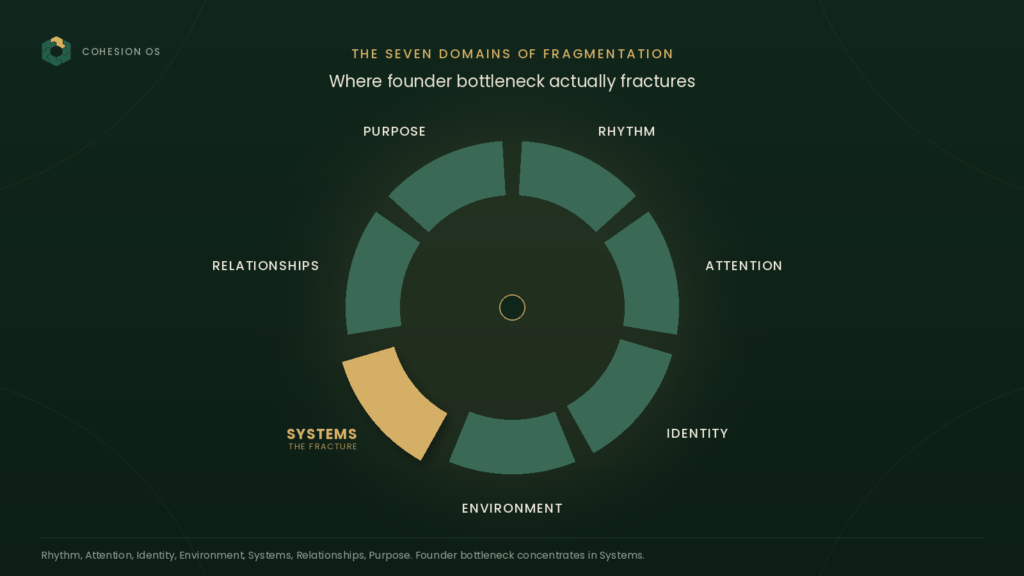
The primary fracture here is Systems, because the missing asset is an encoded decision rule. But it does not stay contained. It pulls Relationships into a dependency pattern where the team’s default posture is waiting. It shreds Rhythm, because every approval is an interruption to whatever you had protected. And it is exactly what AI exposes: plug an assistant into a company where decisions route through the founder and you do not get faster decisions. You get faster requests for the founder’s approval. AI does not fix fragmentation. It multiplies the operating condition already present.
Why Founders Stay Stuck in the Approval Loop
The loop sustains itself.
Pressure rises. You answer the Slack message in ninety seconds because answering is faster than documenting. The team learns that asking works and that asking is quick. So they ask more. The queue grows. You now have even less time to write anything down. The system never gets corrected. The same question returns next week wearing a different client’s name.
There is an identity layer holding it in place too. Being the one who knows feels like leadership. It is the role you built the company in. And your judgement is genuinely good, which is part of the problem: it is good enough that nobody has ever been forced to build a rule to replace it. The company has outsourced its decision architecture to your instincts, and your instincts have been reliable enough that the debt has never been called in.
Until growth calls it in.
3-Minute Diagnostic
Which of the seven domains is actually costing you the most?
What Changes When the Founder Bottleneck Is Corrected?
Nothing dramatic, and that is the point. Structural corrections look boring from the outside.
- Decisions happen where the information already is, not where the authority used to be
- Your team acts inside known boundaries and escalates only genuine exceptions
- Your approval queue shrinks to two categories: real exceptions and strategic calls
- Onboarding gets faster, because a rule can be taught in a day and pattern recognition cannot
- Your protected time actually holds, because the team stops treating your availability as the mechanism for getting things done
You do not stop deciding. You stop deciding the same thing forty times. Your job moves from executing judgement to setting and revising the rules that encode it.
Founder Field Note
One founder of a services business came in believing his team lacked initiative. Good people, he said, but nobody would make a call without checking.
The real issue was that most of the decisions reaching him were repeats. Same category, same answer, different week. Discount approvals inside an agreed range. Supplier substitutions under a threshold he had never actually named. Client escalations that always ended the same way. His team was not lacking initiative. They were correctly declining to guess at rules that had never been written.
The first correction was not a new hire, a new approval tool, or a conversation about ownership. It was writing down the rule behind the five most repeated decisions, one page each, and handing the rule to the people who were already asking. Not the task. The rule.
This pattern repeats because founders mistake responsiveness for resolution. Every fast answer feels like progress. Every fast answer also guarantees the question comes back.
Common Mistakes with the Founder Bottleneck
- Delegating the task and keeping the decision. The most common failure. The work moves. The authority does not.
- Confusing speed of response with resolution. A ninety-second reply is not a fix. It is a deposit into next week’s queue.
- Building an approval workflow. Formalising the loop makes it visible and permanent. You wanted it gone.
- Hiring someone senior to absorb it. They inherit the questions and then bring them to you. Now the loop has two hops.
- Treating every question as unique. Most are not. Most are the third instance of a rule you have never stated.
- Telling the team to “use their judgement.” Without boundaries, that instruction transfers risk without transferring authority. They will keep asking, and they will be right to.
How to Start Correcting the Founder Bottleneck
- Log one week of approvals. Every request that reaches you for a decision. Record the decision type, not the task. “Discount approval,” not “Acme renewal.”
- Group them into decision classes. You will find three to five categories doing most of the volume.
- Write the rule for one class. Threshold, owner, and what counts as an exception. One page. If it needs more than a page, the rule is not clear enough yet.
- Hand over the rule and stop answering. When the question arrives, point to the rule. Do not decide. The first two weeks will feel slower. That is the loop breaking.
- Review exceptions fortnightly. Exceptions are data. They show you where the rule needs a line added, not where you need to step back in.
Do not try to fix the entire business at once. Start where the fracture is loudest.
FAQ
Is the founder bottleneck the same thing as micromanagement?
No. Micromanagement is a founder inserting themselves into work that could run without them. The founder bottleneck is the opposite: work that genuinely cannot run without them because the deciding rule was never written down. Most bottlenecked founders are not controlling. They are simply the only place the rule exists.
How do I know whether I am the founder bottleneck?
Check your queue, not your calendar. If the messages waiting on you are mostly requests for a decision rather than requests for your expertise, and if you recognise most of them as repeats, you are the bottleneck. A second test: ask what would stall if you were unreachable for three working days. Whatever stalls is routed through you.
Why does the founder bottleneck get worse as the company grows?
Because approval demand rises with headcount while founder capacity stays fixed. Each new person brings new situations that need a decision, and if the rules for those decisions live only in you, every hire increases the load on a single node. Growth does not dilute the bottleneck. It concentrates it.
Can hiring a COO remove the founder bottleneck?
Only if the decision rules are written down first. A COO who inherits undocumented judgement becomes a second checkpoint in the same loop. A COO who inherits clear decision classes with thresholds and owners can actually run the operating layer. Hire into a system, not into a gap.
Next Step
If this sounds familiar, do not add another system yet. First, identify where the fracture is actually happening. Take the Founder Cohesion Assessment to see which of the seven domains is creating the most fragmentation in your company and what to correct first.
The company does not need you to decide faster. It needs the decision to stop needing you.
Dominik Boecker is the creator of Cohesion OS. He helps founder-led companies identify the fracture lines that create overload, dependency, and operational fragmentation, then install the systems that restore cohesion across rhythm, attention, identity, environment, systems, relationships, and purpose.
3-Minute Diagnostic