
Fast Answer
Worse overload after every new hire is not a coincidence. It is a predictable outcome of hiring without redesigning how decisions get made. A new person does not remove work from a founder, they add coordination, questions, and approvals on top of whatever the founder was already carrying. Headcount solves a capacity problem only if the new person also gets real decision-making authority. Without that, hiring just adds more surface area for the founder to manage.
Key Takeaways
- Adding headcount without redesigning decision ownership adds coordination load, not relief
- A founder can double their team and still be personally involved in every decision that team produces
- Coordination overhead, checking in, reviewing, approving, scales with headcount just as much as output does
- The visible symptom is a founder more overloaded after a hiring round than before it
- The fix is granting real decision authority alongside every hire, not just adding hands to execute tasks
- Founders who correct this hire less often but with far more relief per hire, because each new person actually removes a decision, not just a task
3-Minute Diagnostic
Which of the seven domains is actually costing you the most?
What Does “More Headcount, Worse Overload” Actually Mean?
It is the specific, frustrating pattern where a founder hires to relieve overload and ends up more overloaded than before. Revenue grows, the team grows, and somehow the founder’s calendar fills up even more, not less. From the outside, this looks like a contradiction, more people should mean less individual burden.
The contradiction dissolves once you separate task execution from decision ownership. A new hire absorbs tasks, they can build the thing, write the thing, handle the thing. But if every decision about how the thing should be built, written, or handled still routes through the founder, the founder has gained a person to manage without losing any of the decisions they were personally making. The hire adds coordination overhead, updates, questions, approvals, reviews, on top of the founder’s existing decision load, rather than removing decisions from it.
This shows up as a founder who now has a larger team and somehow less breathing room. The team executes more. The founder still decides everything. The math never worked in the founder’s favor.
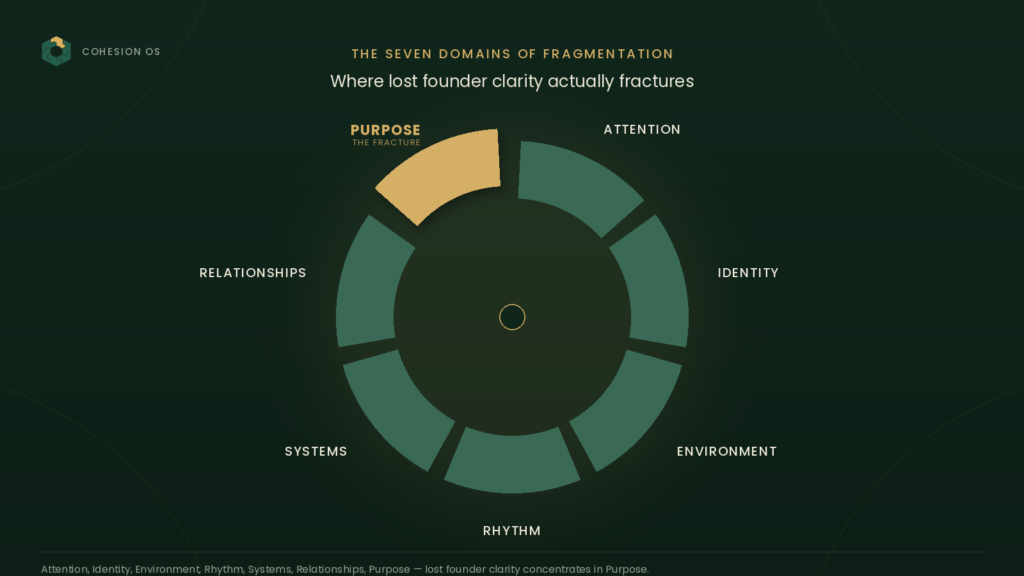
Cohesion OS treats this as a rhythm and structural capacity fracture. Headcount changes how much gets done. It does not automatically change who decides how it gets done, and that second variable is what actually determines whether hiring relieves or worsens overload.
Why Does Adding People Not Fix a Capacity Problem?
The intuitive fix for overload is more hands, hire someone, take work off your plate. Founders do this in good faith and are often startled to find themselves more stretched, not less, within a few months.
Here is why. Capacity overload is rarely a pure execution shortage, it is usually a decision-ownership shortage, the founder is the bottleneck for too many calls, not too many tasks. Adding a person who executes tasks without gaining decision authority does not touch that bottleneck. It just adds a new source of questions, updates, and approval requests flowing toward the same overloaded decision-maker. The founder now has more output to review and more people checking in, which is more coordination burden layered on top of the original decision load, not a reduction of it.
This is the same mechanism behind “automated everything, still cannot delegate.” A tool or a person executing a task without genuine ownership just makes the underlying bottleneck more efficient at generating things that still need the founder’s approval. More capacity to produce work is not the same as more capacity to decide about it.
The Real Mechanism Behind Headcount Overload
There is a specific, repeatable pattern behind why hiring so often backfires this way.
New hires generate more decisions before they generate relief. In the first months, a new person asks more questions than they answer, needing context, clarification, and approval as they ramp up. This genuinely increases the founder’s decision load in the near term, and many founders never look past this initial period to redesign ownership for the long term.
Coordination scales with headcount, not just output. Every additional person means more updates to track, more check-ins to have, more work to review. This overhead grows roughly in proportion to team size, and it lands squarely on whoever is coordinating, which by default is usually the founder.
Task execution and decision ownership get conflated. Founders often describe a hire as “taking X off my plate” when in reality the hire is executing X while the founder still decides everything about how X gets done. The task moved. The decision did not.
Nobody deliberately assigns real authority alongside the hire. Job descriptions specify tasks and responsibilities. They rarely specify explicit decision-making authority. Without that explicit grant, decisions default back to the founder by habit, regardless of how capable the new hire actually is.
Why Founders Stay Stuck in This Pattern
The loop looks like this: the founder feels overloaded, hires to relieve it, the new hire increases near-term coordination demands, the founder interprets the resulting exhaustion as proof they need to hire even more, so they hire again without ever redesigning decision ownership, and the coordination burden compounds with each additional person. Nobody stops to ask whether the actual constraint is decision ownership rather than headcount, because more hiring looks like the obvious, common-sense response to overload.
This is why some of the most overloaded founders run some of the largest teams. Team size and founder relief are not the same variable, and treating them as interchangeable is exactly what keeps this pattern going.
What Changes When This Is Corrected?
When this fracture is corrected, hiring actually relieves founder load instead of adding to it, because every new hire comes with an explicit, named set of decisions they are authorised to make without checking in. The founder’s coordination burden stops scaling linearly with headcount, because most of the team is genuinely deciding, not just executing and waiting for approval.
This is not about hiring less. It is about hiring in a way that actually removes decisions from the founder, not just tasks.
Founder Field Note
One founder doubled his team over eighteen months expecting real relief and instead felt more stretched than when the company was half the size. He assumed the answer was hiring a chief of staff to help him manage the growing coordination load.
The real issue surfaced once he mapped what each recent hire was actually authorised to decide versus what they were simply executing. Almost every hire had been given tasks and responsibilities, but no explicit decision authority. Every output still routed back to him for approval, meaning the team had grown, but his personal decision load had barely moved.
The first correction was not a chief of staff. It was going through every current role and explicitly naming which decisions that person now owned outright, in writing, with clear authority to proceed without checking in.
Within two months, his coordination load dropped meaningfully, using the exact same team he already had.
This pattern repeats because hiring feels like the responsible, obvious fix for overload. It is only visible as incomplete once you separate what a hire executes from what a hire is actually authorised to decide.
Common Mistakes with Headcount and Overload
- Assuming more people automatically means less founder involvement. It only reduces involvement if decision authority moves alongside the task.
- Treating a hire as “taking something off my plate” when only the task moved. The decision often stays exactly where it was.
- Writing job descriptions around tasks without naming decision authority. Without explicit authority, decisions default back to the founder by habit.
- Hiring again to fix overload caused by a previous hire that never got real authority. This compounds the coordination burden instead of resolving it.
- Reviewing every new hire’s output personally during onboarding and never stopping. Onboarding review is reasonable short-term, permanent review defeats the purpose of the hire.
- Assuming capable people will naturally take ownership without it being explicitly granted. Most will not, they will default to checking in unless told clearly that they own the decision.
How to Start Correcting This
- List your current team and what each person is authorised to decide, not just what they execute. Most founders find this list is shorter than expected.
- Identify the gap between task and authority for each role. Where is someone executing something you are still deciding on their behalf?
- Name explicit decision authority for the roles with the biggest gap first. Start with whichever role generates the most approval requests.
- Communicate the change directly and in writing. Ambiguity defaults back to you, clarity is what actually reduces coordination load.
- Track your coordination burden for a month after the change. Confirm the gap actually closed before making it a permanent practice for future hires.
Do not try to fix the entire business at once. Start where the fracture is loudest.
FAQ
Does this mean I should stop hiring until this is fixed?
Not necessarily, but hiring without addressing decision ownership will likely repeat the same pattern. It is worth fixing ownership for your current team before adding more people to the same structure.
How do I know if a role has a task-authority gap?
Track how often that person’s work comes back to you for approval versus how often they simply proceed. Frequent approval requests on routine work usually signal a gap.
Will giving people more authority mean losing quality control?
Usually not, if the authority is granted deliberately with clear standards. Quality risk comes from vague, unchecked authority, not from clear, well-defined ownership.
Is this the same as the general founder bottleneck problem?
Closely related, this is the hiring-specific version. The same underlying pattern, decisions routing back to the founder by default, shows up whenever tasks move without decision ownership moving alongside them, whether through automation, hiring, or delegation generally.
3-Minute Diagnostic
Which of the seven domains is actually costing you the most?
Next Step
If this sounds familiar, do not add another system yet. First, identify where the fracture is actually happening. Take the Founder Cohesion Assessment to see which domain is creating the most fragmentation and what to correct first.
Dominik Boecker is the creator of Cohesion OS. He helps founder-led companies identify the fracture lines that create overload, dependency, and operational fragmentation, then install the systems that restore cohesion across attention, identity, environment, rhythm, systems, relationships, and purpose.