
Fast Answer
Lost founder clarity is what actually happens between founding and scaling, and it is not a sign of incompetence. Early on, decisions felt obvious, you knew what mattered and why almost instantly. That clarity did not vanish because you got worse at thinking. It eroded gradually as complexity grew faster than your structure for processing it did. The fix is not trying harder to think clearly. It is rebuilding the structure that made clarity effortless in the first place.
Key Takeaways
- Early-stage clarity feels effortless because the business is simple enough to hold entirely in your head
- Clarity erodes gradually as complexity grows, not suddenly, so most founders never notice the drift until decisions start feeling genuinely hard
- Losing clarity is not a sign you have gotten less capable, it is a sign your mental model has not kept pace with the business
- Working harder to think clearly does not rebuild clarity, because the constraint is structural, not effort-based
- The fix is rebuilding the structure, clear priorities, defined ownership, a simplified information diet, not forcing more focus
- Founders who correct this describe decisions feeling obvious again, not because the business got simpler, but because their structure caught up to it
3-Minute Diagnostic
Which of the seven domains is actually costing you the most?
What Does “Lost Founder Clarity” Actually Mean?
Every founder remembers the early clarity. You knew the product, the customer, the next three moves, almost instinctively. Decisions did not require much deliberation because the business was simple enough to hold entirely in your head at once. There was no gap between what you understood and what the business actually was.
That clarity does not disappear in one dramatic moment. It erodes gradually as the business grows past the point where it fits in your head. More products, more people, more decisions happening without you, more context you are no longer directly tracking. Each individual addition is manageable. The cumulative effect is a founder who used to decide instantly now hesitating on calls that should be simple, and quietly wondering if they have lost their edge.
They have not lost their edge. Their mental model of the business simply stopped matching the business itself, and nobody rebuilt the model to keep pace with the growth. The visible symptom is decision fatigue, second-guessing, a nagging sense of not quite knowing what is actually happening anymore. The real mechanism is a structural gap between the founder’s understanding and the business’s actual current complexity.
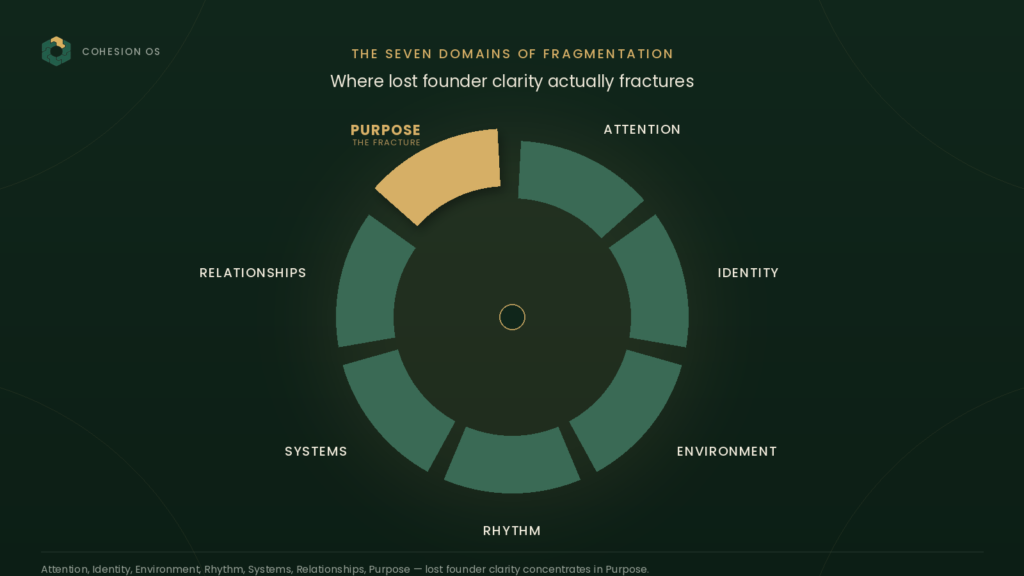
Cohesion OS treats this as a purpose and systems fracture, the erosion of a clear signal underneath the noise of growth. It is not about thinking harder. It is about the structure that used to generate clarity automatically no longer existing.
Why Does Trying to Think Clearly Not Rebuild Clarity?
The common advice is to think more clearly, get more disciplined, focus better. Founders try this seriously, and the fog does not lift, because the advice targets the wrong layer of the problem.
Here is why. Early clarity was not a personal skill, it was a structural condition, the business was simple enough that clarity happened automatically. As complexity grew, that structural condition disappeared, but the founder is still trying to solve a structural problem with a personal effort, thinking harder, focusing more intensely. Effort cannot substitute for a mental model that has not been updated to match a business that has grown considerably more complex.
This is the same trap as trying to fix an approval bottleneck by responding faster, or a capacity leak by working longer hours. The intervention is aimed at the founder’s personal output when the actual gap is structural. No amount of focused thinking rebuilds a mental model that has not kept pace with genuine growth in complexity.
The Real Mechanism Behind Lost Founder Clarity
Clarity erosion follows a specific, repeatable pattern.
Complexity grows faster than mental models update. Each new hire, product line, or process adds real complexity to the business. Founders rarely pause to deliberately rebuild their understanding at the same pace, so the gap between what they know and what the business actually is widens continuously.
Early clarity was never structural, it was situational. In the beginning, clarity existed because the business was simple, not because the founder had built a system for generating it. When the situation that produced clarity disappeared, so did the clarity, and nothing structural was ever built to replace it.
Information volume increases without a corresponding filter. More people means more updates, more decisions, more context flowing at the founder. Without a deliberate system for what actually needs their attention, everything competes for the same bandwidth that used to handle a much simpler business.
The founder mistakes the fog for a personal decline. Because clarity used to be effortless, its absence feels like something is wrong with the founder specifically, rather than a predictable structural consequence of growth that most founders experience the same way.
Why Founders Stay Stuck in This Pattern
The loop looks like this: complexity grows, the founder’s mental model falls further behind, decisions start feeling harder, the founder assumes this means they need to work harder or focus more, they push through with sheer effort rather than rebuilding structure, which does not close the gap, so the next round of complexity makes the fog even worse. Nobody names the actual problem because it looks like a personal capacity issue rather than a structural one.
This is why “just get more disciplined” rarely restores clarity. Discipline applied to a mental model that has not been updated just means working harder inside the same fog, not clearing it.
What Changes When This Is Corrected?
When this fracture is corrected, decisions start feeling obvious again, not because the business got simpler, but because the founder rebuilt a structure, clear priorities, defined ownership, a filtered information diet, that matches the business’s actual current complexity. The fog does not lift through effort. It lifts because the underlying structure finally caught up to what the business has become.
This is not about returning to the simplicity of the early days. It is about building the structural clarity that the early days gave you for free, deliberately, at the scale the business is now.
Founder Field Note
One founder described feeling like he had lost his instincts. Decisions that used to take him minutes were now taking days, and he assumed he was simply burning out or losing his edge.
The real issue surfaced when he mapped what information actually reached him in a typical week. It was enormous, updates from every department, every client issue, every minor operational detail, none of it filtered. He was trying to hold the same total awareness he had when the company was five people, except the company now had forty.
The first correction was not more focus. It was building an explicit filter, deciding which categories of information genuinely needed his attention and which could be handled and resolved without ever reaching him. Everything else got redirected to the people who actually owned those areas.
Within a few weeks, he described decisions feeling instinctive again, not because the business had gotten any simpler, but because what actually reached him had finally been reduced to what mattered.
This pattern repeats because the fog builds gradually enough that it never registers as a structural problem. It is only visible once you compare what you are currently trying to track against what the business has actually become.
Common Mistakes with Lost Founder Clarity
- Assuming the fog means you have lost your edge. It almost always means your structure has not kept pace with growth, not that your judgment has declined.
- Trying to fix it by working harder or focusing more intensely. Effort cannot substitute for a mental model that needs to be deliberately rebuilt.
- Trying to hold the same total awareness you had at an earlier, simpler stage. That level of awareness was only ever possible because the business was smaller.
- Waiting for the fog to clear on its own. It will not, complexity keeps growing, and the gap widens further without a deliberate correction.
- Rebuilding structure once and assuming it will hold indefinitely. The business keeps changing, structure needs periodic rebuilding to stay matched to it.
- Blaming external circumstances instead of naming the structural gap. This delays the actual fix, which is rebuilding the founder’s information structure, not waiting for conditions to improve.
How to Start Correcting This
- Track every piece of information that reached you this week. Updates, questions, escalations, everything, without filtering as you go.
- Sort it into what genuinely needed your judgment and what did not. Be honest, most founders find the second category is much larger than expected.
- For what did not need you, name who should be filtering it before it reaches you. A specific person, not a vague “the team.”
- Rebuild your priorities explicitly for the business as it actually exists now. Not as it existed when clarity felt automatic.
- Revisit this filter every quarter. The business keeps changing, and the structure needs to keep pace deliberately, not by accident.
Do not try to fix the entire business at once. Start where the fracture is loudest.
FAQ
Is this the same thing as decision fatigue?
Related but distinct. Decision fatigue is about depleted capacity within a single day. Lost founder clarity is about a mental model that has not kept pace with the business over months or years, it persists even when well-rested.
Does rebuilding clarity mean simplifying the business itself?
Not necessarily. It usually means simplifying what reaches the founder, not simplifying the business. The business can stay exactly as complex as it needs to be while the founder’s information diet gets deliberately filtered.
How do I know if I have actually lost clarity or if the business has just gotten genuinely harder?
Both are often true simultaneously. The test is whether decisions that should be simple, given accurate information, still feel hard. If so, the gap is in your structure, not in the underlying difficulty of the business.
Can this happen even to experienced, capable founders?
Yes, and it often does specifically because experienced founders trust their instincts and delay rebuilding structure longer than they should, assuming their judgment alone should still be enough.
3-Minute Diagnostic
Which of the seven domains is actually costing you the most?
Next Step
If this sounds familiar, do not add another system yet. First, identify where the fracture is actually happening. Take the Founder Cohesion Assessment to see which domain is creating the most fragmentation and what to correct first.
Dominik Boecker is the creator of Cohesion OS. He helps founder-led companies identify the fracture lines that create overload, dependency, and operational fragmentation, then install the systems that restore cohesion across attention, identity, environment, rhythm, systems, relationships, and purpose.