
Fast Answer
You are overinvolved, not overworked. That is the actual pattern behind most founder overload. It is not that there is too much work, it is that you are still personally involved in decisions that stopped needing you months ago. The fix is not doing less work. It is withdrawing from decisions that never required your specific judgment in the first place.
Key Takeaways
- Founder overload is usually mislabeled as a workload problem when it is actually an involvement problem
- Overinvolvement means staying inside decisions after the point where your judgment was genuinely required
- Working fewer hours does not fix overinvolvement, it just compresses the same level of involvement into less time
- The pattern is self-inflicted, not imposed, founders stay involved because withdrawing feels risky, not because the business demands it
- The fix is identifying which decisions still require your presence and deliberately withdrawing from the rest
- Founders who correct this are not doing less, they are doing the right things without the constant background involvement in everything else
3-Minute Diagnostic
Which of the seven domains is actually costing you the most?
What Does “You Are Overinvolved, Not Overworked” Actually Mean?
The founder overload story almost always gets told as a workload story. There is too much to do, too many hours required, not enough time in the day. The proposed fix follows the same logic, work fewer hours, hire more people, get better at time management.
But most founder overload is not actually a volume problem. It is an involvement problem. The founder is still personally present in decisions that used to genuinely require them and no longer do, the team has grown, processes have matured, but the founder’s level of involvement never adjusted downward to match. The work grew past the point where the founder’s specific judgment was needed on most of it, and the founder just kept showing up anyway.
This distinction matters because the two problems have completely different fixes. A workload problem is solved by reducing volume. An involvement problem is solved by withdrawing from decisions that no longer need you, regardless of how much total work exists in the business.
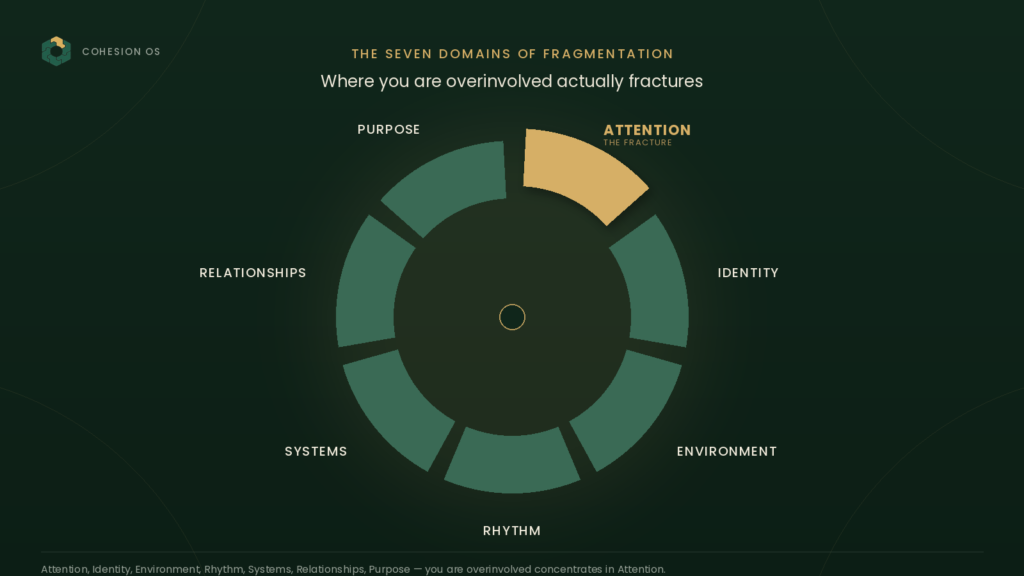
Cohesion OS treats overinvolvement as a rhythm and attention fracture. It is not about how much work is happening. It is about how much of that work still routes through the founder’s personal attention, long after it stopped needing to.
Why Does Working Fewer Hours Not Fix Overinvolvement?
The standard advice for overload is to work less, delegate more, protect your time. Founders try this and often find they are just as involved in everything, only now compressed into fewer hours, which feels worse, not better.
Here is why. Working fewer hours changes how much time you spend, not how many decisions you are personally involved in. If you are still the one weighing in on every hire, every client escalation, every minor product decision, cutting your hours just means you are cramming the same level of involvement into a tighter window. The involvement itself never shrank, only the time available to handle it did.
This is why founders who take a genuine step back, a real vacation, a reduced schedule, frequently come back more anxious, not less. The decisions they were involved in did not go anywhere. They just piled up waiting, proving to the founder that stepping back was not safe, when the real lesson was that those decisions never needed the founder’s involvement to begin with.
The Real Mechanism Behind Overinvolvement
Overinvolvement builds through a specific, repeatable pattern.
Involvement was earned once, and never revisited. Early on, the founder’s involvement in every decision was genuinely necessary, the team was small, the stakes were high, judgment mattered. That level of involvement becomes habit and is rarely deliberately scaled back as the team and processes mature.
Withdrawing feels riskier than staying involved. Staying in a decision feels safe, nothing can go wrong on your watch if you are still present for it. Withdrawing feels like a gamble, what if it goes wrong without you there. This asymmetry keeps founders involved in decisions long after their presence stopped adding value.
Team members stop pushing back on founder involvement. Once a founder consistently shows up in a certain type of decision, the team adapts around that presence rather than questioning it. Nobody proposes taking it fully off the founder’s plate, because the founder has never signaled that they want it removed.
Involvement gets confused with care. Founders often equate staying personally involved with caring about quality or outcomes. This makes withdrawing feel like caring less, even when the actual effect of staying involved is slower decisions and a growing bottleneck, not better ones.
Why Founders Stay Stuck in This Pattern
The loop looks like this: the founder feels overloaded, reads it as a workload problem, tries to manage time or hours more tightly, which does not reduce actual involvement, so the overload persists, which the founder interprets as further proof that there is simply too much work. Nobody stops to ask whether the founder should still be involved in as much as they currently are, because the framing never shifts from volume to involvement.
This is why hiring more people often does not solve overload either. New hires take on tasks, but if the founder remains personally involved in reviewing and approving what those hires produce, the involvement level stays exactly the same, it just has more people generating things for the founder to weigh in on.
What Changes When This Is Corrected?
When this fracture is corrected, the founder is not necessarily doing less work, they are doing dramatically less unnecessary involvement. Decisions that used to route through the founder by habit now genuinely stop at the person who owns them. The founder’s actual time gets spent on the handful of decisions that still require their judgment, not spread thin across everything that used to.
This is not about caring less or being less hands-on. It is about your involvement being reserved for the decisions that actually need it.
Founder Field Note
One founder described feeling permanently underwater despite having built a genuinely capable team. He assumed the answer was hiring one more senior person to absorb some of the load.
Tracking his actual week revealed something different. He was not short on capable people, he was personally weighing in on decisions his team was already fully equipped to make without him, product tweaks, minor hiring calls, small client requests. None of it required his specific judgment anymore. He had simply never stopped showing up for it.
The first correction was not a new hire. It was going through a list of recurring decision types and explicitly telling his team which ones no longer needed his input at all, effective immediately, with clear authority to proceed without him.
Within weeks, his sense of overload dropped noticeably, not because his workload changed, but because his involvement in decisions that were never really his to make had finally stopped.
This pattern repeats because staying involved feels responsible while it is happening. It is only visible as the actual cost once you separate what genuinely needs you from what you have simply never stopped showing up for.
Common Mistakes with Overinvolvement
- Treating overload as a pure workload problem. This leads to time management fixes that never touch the actual involvement pattern underneath.
- Assuming hiring more people automatically reduces founder involvement. It only helps if the founder also deliberately withdraws from reviewing and approving what those hires do.
- Confusing staying involved with staying responsible. You can remain accountable for outcomes without being personally present in every decision that produces them.
- Withdrawing from everything at once without warning the team. Sudden, unexplained absence creates confusion. Explicit, deliberate handoff does not.
- Waiting for burnout to force the withdrawal. It is cheaper and calmer to withdraw deliberately than to be forced out by exhaustion.
- Assuming your team will ask you to step back. They usually will not, they have adapted to your presence and will not question it unless you name the change yourself.
How to Start Correcting This
- List the decision types you were personally involved in this past week. Include the small, habitual ones, not just the dramatic ones.
- For each type, ask whether your specific judgment was actually required. Be honest, most founders find the answer is no more often than expected.
- Identify who is already capable of owning the ones that did not need you. In most cases, that person already exists on the team.
- Tell them explicitly that this decision type no longer needs your involvement. Silence gets interpreted as “still involved,” clarity is what actually changes behavior.
- Track your actual involvement level for two weeks after the change. Confirm you have genuinely withdrawn, not just intended to.
Do not try to fix the entire business at once. Start where the fracture is loudest.
FAQ
Is this the same as founder overload or is it a separate problem?
Overinvolvement is a specific mechanism that produces founder overload. Not all overload comes from overinvolvement, but a large share of it does, especially in businesses that have grown past their earliest stage without the founder’s involvement level adjusting.
How do I know if I am overinvolved versus genuinely needed everywhere I currently show up?
Track whether decisions stall or genuinely get worse without your input. If they proceed fine without you, your involvement was habitual, not necessary.
Will my team think I am checked out if I withdraw from decisions I used to be part of?
Usually the opposite, when the withdrawal is explicit and deliberate, teams typically feel more trusted and more capable, not abandoned. The risk comes from silent, unexplained withdrawal, not clear communication.
Does correcting this mean I will have less influence over the business?
No, it means your influence concentrates where it actually matters. Founders who correct this usually report more influence over the decisions that count, since their attention is no longer spread across everything.
3-Minute Diagnostic
Which of the seven domains is actually costing you the most?
Next Step
If this sounds familiar, do not add another system yet. First, identify where the fracture is actually happening. Take the Founder Cohesion Assessment to see which domain is creating the most fragmentation and what to correct first.
Dominik Boecker is the creator of Cohesion OS. He helps founder-led companies identify the fracture lines that create overload, dependency, and operational fragmentation, then install the systems that restore cohesion across attention, identity, environment, rhythm, systems, relationships, and purpose.