
Fast Answer
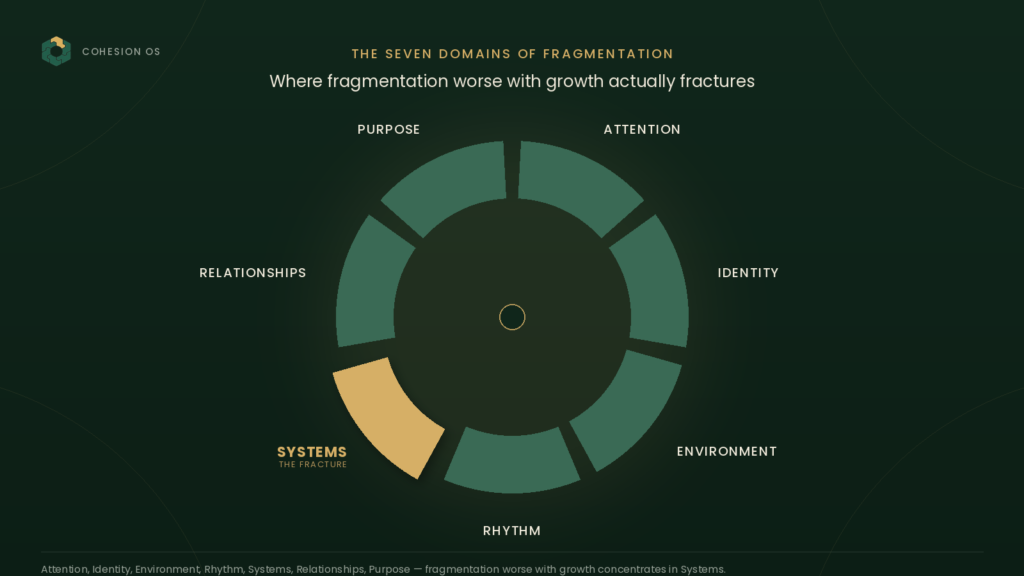
Fragmentation worse with growth isn’t a fluke, it’s the default outcome. More revenue doesn’t heal a fractured business, it just gives the fracture more places to hide. Every domain that was already inconsistent, unclear ownership, undocumented process, reactive rhythm, gets a bigger surface area to operate across as the business scales. Growth doesn’t correct fragmentation. It multiplies it.
Key Takeaways
- Revenue growth is often mistaken for a health signal, but fragmentation and revenue can rise together without contradiction
- Every domain that’s already fractured gets more surface area to hide across as the business scales, not less
- “We’ll fix that once we’re bigger” is exactly backwards, bigger makes the same fracture harder to see and more expensive to correct
- Growth adds people, tools, and complexity, and fragmentation compounds across all three simultaneously
- The correction isn’t slowing growth down. It’s fixing the underlying fracture before it has more surface area to spread across
- Founders who catch this early correct a small, contained fracture. Founders who wait correct the same fracture at ten times the size
3-Minute Diagnostic
Which of the seven domains is actually costing you the most?
What Does “Growth Makes Fragmentation Worse” Actually Mean?
Founders generally assume growth is proof things are working. Revenue’s up, headcount’s up, the business looks healthier by every visible metric. So when things feel more chaotic internally, more approvals bottlenecked, more inconsistent decisions, more founder dependency, it’s read as a temporary, growth-related discomfort rather than an actual worsening problem.
But fragmentation and revenue aren’t opposites. A business can be genuinely fractured, no clear ownership, inconsistent process, reactive rhythm, and still grow, especially if the founder is personally absorbing the cost of that fracture through sheer effort. Growth doesn’t require the underlying structure to be sound. It just requires demand and enough founder willpower to hold the gaps together a little longer.
The problem is that growth increases the surface area the fracture operates across. A structural gap that cost a founder two hours a week at ten clients costs proportionally more at a hundred, and it doesn’t scale linearly, it compounds, because more people are now operating inside the same undefined process, each interpreting the gap slightly differently.
Cohesion OS treats “growth exposes fragmentation” as one of the most consistent patterns across founder-led businesses. It’s rarely that growth causes new problems. It’s that growth removes the founder’s ability to personally compensate for old ones.
Why Doesn’t “We’ll Fix It Once We’re Bigger” Work?
The common founder instinct is to defer structural fixes until the business has “settled down” or reached some future size where there’s more time and resources to address them properly.
Here’s why that’s backwards. The fracture doesn’t wait for a convenient moment, it operates continuously, and every month it goes uncorrected, it gets embedded into more processes, more hires’ expectations, and more customer-facing habits that are harder to unwind later. Fixing an approval bottleneck when three people route around you is a conversation. Fixing the same bottleneck when thirty people have built their entire workflow around waiting for you is a much larger, more disruptive project.
“We’ll fix it once we’re bigger” assumes the fix gets easier with scale. It gets harder, because scale is exactly what increases the surface area fragmentation has already claimed. The right time to fix a structural fracture is always earlier than it feels comfortable to, because comfort here is directly proportional to how much damage is still being contained rather than compounded.
The Hidden Mechanism Behind Growth-Driven Fragmentation
There’s a specific, repeatable mechanism at play.
Growth adds people who each interpret the gap differently. When a process is undocumented, one person compensates for it consistently through familiarity. Ten people compensate for it ten different ways, and now the inconsistency itself has scaled alongside headcount.
Growth adds tools that automate whatever process already exists. A CRM, an AI workflow, a new piece of software, these all execute the current process faster. If the process was fragmented, the tool just fragments faster and at higher volume, it doesn’t quietly correct anything on its own.
Growth increases the cost of the founder’s personal compensation. Early on, a founder can absorb a structural gap through extra hours and direct attention. As the business scales, that same compensation strategy requires exponentially more of the founder, until it becomes physically impossible to sustain, and the fracture becomes visible all at once, appearing as a sudden crisis rather than the years-long accumulation it actually was.
Success provides social cover for structural problems. Revenue growth is treated as evidence that things are basically fine, which makes it harder for anyone, including the founder, to justify stopping to fix something that “clearly isn’t broken” by the metrics everyone’s watching.
Why Founders Stay Stuck in This Pattern
The loop looks like this: the business grows, which increases the surface area for an existing fracture, which increases the founder’s personal effort to compensate for it, which the founder reads as “just what growth requires” rather than as an escalating cost of an uncorrected structural problem. The business keeps growing, the compensation cost keeps climbing, and the fracture never gets named because revenue is still climbing too, right up until the founder’s capacity to personally absorb it runs out.
This is why “grow first, fix later” so rarely gets revisited voluntarily. There’s no natural stopping point that signals “now is the moment,” growth just keeps producing enough short-term evidence that things are working to keep deferring the correction, until the correction becomes unavoidable and far more expensive than it would have been earlier.
What Changes When This Is Corrected?
When this fracture is corrected, growth stops requiring the founder to personally absorb an increasing structural cost. Fixing the underlying gap while the business is smaller means the correction is contained, cheaper, and faster than fixing the same gap after it’s had years to embed itself across more people and more process. Growth then compounds the business’s actual strengths instead of compounding an unaddressed weakness alongside them.
This isn’t about slowing growth down to be cautious. It’s about making sure growth is scaling something solid, not just scaling the gap.
Founder Field Note
One founder, three years into rapid growth, described feeling like the business was “somehow getting harder to run, not easier,” despite tripling revenue. He assumed this was just the natural cost of scale.
The real issue surfaced when he mapped one recurring bottleneck, client onboarding, across the company’s history. At ten clients, onboarding was inconsistent but manageable, he personally smoothed over the gaps. At a hundred clients, the same undocumented process was now being run by eight different team members, each doing it slightly differently, producing wildly inconsistent client experiences and a growing pile of support escalations.
The fracture hadn’t appeared with growth. It had existed since client number one. Growth had simply given it eight times the surface area to operate across, and removed the founder’s ability to personally patch it.
The first correction wasn’t slowing down new client acquisition. It was documenting a single, consistent onboarding standard and retraining the team against it, a project that would have taken an afternoon at ten clients and took three weeks at a hundred.
This pattern repeats because growth looks like proof that things are working. It’s only visible as compounding cost once you trace a specific fracture back to before the business scaled at all.
Common Mistakes with Growth-Driven Fragmentation
- Reading revenue growth as proof the business is structurally sound. They’re independent signals. A business can be genuinely fractured and still grow.
- Deferring structural fixes until “things settle down.” Things rarely settle down on their own, and the fracture gets more expensive to correct the longer it’s deferred.
- Assuming new tools or hires will absorb the fragmentation automatically. They usually scale it faster instead, since they execute whatever process already exists.
- Treating growing pains and structural fracture as the same thing. Some friction is a normal part of scaling. Recurring, worsening friction around the same specific process usually isn’t.
- Waiting for a crisis to justify the fix. The correction is cheaper and less disruptive the earlier it happens, waiting for a forcing event guarantees the most expensive possible timing.
- Fixing the symptom the crisis exposed instead of the underlying fracture. A crisis reveals where the fracture lives, but the fix still has to address the root cause, not just the specific incident that made it visible.
How to Start Correcting This
- Pick the process that feels hardest to manage as you’ve grown. That’s usually where an old fracture has been given the most new surface area.
- Trace that process back to before the business scaled. Ask honestly whether it was ever actually consistent, or whether you were personally smoothing it over from the start.
- Document the one correct version of that process now, while it’s still contained. The longer this waits, the more people and habits will need to be retrained around the fix.
- Retrain everyone currently touching that process against the documented standard. Consistency has to be rebuilt deliberately, it won’t happen on its own at scale.
- Revisit this exercise for one process every quarter. Growth will keep exposing whatever’s next, catching it early each time is what keeps the correction cheap.
Do not try to fix the entire business at once. Start where the fracture is loudest.
FAQ
Doesn’t this mean growth is inherently bad for a fragmented business?
No, growth isn’t the problem, it’s the amplifier. A fractured business that stays small keeps the fracture small too. Growth doesn’t create the fracture, it just makes an existing one more expensive and more visible.
How do I know if friction I’m experiencing is normal growing pains or an actual fracture?
Normal growing pains tend to resolve as the team adjusts. A fracture is friction that keeps recurring around the same specific process, regardless of how experienced the team becomes.
Should I pause growth to fix structural problems first?
Rarely necessary. Most structural fixes can happen alongside continued growth, they just need to happen deliberately rather than being indefinitely deferred until “later.”
Is this the same as the general founder overload problem?
Related but distinct. Founder overload is often a downstream symptom of this pattern, the founder personally compensating for fragmentation is exactly what eventually produces overload as the business scales.
3-Minute Diagnostic
Which of the seven domains is actually costing you the most?
Next Step
If this sounds familiar, do not add another system yet. First, identify where the fracture is actually happening. Take the Founder Cohesion Assessment to see which domain is creating the most fragmentation and what to correct first.
Dominik Boecker is the creator of Cohesion OS. He helps founder-led companies identify the fracture lines that create overload, dependency, and operational fragmentation, then install the systems that restore cohesion across attention, identity, environment, rhythm, systems, relationships, and purpose.